Native element mineral
In-game article clicks load inline without leaving the challenge.
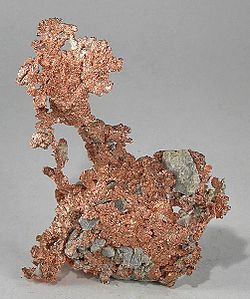


Native element minerals are those elements that occur in nature in uncombined form with a distinct mineral structure. The elemental class includes metals, intermetallic compounds, alloys, metalloids, and nonmetals. The Nickel–Strunz classification system also includes the naturally occurring phosphides, silicides, nitrides, carbides, and arsenides.
Elements
The following elements occur as native element minerals or alloys:[non-primary source needed]
- Aluminium Native aluminium
- Antimony Native antimony
- Arsenic
- Bismuth
- Cadmium
- Carbon Diamond Graphite
- Chromium
- Cobalt[citation needed]
- Copper Native copper
- Gold
- Indium
- Iridium
- Iron Telluric iron
- Lead
- Manganese[citation needed]
- Mercury
- Molybdenum[citation needed]
- Nickel
- Niobium[citation needed]
- Osmium
- Palladium
- Platinum
- Rhenium[citation needed][disputed – discuss]
- Rhodium
- Selenium
- Silicon
- Silver Native silver
- Sulfur
- Tantalum[citation needed]
- Tellurium
- Tin
- Titanium
- Tungsten
- Vanadium Native vanadium
- Zinc
Nickel–Strunz Classification -01- Native elements
This list uses the Classification of Nickel–Strunz (mindat.org, 10 ed, pending publication).
Abbreviations
- "*" – discredited (IMA/CNMNC status).
- "?" – questionable/doubtful (IMA/CNMNC status).
- "REE" – Rare-earth element (Sc, Y, La, Ce, Pr, Nd, Pm, Sm, Eu, Gd, Tb, Dy, Ho, Er, Tm, Yb, Lu)
- "PGE" – Platinum-group element (Ru, Rh, Pd, Os, Ir, Pt)
- 03.C Aluminofluorides, 06 Borates, 08 Vanadates (04.H V[5,6] Vanadates), 09 Silicates: Neso: insular (from Greek νησος nēsos, island) Soro: grouping (from Greek σωροῦ sōros, heap, mound (especially of corn)) Cyclo: ring Ino: chain (from Greek ις [genitive: ινος inos], fibre) Phyllo: sheet (from Greek φύλλον phyllon, leaf) Tecto: three-dimensional framework
Nickel–Strunz code scheme
NN.XY.##x:
- NN: Nickel–Strunz mineral class number
- X: Nickel–Strunz mineral division letter
- Y: Nickel–Strunz mineral family letter
- ##x: Nickel–Strunz mineral/group number, x add-on letter
Class: native elements
- 01.A Metals and intermetallic alloys 01.AA Copper-cupalite family: 05 native copper, 05 lead, 05 native gold, 05 native silver, 05 nickel, 05 aluminium; 10a auricupride, 10b tetra-auricupride; 15 novodneprite, 15 khatyrkite, 15 anyuiite; 20 cupalite, 25 hunchunite 01.AB Zinc-brass family (Cu-Zn alloys): 05 cadmium, 05 zinc, 05 titanium*, 05 rhenium*; 10a brass*, 10a zhanghengite, 10b danbaite, 10b tongxinite* 01.AC Indium-tin family: 05 indium, 10 tin; 15 yuanjiangite, 15 sorosite 01.AD Mercury-amalgam family: 00 amalgam*, 05 mercury; 10 belendorffite, 10 kolymite; 15a paraschachnerite, 15a schachnerite, 15b luanheite, 15c eugenite, 15d moschellandsbergite; 20a weishanite, 20b goldamalgam*; 25 potarite, 30 leadamalgam 01.AE Iron-chromium family: 05 kamacite? (iron var.), 05 iron, 05 chromium; 10 antitaenite*, 10 taenite, 10 tetrataenite; 15 chromferide, 15 wairauite, 15 ferchromide; 20 awaruite, 25 jedwabite 01.AF Platinum-group elements: 05 osmium, 05 rutheniridosmine, 05 ruthenium; 10 palladium, 10 iridium, 10 rhodium, 10 platinum 01.AG PGE-metal alloys: 05 garutiite, 05 hexaferrum; 10 atokite, 10 zvyagintsevite, 10 rustenburgite; 15 taimyrite, 15 tatyanaite; 20 paolovite; 25 plumbopalladinite, 25 stannopalladinite; 30 cabriite; 35 chengdeite, 35 isoferroplatinum; 40 ferronickelplatinum, 40 tetraferroplatinum, 40 tulameenite; 45 hongshiite*, 45 skaergaardite; 50 yixunite, 55 damiaoite, 60 niggliite, 65 bortnikovite, 70 nielsenite
- 01.B Metallic carbides, silicides, nitrides and phosphides 01.BA Carbides: 05 cohenite; 10 isovite, 10 haxonite; 15 tongbaite; 20 khamrabaevite, 20 niobocarbide, 20 tantalcarbide; 25 qusongite, 30 yarlongite 01.BB Silicides: zangboite; 05 mavlyanovite, 05 suessite; 10 perryite, 15 fersilicite*, 20 ferdisilicite*, 25 luobusaite, 30 gupeiite, 35 hapkeite, 40 xifengite 01.BC Nitrides: 05 roaldite, 10 siderazot, 15 carlsbergite, 15 osbornite 01.BD Phosphides: 05 schreibersite, 05 nickelphosphide; 10 barringerite, 10 monipite; 15 allabogdanite, 15 florenskyite, 15 andreyivanovite; 20 melliniite
- 01.C Metalloids and nonmetals 01.CA Arsenic group elements: 05 bismuth, 05 native antimony, 05 arsenic, 05 stibarsen; 10 arsenolamprite, 10 pararsenolamprite; 15 paradocrasite 01.CB Carbon-silicon family: 05a graphite, 05b chaoite, 05c fullerite; 10a diamond, 10b lonsdaleite, 15 silicon 01.CC Sulfur-selenium-iodine: 05 sulfur, 05 rosickyite; 10 tellurium, 10 selenium
- 01.D Nonmetallic carbides and nitrides 01.DA Nonmetallic carbides: 05 moissanite 01.DB Nonmetallic nitrides: 05 nierite, 10 sinoite
- 01.X Unclassified Strunz elements (metals and intermetallic alloys; metalloids and nonmetals; carbides, silicides, nitrides, phosphides) 01.XX Unknown: 00 hexamolybdenum, 00 tantalum*, 00 brownleeite
See also
- Stuart J. Mills; Frédéric Hatert; Ernest H. Nickel & Giovanni Ferraris (2009). (PDF). Eur. J. Mineral. 21 (5): 1073–1080. Bibcode:. doi:. hdl:.
- Nickel, Ernest H.; Nichols, Monte C. (March 2009). (PDF). IMA-CNMNC.
- Ferraiolo, Jim. . webmineral.com.
- Hr. Dr. Udo Neumann der Uni-Tuebingen ()