Pelé
In-game article clicks load inline without leaving the challenge.
Edson Arantes do Nascimento (23 October 1940 – 29 December 2022), better known by his nickname Pelé, was a Brazilian professional footballer who played as a forward. Widely regarded as one of the greatest players in history, he was among the most successful and popular sports figures of the 20th century. His 1,279 goals in 1,363 games, which includes friendlies, is recognised as a Guinness World Record. In 1999, he was named Athlete of the Century by the International Olympic Committee and was included in the Time list of the 100 most important people of the 20th century. In 2000, Pelé was voted World Player of the Century by the International Federation of Football History & Statistics (IFFHS) and was one of the two joint winners of the FIFA Player of the Century, alongside Diego Maradona.
Pelé began playing for Brazilian football club Santos at age 15, and for the Brazil national team at 16. During his international career, he won three FIFA World Cup titles – in 1958, 1962, and 1970 – becoming the only player to do so and the youngest to win a World Cup, at just 17 years old. He was nicknamed O Rei (The King) following the 1958 World Cup. With 77 goals in 92 games for Brazil, Pelé held the record as the national team's top goalscorer for over fifty years.
At the club level, Pelé is Santos's all-time top goalscorer with 643 goals in 659 games. In a golden era for Santos, Pelé led the club to the 1962 and 1963 Copa Libertadores, and to the 1962 and 1963 Intercontinental Cup. Credited with connecting the phrase "The Beautiful Game" with football, Pelé's tremendous skill and penchant for spectacular goals made him a global star, and his teams toured internationally to take full advantage of his popularity. During his playing days, Pelé was for a period the highest-paid athlete in the world. After retiring in 1977, he was a worldwide ambassador for football and undertook acting and commercial ventures. In 2010, he was named the honorary president of the New York Cosmos.
Pelé averaged almost a goal per game throughout his career and could strike the ball with either foot. While predominantly a striker, he could also be a playmaker, providing assists with his vision and passing ability. In Brazil, he was hailed as a national hero for his accomplishments in football and for his outspoken support of policies to benefit the poor. His emergence at the 1958 World Cup, where he became a global sporting star, was a source of inspiration. Throughout his career and in his retirement, Pelé received numerous individual and team awards for his performance on the field, his record-breaking achievements, and his legacy in the sport.
Early years
Pelé was born Edson Arantes do Nascimento on 23 October 1940 in Três Corações, Minas Gerais, Brazil. He was the son of Fluminense footballer Dondinho (born João Ramos do Nascimento) and Celeste Arantes. He had a younger brother, Zoca, who would also play for Santos. Pelé was named after the American inventor Thomas Edison. His parents decided to remove the "i" and call him "Edson", but there was an error on his birth certificate, leading many documents to show his name as "Edison". He was called "Edson" by his family, who also gave him the nickname "Dico". It has been claimed[by whom?] that he received the nickname "Pelé" during his school days, after mispronouncing the name of his favourite player, Bilé, a goalkeeper for Vasco da Gama. In Pelé's 2006 autobiography, he said he has no idea what the name means, nor do his school friends. He would later learn that "péle" means "miracle" (פֶּלֶא) in Hebrew.
Pelé grew up in poverty in Bauru in the state of São Paulo. He earned money by working in tea shops as a servant. Taught to play football by his father, he could not afford a proper ball and usually played with either a grapefruit or a sock stuffed with newspaper. He played for several amateur teams in his youth, including Sete de Setembro, Canto do Rio, São Paulinho, and Ameriquinha. Pelé led Bauru Atlético Clube juniors (coached by Waldemar de Brito) to two São Paulo state youth championships. In his mid-teens, a type of indoor football called futsal was becoming popular in Bauru, and Pelé played for a futsal team called Radium. He played in the first futsal competition in the region, and he and his team won the first championship and several others.
According to Pelé, the gameplay of futsal was much quicker than football on grass, and players had to think faster because everyone was close to each other on the pitch. He credits futsal for helping him think better on the spot. In addition, futsal allowed him to play with adults when he was about 14 years old. In one of the tournaments he played in, he was initially considered too young to play, but ultimately became the top scorer with 14 or 15 goals. "That gave me a lot of confidence", Pelé said. "I knew then not to be afraid of whatever might come". Pelé named Brazilian playmaker Zizinho among his inspirations growing up.
Club career
Santos
1956–1962: Early years with Santos and being declared a national treasure
In 1956, de Brito took Pelé to Santos, an industrial port city located near São Paulo, to try out for the professional club Santos FC. He told the club's directors that the 15-year-old would be "the greatest football player in the world". Pelé impressed Santos coach Lula during his trial at the Estádio Vila Belmiro, and he signed a professional contract with the club in June 1956. Pelé was highly promoted in the local media as a future superstar. He made his senior team debut on 7 September 1956 at the age of 15 against Corinthians de Santo André and had an impressive performance in a 7–1 victory, scoring the first goal in his prolific career during the match.

When the 1957 season started, Pelé was given a starting place on the Santos senior team. At the age of 16, he became the top scorer in their league, the Campeonato Paulista. In 1958, Pelé helped the team win the Campeonato Paulista trophy, his first major title with the team. He again finished the season as the league's top scorer, with 58 goals, a record that still stands today. A year later, he helped Santos earn their first victory in the Torneio Rio-São Paulo. Ten months after signing professionally, Pelé was called up to the Brazil national team. After the 1958 World Cup, wealthy European clubs, such as Real Madrid, Juventus and Manchester United, tried to sign him in vain. In 1958, Inter Milan managed to get him a contract, but the club's owner Angelo Moratti tore it up at the request of Santos's chairman following a revolt by Santos's fans. Valencia CF arranged an agreement that would have brought Pelé to the club after the 1958 World Cup, but after his performances at the tournament, Santos declined to let him leave.
During the 1960 season, Pelé scored 34 goals as Santos regained the Campeonato Paulista trophy. During the 1961 season, Pelé scored 47 goals as his team won both the Campeonato Paulista and the Taça Brasil. The Taça victory allowed Santos to participate in the Copa Libertadores, the most prestigious club tournament in the Western hemisphere. In 1961, the government of Brazil under President Jânio Quadros declared Pelé an "official national treasure" to prevent him from being transferred out of the country.
1962–1965: Copa Libertadores success
Santos's most successful Copa Libertadores season started in 1962. They defeated Universidad Católica in the semi-finals and triumphed 3–0 over defending champions Peñarol in the finals. Pelé scored twice in the final match, and was the second top scorer of the competition with four goals. That same year, Santos successfully defended the Campeonato Paulista with 37 goals from Pelé, as well as the Taça Brasil. Santos also won the 1962 Intercontinental Cup against Benfica. Pelé produced one of the best performances of his career, scoring a hat-trick in Lisbon as Santos won 5–2. Following the match, Benfica goalkeeper Costa Pereira remarked, "I arrived hoping to stop a great man, but I went away convinced I had been undone by someone who was not born on the same planet as the rest of us.".

Pelé said his most memorable goal was scored against Clube Atlético Juventus on 2 August 1959. As there is no video footage of this match, Pelé asked that a computer animation be made of this specific goal. In March 1961, Santos played against Fluminense at the Maracanã stadium. Near the end of the first half, Pelé received the ball on the edge of his own penalty area, then ran the length of the field, eluding opposing players with feints, before striking the ball beyond the goalkeeper. According to the newspaper O Globo, Pelé's goal earned him a two-minute standing ovation from the crowd, including Fluminense fans. Several days later, a plaque was mounted on the wall of the stadium with a dedication to "the most beautiful goal in the history of the Maracanã". The goal became known as the gol de placa, "the goal of the plaque". Over the years, this phrase found its way into Brazilian footballing vocabulary as a way to describe a remarkable goal worthy of commemoration.
As the defending champions, Santos qualified automatically to the semi-final stage of the 1963 Copa Libertadores. They overcame a Botafogo team that featured the Brazilian superstars Garrincha and Jairzinho, and with five goals from Pelé throughout the tournament, Santos claimed the title once again. Santos lost the Campeonato Paulista after finishing in third place, but went on to win the Rio-São Paulo tournament. Pelé also helped Santos retain the Intercontinental Cup and the Taça Brasil.
Santos was eliminated from the 1964 Copa Libertadores in the semi-finals by Independiente, but managed to win the 1964 Campeonato Paulista, with Pelé scoring 34 goals. The club won the Taça Brasil for the fourth consecutive year and shared the 1964 Rio-São Paulo title with Botafogo. Pelé was the top scorer of the 1965 Copa Libertadores with eight goals, although Santos was eliminated by Peñarol.
1965–1974: O Milésimo and final years with Santos

In December 1965, Santos won the Taça Brasil, their fifth straight Brazilian league title. The following year, the club failed to retain the Taça Brasil, but won the Campeonato Paulista in 1967, 1968, and 1969. On 19 November 1969, Pelé scored his 1,000th goal in all competitions, in what was a highly anticipated moment in Brazil. The goal, dubbed O Milésimo, "The Thousandth", occurred when Pelé scored from a penalty kick against Vasco da Gama at the Maracanã Stadium.
Various sources have said that the two factions involved in the Nigerian Civil War agreed to a 48-hour ceasefire in 1969 so they could watch Pelé play an exhibition game in Lagos. An early source for this story was Ebony magazine in 1975. Santos played to a 2–2 draw with the Lagos team Stationary Stores FC, with Pelé scoring his team's goals; the civil war continued for another year after the game. In his autobiography, Pelé said he was unsure if there was a ceasefire, but said there was increased security at the game. Some sources, including Santos's website, say that the ceasefire was instead for an exhibition game in Benin City. Local researchers have not found any contemporary reports of the Lagos ceasefire.
During his time with Santos, Pelé played alongside many celebrated players, including Zito, Pepe, and Coutinho. He partnered with Coutinho in numerous one-two plays, attacks, and goals. During international tours with Santos, Pelé played exhibition games in various countries. He played in Spain against Real Madrid and Barcelona, in Italy against Juventus, Inter Milan, AC Milan and AS Roma, in Egypt against Al Ahly, and in Kuwait against Qadsia. In Kuwait, he met the Egyptian film star Zubaida Tharwat, and reportedly wanted to marry her and take her back with him to Brazil.
New York Cosmos

In 1975, during Pelé's 19th season with Santos, he retired from Brazilian club football, although he continued to occasionally play for Santos in official competitive matches. His 643 goals for Santos were the most goals scored for a single club until the record was surpassed by Lionel Messi of Barcelona in December 2020. A year later, he came out of retirement to sign with the New York Cosmos of the North American Soccer League (NASL) for the 1975 season. At a chaotic press conference at New York's 21 Club, the Cosmos unveiled Pelé. John O'Reilly, the club's media spokesman, stated, "We had superstars in the United States but nothing at the level of Pelé. Everyone wanted to touch him, shake his hand, get a photo with him." Though well past his prime at this point, Pelé was credited with significantly increasing public interest in football in the United States.
Pelé opened the door for many other stars to play in North America. Giorgio Chinaglia followed him to the Cosmos, then Franz Beckenbauer and his former Santos teammate Carlos Alberto. Over the next few years other players came to the league, including Johan Cruyff, Eusébio, Bobby Moore, George Best and Gordon Banks.
During Pelé's first public appearance in Boston, he was injured by a crowd of fans who had surrounded him, and was evacuated on a stretcher. Pelé made his debut for the Cosmos on 15 June 1975 against the Dallas Tornado at Downing Stadium, scoring one goal in a 2–2 draw. A week before the outbreak of the Lebanese Civil War, Pelé played a friendly game for the Lebanese club Nejmeh against a team of Lebanese Premier League stars.

The 1977 NASL season was Pelé's third and final season with New York, and the final season of his career. In June, the Cosmos won 3–0 over the Tampa Bay Rowdies, with the 37-year-old Pelé scoring a hat-trick. In the first leg of the league quarter-finals, Pelé's team attracted a league-record crowd of 77,891 as they achieved an 8–3 victory over the Fort Lauderdale Strikers. In the second leg of the semi-finals against the Rochester Lancers, the Cosmos won 4–1. Pelé finished his official playing career on 28 August, after leading the Cosmos to their second Soccer Bowl title with a 2–1 win over the Seattle Sounders.
On 1 October 1977, Pelé closed out his career with an exhibition match between the Cosmos and Santos. The match was played in front of a sold-out crowd at Giants Stadium and was televised on ABC's Wide World of Sports. Pelé's father and wife attended the match, as well as Muhammad Ali and Bobby Moore. Pelé played the first half of the match with the Cosmos, during which he scored a 30-yard free kick, which was the final goal of his career. He played the second half with Santos, and the Cosmos won the game 2–1. It started to rain during the second half, prompting a Brazilian newspaper to print the headline the following day: "Even The Sky Was Crying."
International career
Pelé played his first match for the Brazilian national team on 7 July 1957, at the age of 16. During the 2–1 loss to Argentina, he scored his first goal for Brazil, and he remains the youngest goalscorer for his country.
1958 FIFA World Cup
Pelé arrived in Sweden for the 1958 World Cup with a knee injury, which caused him to sit out the first two matches. A team psychologist told Brazil's coach Vicente Feola that the 17-year-old Pelé was "infantile" and not fit to play the next match against the USSR. Feola chose to play Pelé, who provided an assist during Brazil's 2–0 victory. Pelé was at the time the youngest player to participate in a World Cup, and he became the tournament's youngest goalscorer after scoring against Wales in the quarter-finals. During the semi-final against France, Pelé scored a hat-trick during the second half.

On 29 June 1958, Pelé scored two goals as Brazil defeated Sweden 5–2 in the final. His first goal, in which he flicked the ball over a defender before volleying it into the corner of the net, was selected as one of the best goals in the history of the World Cup. When the match ended, Pelé passed out on the field. He was revived by his teammate Garrincha, and he wept while being congratulated by his team. He finished the World Cup with six goals in four matches played, and was named the best young player of the tournament. Sigvard Parling of the Swedish team would later comment, "When Pelé scored the fifth goal in that Final, I have to be honest and say I felt like applauding".
It was during the 1958 World Cup that Pelé began wearing a shirt with the number 10, which was the result of disorganization: the Brazilian Federation did not allocate shirt numbers for players, so FIFA chose the number 10 for Pelé.
1959 South American Championship
Pelé was the top scorer at the 1959 South American Championship with eight goals, and was named the best player of the tournament. Brazil finished second despite being undefeated in the tournament.
1962 World Cup
When the 1962 FIFA World Cup in Chile started, Pelé was considered the best player in the world. In Brazil's first match of the tournament, he assisted the first goal and scored the second one, leading his team to a 2–0 victory over Mexico. He was injured during the next game while attempting a long-range shot against Czechoslovakia, which kept him out of the rest of the tournament. Brazil managed to win their second World Cup title without Pelé, after defeating Czechoslovakia in the final. At the time, only players who appeared in the final were eligible for a medal; FIFA regulations were changed in 1978 to include the entire squad, and in 2007 Pelé received a winner's medal for the 1962 World Cup.
1966 World Cup
There were high expectations for Brazil in the 1966 FIFA World Cup, held in England. In addition to Pelé, the Brazilian squad featured the stars Djalma Santos, Garrincha, Gérson, Gilmar, Jairzinho and Tostão. Pelé scored in the first match against Bulgaria, becoming the first player to score in three successive FIFA World Cups. However, he was injured due to persistent fouling by the Bulgarians, and had to miss the second game against Hungary. After witnessing the fouls, Brazil's coach Vicente Feola expected that other teams would treat Pelé in a similar manner. Brazil lost to Hungary, and Pelé, although still recovering, was brought back for the last crucial match against Portugal. During the game, Portugal defender João Morais fouled Pelé twice, but was not sent off by referee George McCabe, a decision retrospectively viewed as being among the worst refereeing errors in World Cup history. Pelé had to stay on the field limping for the rest of the game since substitutes were not allowed in football at that time. Brazil lost the match and were eliminated from the tournament. After the game, Pelé vowed he would never play again in the World Cup.
1970 World Cup
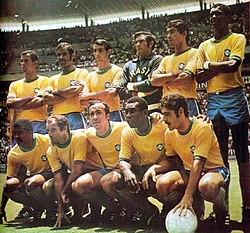
When Pelé was called to the national team in early 1969, he refused at first, but then accepted and scored six goals in six World Cup qualifying matches. The 1970 FIFA World Cup in Mexico was expected to be Pelé's last. Brazil's squad for the tournament was markedly different than the 1966 team. Star players Garrincha, Nilton Santos, Valdir Pereira, Djalma Santos, and Gilmar had retired. However, Brazil's 1970 World Cup squad, which included Pelé, Rivellino, Jairzinho, Gérson, Carlos Alberto Torres, Tostão and Clodoaldo, has often been considered the greatest football team in history.
The front five of Jairzinho, Pelé, Gerson, Tostão, and Rivellino together created an attacking momentum, with Pelé playing a key role in Brazil's road to the final. In the first match against Czechoslovakia, Pelé gave Brazil a 2–1 lead by controlling a 50-yard pass with his chest and then scoring. Later in the match, he narrowly missed scoring from the halfway line; Brazil achieved a 4–1 victory. During a match against England, Pelé nearly scored with a header that was saved by the England goalkeeper Gordon Banks; the moment has been referred to as the "save of the century". Years later, Pelé would comment on the save: "I have scored more than a thousand goals in my life and the thing people always talk to me about is the one I didn't score."

During Brazil's 3–2 win over Romania, Pelé scored two goals, including a 20-yard bending free kick. During the semi-final against Uruguay, Pelé made one of his most famous plays. Tostão made a pass to Pelé, and Uruguay's goalkeeper Ladislao Mazurkiewicz ran to intercept the ball. Pelé got there first and fooled Mazurkiewicz with a feint; as the ball rolled to the goalkeeper's left, Pelé went around him to the right and took a shot while turning towards the goal. He turned too far as he shot, and the ball drifted just wide of the far post.
Brazil played against Italy in the final at the Azteca Stadium in Mexico City. Pelé scored the opening goal with a header, which was Brazil's 100th World Cup goal. His leap of joy into the arms of his teammate Jairzinho following the goal is regarded as one of the most iconic moments in World Cup history. Pelé then made assists for Brazil's third and fourth goals. The last goal of the game is often considered the greatest team goal of all time because it involved all but two of the team's outfield players. The play culminated in a blind pass from Pelé that went to Carlos Alberto, allowing him to score. Brazil won the match 4–1, and Pelé received the Golden Ball as the player of the tournament. Tarcisio Burgnich, an Italian player who marked Pelé during the final, was quoted as saying, "I told myself before the game, he's made of skin and bones just like everyone else. But I was wrong". Through scoring and assists, Pelé was responsible for 53% of Brazil's goals during the tournament.
Pelé's last international match was on 18 July 1971 against Yugoslavia in Rio de Janeiro. With Pelé on the field, the Brazilian team's record was 67 wins, 14 draws, and 11 losses. Brazil never lost a match while fielding both Pelé and Garrincha. Pelé's 77 goals in 92 games for Brazil saw him hold the record as the national team's top goalscorer for over fifty years until it was surpassed by Neymar in September 2023, in his 125th game.
On 19 December 1973, Pelé played for a Brazil XI team against the Rest of The World in a farewell game for Garrincha, scoring the equalizer in an eventual 2–1 win. In July 1983, the 42-year-old Pelé played for another Brazil XI squad against a South Brazil team in a friendly to benefit the victims of a flood in Santa Catarina; he scored a free kick in a 1–2 loss.
Style of play

Pelé was known for connecting the phrase "The Beautiful Game" with football. A prolific goalscorer, he was known for his ability to anticipate his opponents' movements and finish off chances with an accurate and powerful shot with either foot. He has been described as a hard-working and complete player with exceptional vision and intelligence, and has been recognised for his precise passing and ability to provide assists. Brazil's 1970 World Cup-winning captain Carlos Alberto Torres remarked: "His great secret was improvisation. He had an extraordinary perception of the game."
During his early career, Pelé played in a variety of attacking positions. Although he often operated inside the penalty area as a striker or centre forward, his wide range of skills allowed him to also play as an inside forward or a second striker. Later in his career, he took on a playmaking role behind the strikers, often functioning as an attacking midfielder. Pelé's playing style combined speed, creativity, and technical skill with physical power, stamina, and athleticism. His technique, flair, agility, and dribbling skills allowed him to beat opponents with the ball, and frequently saw him use sudden changes of direction and elaborate feints to get past players, such as his trademark move, the drible da vaca. Another one of his signature moves was the paradinha, or "little stop". Pelé excelled in the air, due to his heading accuracy, timing, and elevation. He was known for his bending shots and the accuracy of his free kicks and penalty kicks, although he often refrained from taking penalty kicks, as he believed it was a cowardly way to score. Pelé earned a reputation for being a "big game player" due to his tendency to score crucial goals in important matches.
Pelé was also known to be a fair and highly influential player, who stood out for his charismatic leadership and sportsmanship on the pitch. His warm embrace of Bobby Moore following the Brazil vs England game at the 1970 World Cup is viewed as the embodiment of sportsmanship, with The New York Times stating the image "captured the respect that two great players had for each other. As they exchanged jerseys, touches, and looks, the sportsmanship between them was all in the image. No gloating and no fist-pumping from Pelé. No despair, no defeatism from Bobby Moore."
Legacy

Named the "greatest" by FIFA in 2012 and 2024, Pelé is one of the most lauded players in the history of football and has been frequently ranked as the greatest and most important player of all time. Barney Ronay of The Guardian wrote that Pelé was the first global sports superstar, while David Goldblatt said that he "set the standards by which footballing greatness is judged". According to Tostão, Pelé's strike partner at the 1970 World Cup, "Pelé was the greatest – he was simply flawless." England's 1966 World Cup-winning captain Bobby Moore commented: "Pelé was the most complete player I've ever seen, he had everything ... Perfect balance and impossible vision. He was the greatest because he could do anything and everything". Former Manchester United striker Sir Bobby Charlton said he felt "as though football was invented for this magical player." Former Real Madrid and Hungary star Ferenc Puskás stated: "The greatest player in history was Di Stéfano. I refuse to classify Pelé as a player. He was above that." Pelé's teammate Clodoaldo observed that around the world, people wanted to touch or kiss Pelé, or kiss the ground he walked on. Observing the effect Pelé had on people, journalist Simon Hattenstone compared him to Princess Diana, Mother Teresa and Nelson Mandela. Hattenstone wrote, "To be touched by Pelé is to be blessed." Multiple former players have compared Pelé to a god.
US diplomat Henry Kissinger stated: "Performance at a high level in any sport is to exceed the ordinary human scale. But Pelé's performance transcended that of the ordinary star by as much as the star exceeds ordinary performance." The artist Andy Warhol remarked that instead of 15 minutes of fame, Pelé would have 15 centuries.
Accolades
Presenting Pelé with the Laureus Lifetime Achievement Award, former South African president Nelson Mandela said, "To watch him play was to watch the delight of a child combined with the extraordinary grace of a man in full." In 1999, the International Olympic Committee elected Pelé the Athlete of the Century, while Time magazine named him one of the 100 Most Important People of the 20th Century. In 2000, the International Federation of Football History & Statistics (IFFHS) voted Pelé the World Player of the Century. During his career, he became known as "The Black Pearl" (A Pérola Negra), "The King of Football" (O Rei do Futebol ), "The King Pelé" (O Rei Pelé) or simply "The King" (O Rei ). In 2014, the city of Santos inaugurated the Museu Pelé, a museum which displays a 2,400 piece collection of Pelé memorabilia. Approximately $22 million was invested in the construction of the museum.

Pelé is ranked among the leading scorers in football history in both official and total matches. According to the RSSSF, Pelé scored 538 league goals, and a total of 775 goals in 840 official games. The RSSSF put Pelé's grand total at 1,301 goals in 1,390 appearances during his professional senior career, which included friendlies and tour games. In January 2014, Pelé was awarded the first ever FIFA Ballon d'Or Prix d'Honneur to acknowledge his contributions to football around the world. In 2020, he was named in the Ballon d'Or Dream Team.
Sponsorships and business interests
Ahead of the 1970 World Cup, the German sportswear companies Adidas and Puma—each owned by one of the Dassler brothers—established the "Pelé Pact". The pact was an agreement that neither company would sign a sponsorship deal with Pelé, due to the possibility of an expensive bidding war. However, Puma broke the pact and signed Pelé. In addition to paying him a percentage of Puma King boot sales, the company paid Pelé US$120,000 ($2.85 million in 2022) to tie his laces prior to Brazil's quarter-final against Peru. With news cameras recording Pelé, the Puma King Pelé boots were broadcast to a global audience, generating enormous publicity for the brand. Puma's deal with Pelé played a prominent role in the Dassler brothers feud. Many business experts credited the feud with transforming sports apparel into a multi-billion pound industry.
In 1976, Pelé was on a Pepsi-sponsored trip in Lagos, Nigeria, when the military attempted a coup. Pelé was trapped in a hotel with Arthur Ashe and other professional tennis players, who were participating in the 1976 Lagos WCT tournament. Pelé and the others eventually left the hotel and stayed at the residence of Brazil's ambassador, as they could not leave the country for several days. Eventually the airport was opened and Pelé left Nigeria disguised as a pilot.
In 1993, Pelé publicly accused the Brazilian football administrator Ricardo Teixeira of corruption after Pelé's television company was rejected in a contest for the Brazilian domestic rights to the 1994 World Cup. Pelé's accusations led to an eight-year feud between him and Teixeira. As a consequence of the feud, the President of FIFA, João Havelange, Teixeira's father-in-law, banned Pelé from participating in the draw for the 1994 FIFA World Cup in Las Vegas.
In 2016, Pelé filed a lawsuit in the United States against Samsung Electronics, claiming violations under the Lanham Act for false endorsement, as well as a violation of his right of publicity. The suit, which sought US$30 million in damages, alleged that Samsung and Pelé had nearly entered into a licensing agreement for Pelé to appear in a Samsung advertising campaign, but Samsung abruptly pulled out of the negotiations. The October 2015 advert in question included images of a man who allegedly resembled Pelé. The case was settled out of court several years later.
Philanthropy and public service

In 1992, Pelé was appointed a United Nations ambassador for ecology and the environment, and in 1994 he was named a UNESCO Goodwill Ambassador. Pelé supported various charitable causes throughout his life, including Action for Brazil's Children, Gols Pela Vida, SOS Children's Villages, The Littlest Lamb, and Prince's Rainforests Project. In 2001, he was accused of involvement in a corruption scandal that resulted in a theft of $700,000 from UNICEF. It was claimed that money given to Pelé's company for a benefit match was not returned after the match was cancelled. The claim was not proven, and it was denied by UNICEF.
In January 1995, Pelé was appointed Brazil's Minister of Sport by President Fernando Cardoso. During his tenure, Pelé proposed legislation to reduce corruption in Brazilian football, which became known as the "Pelé law". He left the position in April 1998. In 1997, Pelé received an honorary knighthood from Queen Elizabeth II in a ceremony at Buckingham Palace.
On 9 August 2012, Pelé was awarded an honorary degree from the University of Edinburgh for his contributions to humanitarian and environmental causes, and for his sporting achievements. Three days later, he attended the 2012 Olympic hunger summit hosted by British prime minister David Cameron in London, which was part of a series of international efforts to highlight hunger as an important global issue. In 2016, Pelé auctioned more than 1600 items and raised £3.6 million for charity. In 2018, he launched the Pelé Foundation, which carries out charitable work related to poverty and education around the world.
Other activities

Pelé published several autobiographies, starred in documentary films, and composed musical pieces, including Sérgio Mendes' soundtrack for the film Pelé (1977).[additional citation(s) needed] He appeared in the 1981 film Escape to Victory, about a World War II-era football match between Allied prisoners of war and a German team. In 1969, Pelé starred in a telenovela called Os Estranhos, about first contact with aliens, which was created to drum up interest in the Apollo missions. Pelé was asked to participate in the 2006 ESPN documentary film Once in a Lifetime: The Extraordinary Story of the New York Cosmos, but declined when the producers would not pay his requested $100,000 fee.
Pelé appeared at the 2006 World Economic Forum in Davos, Switzerland, speaking about the role of sport in economic development. In November 2007, Pelé was the guest of honour at an exhibition match celebrating the 150th anniversary of Sheffield F.C., the world's oldest football club. While in Sheffield, Pelé opened an exhibition which included the first public showing in 40 years of the original hand-written rules of football.
In 2009, Pelé assisted the Rio de Janeiro bid for the 2016 Summer Olympics, spearheading the Rio 2016 presentation to the Association of National Olympic Committees of Africa General Assembly in Abuja, Nigeria. In August 2010, Pelé was introduced as the honorary president of a revived New York Cosmos.
On 1 June 2022, Pelé published an open letter to President Vladimir Putin of Russia on his Instagram account, in which he asked Putin to stop the "evil" and "unjustified" invasion of Ukraine.
Filmography
| Year | Title | Role | Notes | Ref |
|---|---|---|---|---|
| 1969 | Os Estranhos | Plínio Pompeu | TV series | |
| 1971 | O Barão Otelo no Barato dos Bilhões | Dr. Arantes/Himself | ||
| 1972 | A Marcha | Chico Bondade | ||
| 1981 | Escape to Victory | Corporal Luis Fernandez | ||
| 1983 | A Minor Miracle | Himself | Also known as Young Giants | |
| 1985 | Pedro Mico | |||
| 1986 | Hotshot | Santos | ||
| 1986 | Os Trapalhões e o Rei do Futebol | Nascimento | ||
| 1989 | Solidão, Uma Linda História de Amor | |||
| 2001 | Mike Bassett: England Manager | Himself | ||
| 2016 | Pelé: Birth of a Legend | Man sitting in hotel lobby | Cameo appearance |
Personal life
Relationships and children
- By Anizia Machado Sandra (1964–2006)
- By Lenita Kurtz Flávia (born 1968)
- By Rosemeri dos Reis Cholbi Kely Cristina (born 1967) Edson (born 1970) Jennifer (born 1978)
- By Assíria Lemos Seixas Joshua (born 1996) Celeste (born 1996)
Pelé married three times and had several extramarital affairs, fathering seven children in all. In 1966, he married Rosemeri dos Reis Cholbi. They had two daughters, Kely Cristina and Jennifer, and a son, Edson. Pelé and Cholbi divorced in 1982. In 2014, Edson was sentenced to 33 years in prison for laundering money from drug trafficking. On appeal, the sentence was reduced to 12 years and 10 months.
From 1981 to 1986, Pelé was romantically linked with the television presenter Xuxa. She was 17 when they started dating. In 1994, Pelé married the psychologist and gospel singer Assíria Lemos Seixas, who gave birth to the twins Joshua and Celeste through fertility treatments. Pelé and Seixas divorced in 2008.
Pelé had at least two more children from extramarital affairs. Sandra Machado was conceived from an affair he had in 1964 with a housemaid, Anizia Machado. Sandra fought for years to be acknowledged by Pelé, who refused to submit to DNA tests. He finally relented, and a court-ordered DNA test proved she was his daughter. Sandra died of cancer in 2006.
In 2016, Pelé married Marcia Aoki, a Japanese-Brazilian importer of medical equipment from Penápolis, São Paulo. The couple had been dating since 2010.
Health

In 1977, Pelé had his right kidney removed. In 2012, he underwent a successful hip operation. In December 2017, he appeared in a wheelchair at the 2018 World Cup draw in Moscow, and a month later he collapsed from exhaustion and was taken to hospital. In 2019, after a hospitalisation due to a urinary tract infection, Pelé underwent surgery to remove kidney stones. The following year, his son Edinho reported that Pelé was unable to walk independently and reluctant to leave home; Edinho ascribed his father's condition to a lack of rehabilitation following his hip operation.
Death and funeral
In 2021, Pelé was diagnosed with colon cancer. He underwent surgery the same month, and was treated with several rounds of chemotherapy. In early 2022, metastasis was detected in his intestine, lung and liver. On 29 November, he was admitted to the Albert Einstein Israelite Hospital in São Paulo due to a respiratory infection after he contracted COVID-19, and for reassessment of the treatment of the cancer. On 3 December, it was reported that Pelé had become unresponsive to chemotherapy and was in palliative care.
He had a magnetic presence and, when you were with him, the rest of the world stopped. Today, the whole world mourns the loss of Pelé; the greatest footballer of all time.
On 21 December, the hospital stated that Pelé's tumour had advanced and he required "greater care related to renal and cardiac dysfunctions". He was not allowed to spend Christmas at home, as his family had wanted. Pelé died on 29 December 2022 at the age of 82, due to multiple organ failure, a complication of colon cancer. Pelé's death certificate stated that he had died of kidney failure, heart failure, bronchopneumonia and colon adenocarcinoma. Pelé was survived by his 100-year-old mother, Dona Celeste, although she had been in a vegetative state since 2019, and was therefore unaware of his death.
Tributes were paid to Pelé by current and former players, including Neymar, Cristiano Ronaldo, Kylian Mbappé, Lionel Messi, Ronaldo and Roberto Carlos, along with other major sporting figures, celebrities, and world leaders. The outgoing Brazilian president, Jair Bolsonaro, declared a three-day period of national mourning. At FIFA headquarters in Zürich, the flags of the 211 member associations were flown at half-mast. Landmarks and stadiums were lit up in honour of Pelé, including Rio de Janeiro's Christ the Redeemer statue and Maracanã Stadium, the CONMEBOL headquarters in Paraguay, and Wembley Stadium in London. There was applause and a minute's silence at football matches in honour of Pelé.
"I used to go out and people said Pelé! Pelé! Pelé! Pelé! all over the world, but no one remembers Edson. Edson is the person who has the feelings, who has the family, who works hard, and Pelé is the idol ... Pelé will never die ... But Edson is a normal person who is going to die one day, and the people forget that."
Pelé's funeral, which involved his body being publicly displayed in an open coffin draped with the flags of Brazil and Santos FC, began at Vila Belmiro stadium in Santos on 2 January 2023. Thousands of fans—many of whom were wearing Pelé's No. 10 Brazilian jersey or his Santos club jersey—flooded the streets to attend the first day of the funeral service. Some attendees said they had to wait three hours in line. The public wake lasted until the following day and had more than 230,000 people in attendance, including Pelé's wife Marcia Aoki, his son Edinho, Brazilian president Luiz Inácio Lula da Silva, FIFA president Gianni Infantino, CONMEBOL president Alejandro Domínguez and Ednaldo Rodrigues, the president of the Brazilian Football Confederation. Brazilian television channels suspended normal broadcasting to cover the funeral procession. After the procession, Pelé was buried at the Memorial Necrópole Ecumênica.
Kigali Pelé Stadium in Rwanda was renamed in honor of him in March 2023 by Infantino and Rwandan president Paul Kagame as part of the 73rd FIFA Congress. On 26 April 2023, the nickname pelé became synonymous with "exceptional, incomparable, unique" in the Michaelis Portuguese-language dictionary after a campaign with 125,000 signatories.
Career statistics
Club
Pelé's goalscoring record is often reported by FIFA as being 1,281 goals in 1,363 games. This figure includes goals scored in friendly club matches (including international tours with Santos and the New York Cosmos) and goals scored in several games Pelé played in for the Brazilian armed forces teams and the state team of São Paulo. Pelé was listed in the Guinness World Records for most career goals scored in football. In 2000, IFFHS declared Pelé the "World's Best and Successful Top Division Goal Scorer of all time" with 541 goals in 560 games, and honoured him with a trophy.
The tables below record every goal Pelé scored in official club competitions for Santos FC and all matches and goals for the New York Cosmos.
| Club | Season | Campeonato Paulista | Rio-São Paulo | Campeonato Brasileiro Série A | Domestic competitions Sub-total | International competitions | Total | ||||||||
|---|---|---|---|---|---|---|---|---|---|---|---|---|---|---|---|
| Copa Libertadores | Intercontinental Cup | ||||||||||||||
| Apps | Goals | Apps | Goals | Apps | Goals | Apps | Goals | Apps | Goals | Apps | Goals | Apps | Goals | ||
| Santos | 1956 | 0* | 0* | 1 | 1 | 1 | 1 | ||||||||
| 1957 | 14+15* | 19+17* | 9 | 5 | 38* | 41* | 38* | 41* | |||||||
| 1958 | 38 | 58 | 8 | 8 | 46 | 66 | 46* | 66* | |||||||
| 1959 | 32 | 45 | 7 | 6 | 4* | 2* | 39 | 51 | 43* | 53* | |||||
| 1960 | 30 | 33 | 3 | 0 | 0 | 0 | 33 | 33 | 0 | 0 | 0 | 0 | 33* | 33* | |
| 1961 | 26 | 47 | 7 | 8 | 5* | 7 | 33 | 55 | 0 | 0 | 0 | 0 | 38* | 62* | |
| 1962 | 26 | 37 | 0 | 0 | 5* | 2* | 26 | 37 | 4* | 4* | 2 | 5 | 37* | 48* | |
| 1963 | 19 | 22 | 8 | 14 | 4* | 8 | 27 | 36 | 4* | 5* | 1 | 2 | 36 | 51* | |
| 1964 | 21 | 34 | 4 | 3 | 6* | 7 | 25 | 37 | 0* | 0* | 0 | 0 | 31* | 44* | |
| 1965 | 28 | 49 | 7 | 5 | 4* | 2* | 39 | 54 | 7* | 8 | 0 | 0 | 46* | 64* | |
| 1966 | 14 | 13 | 0* | 0* | 5* | 2* | 14* | 13* | 0 | 0 | 0 | 0 | 19* | 15* | |
| 1967 | 18 | 17 | 14* | 9* | 32* | 26* | 0 | 0 | 0 | 0 | 32* | 26* | |||
| 1968 | 21 | 17 | 17* | 12* | 38* | 28* | 0 | 0 | 5 | 1 | 43* | 30* | |||
| 1969 | 25 | 26 | 12* | 12* | 37* | 38* | 0 | 0 | 0 | 0 | 37* | 38* | |||
| 1970 | 15 | 7 | 13* | 4* | 28* | 11* | 0 | 0 | 0 | 0 | 28* | 11* | |||
| 1971 | 19 | 6 | 21 | 1 | 40 | 7 | 0 | 0 | 0 | 0 | 40 | 7 | |||
| 1972 | 20 | 9 | 16 | 5 | 36 | 14 | 0 | 0 | 0 | 0 | 36 | 14 | |||
| 1973 | 19 | 11 | 30 | 19 | 49 | 30 | 0 | 0 | 0 | 0 | 49 | 30 | |||
| 1974 | 10 | 1 | 17 | 9 | 27 | 10 | 0 | 0 | 0 | 0 | 27 | 10 | |||
| Total | 410 | 468 | 53 | 49 | 173* | 101* | 636* | 618* | 15 | 17 | 8 | 8 | 659 | 643 |
- * Indicates that the number was deduced from the list of rsssf.com and this list of Pelé games.
| Club | Season | League | Postseason | Other[citation needed] | Total | |||
|---|---|---|---|---|---|---|---|---|
| Apps | Goals | Apps | Goals | Apps | Goals | Apps | Goals | |
| New York Cosmos | 1975 | 9 | 5 | – | 14 | 12 | 23 | 17 |
| 1976 | 22 | 13 | 2 | 2 | 18 | 11 | 42 | 26 |
| 1977 | 25 | 13 | 6 | 4 | 11 | 6 | 42 | 23 |
| Total | 56 | 31 | 8 | 6 | 43 | 29 | 107 | 66 |
International
With 77 goals in 92 official appearances, Pelé is the second-highest goalscorer of the Brazilian national team. He scored twelve goals and is credited with ten assists in fourteen World Cup matches.
| Team | Year | Apps | Goals | Goal average |
|---|---|---|---|---|
| Brazil | 1957 | 2 | 2 | 1.00 |
| 1958 | 7 | 9 | 1.28 | |
| 1959 | 9 | 11 | 1.22 | |
| 1960 | 6 | 4 | 0.67 | |
| 1961 | 0 | 0 | — | |
| 1962 | 8 | 8 | 1.00 | |
| 1963 | 7 | 7 | 1.00 | |
| 1964 | 3 | 2 | 0.67 | |
| 1965 | 8 | 9 | 1.12 | |
| 1966 | 9 | 5 | 0.55 | |
| 1967 | 0 | 0 | — | |
| 1968 | 7 | 4 | 0.57 | |
| 1969 | 9 | 7 | 0.77 | |
| 1970 | 15 | 8 | 0.53 | |
| 1971 | 2 | 1 | 0.50 | |
| Total | 92 | 77 | 0.84 | |
| Source: |
Honours
São Paulo state team
Santos
- Campeonato Brasileiro Série A: 1961, 1962, 1963, 1964, 1965, 1968
- Copa Libertadores: 1962, 1963
- Intercontinental Cup: 1962, 1963
- Intercontinental Supercup: 1968
- Campeonato Paulista: 1958, 1960, 1961, 1962, 1964, 1965, 1967, 1968, 1969, 1973
- Torneio Rio-São Paulo: 1959, 1963, 1964, 1966
New York Cosmos
- North American Soccer League, Soccer Bowl: 1977
- North American Soccer League, Atlantic Conference Championship: 1977
Brazil
- FIFA World Cup: 1958, 1962, 1970
- Taça do Atlântico: 1960
- Roca Cup: 1957, 1963
- Taça Oswaldo Cruz: 1958, 1962, 1968
- Copa Bernardo O'Higgins: 1959
Individual
In December 2000, Pelé and Diego Maradona shared the prize of FIFA Player of the Century. The award was originally intended to be based upon votes in an online poll. However, when it became apparent that the poll favoured Maradona due to a wave of voting by his fans, a committee of FIFA members was appointed to choose the winner, along with readers of the FIFA magazine. The committee chose Pelé. Since Maradona was winning the Internet poll, however, it was decided he and Pelé should share the award.
- Campeonato Paulista Top Scorer: 1957, 1958, 1959, 1960, 1961, 1962, 1963, 1964, 1965, 1969, 1973
- FIFA World Cup Best Young Player: 1958
- FIFA World Cup Silver Ball: 1958
- France Football's Ballon d'Or: 1958, 1959, 1960, 1961, 1963, 1964, 1970 – Le nouveau palmarès (the new winners)
- South American Championship Best Player: 1959
- South American Championship Top Scorer: 1959
- Copa Bernardo O'Higgins Top Scorer: 1959 (shared with Quarentinha)
- Gol de Placa: 1961
- Campeonato Brasileiro Série A Top Scorer: 1961, 1963, 1964
- Intercontinental Cup Top Scorer: 1962, 1963
- Torneio Rio-São Paulo Top Scorer: 1963
- Copa Libertadores Top Scorer: 1965
- BBC Overseas Sports Personality of the Year: 1970
- Bola de Prata: 1970
- FIFA World Cup Golden Ball (Best Player): 1970
- South American Footballer of the Year: 1973
- Included in the North American Soccer League (NASL) All-Star team: 1975, 1976, 1977
- NASL Top Assist Provider: 1976
- NASL Most Valuable Player: 1976
- Number 10 retired by the New York Cosmos as a recognition to his contribution to the club: 1977
- Elected Citizen of the World, by the United Nations: 1977
- International Peace Award: 1978
- Sports Champion of the Century, by L'Équipe: 1981
- Inducted into the American National Soccer Hall of Fame: 1992
- Elected Goodwill Ambassador, by UNESCO: 1993
- Winner of France Football's World Cup Top-100 1930–1990: 1994
- Marca Leyenda: 1997
- World Team of the 20th Century: 1998
- Football Player of the Century, elected by France Football's Ballon d'Or Winners: 1999
- TIME: One of the 100 Most Important People of the 20th century: 1999
- Greatest Player of the 20th Century, by World Soccer: 1999
- Athlete of the Century, by Reuters News Agency: 1999
- Athlete of the Century, elected by International Olympic Committee: 1999
- World Player of the Century, by the IFFHS: 2000
- South American player of the century, by the IFFHS: 2000
- FIFA Player of the Century: 2000
- Laureus Lifetime Achievement Award: 2000
- FIFA 100 Greatest Living Footballers: 2004
- BBC Sports Personality of the Year Lifetime Achievement Award: 2005
- Elected best Brazilian player of the century, by the IFFHS: 2000
- FIFA Presidential Award: 2007
- Greatest football player to have ever played the game, by Golden Foot: 2012
- FIFA Ballon d'Or Prix d'Honneur: 2013
- World Soccer Greatest XI of All Time: 2013
- Legends of Football Award: 2013
- South America's Best Player in History, by L'Équipe: 2015
- Inspiration Award, by GQ: 2017
- Global Citizen Award, by the World Economic Forum: 2018
- FWA Tribute Award: 2018
- Ballon d'Or Dream Team: 2020
- IFFHS All-time Men's Dream Team: 2021
- IFFHS South America Men's Team of All Time: 2021
- Player of History Award: 2022
- FIFA Best Special Award: 2022
Orders
- FIFA Order of Merit: 1984
- FIFA Centennial Award: 2004
- Knight of the Order of Rio Branco: 1967
- Elected Commander of the Order of Rio Branco after scoring the thousandth goal: 1969
- Officer of the Order of Ouissam Alaouite of the Kingdom of Morocco: 1976
- Awarded with the Order of Champions, by the Organization of Catholic Youth in the USA: 1978
- Awarded with the Order of Merit of South America, by CONMEBOL: 1984
- He was awarded the National Order of Merit, by the government of Brazil: 1991
- Awarded with the Cross of the Order of the Republic of Hungary: 1994
- Awarded the Order of Military Merit: 1995
- Knight Commander of the Order of the British Empire (honorary knighthood): 1997
- Awarded with the Order of Cultural Merit, by the government of Brazil: 2004
- Olympic Order, by the International Olympic Committee: 2016
Records
- Highest goals-per-game ratio for Brazil national football team: 0.84
- Highest goals-per-game ratio of any South American top international scorer: 0.84
- Highest goals-per-game ratio of any leading scorer in the Intercontinental Cup: 2.33
- Most goals in the Intercontinental Cup: 7
- Most goals for Santos: 643 (in 659 competitive games)
- Most goals for Santos: 1091 (including friendlies)
- Most appearances for Santos: 1116
- Most goals within a single Brazilian top-flight league season: 58
- Most goals scored in a single Campeonato Paulista season: 58 (in 38 competitive games,1958)
- Most goals scored in a single Campeonato Paulista match: 8 (1964)
- Most goals scored in Campeonato Paulista history: 466
- Most seasons as Campeonato Paulista Top Scorer: 11
- Most consecutive seasons as Campeonato Paulista Top Scorer: 9 (1957–1965)
- Most goals in a calendar year (including friendlies, recognised by FIFA): 127 (1959)
- RSSSF record for most top level goals scored in one season (including friendlies): 120 (1959)
- RSSSF record for most seasons with over 100 top level goals scored (including friendlies): 3 (1959, 1961, 1965)
- RSSSF record for most goals scored before the age of 30: 675
- RSSSF record for most top level career goals (including friendlies): 1,274
- Guinness World Record for most career goals in world football (including friendlies): 1,283 (in 1,363 games)
- IFFHS record for most top division league goals: 604
- IFFHS record for most top level domestic goals: 659
- Guinness World Record for most hat-tricks in world football: 92
- Most hat-tricks for Brazil: 7
- Most FIFA World Cup winners' medals: 3 (1958, 1962, 1970)
- Youngest winner of a FIFA World Cup: aged 17 years and 249 days (1958)
- Youngest goalscorer in a FIFA World Cup: aged 17 years and 239 days (for Brazil vs Wales, 1958)
- Youngest player to score twice in a FIFA World Cup semi-final: aged 17 years and 244 days (for Brazil vs France, 1958)
- Youngest player to score a hat-trick in a FIFA World Cup: aged 17 years and 244 days (for Brazil vs France, 1958)
- Youngest player to play in a FIFA World Cup Final: aged 17 years and 249 days (1958)
- Youngest goalscorer in a FIFA World Cup Final: aged 17 years and 249 days (for Brazil vs Sweden, 1958)
- Youngest player to score twice in a FIFA World Cup Final: aged 17 years and 249 days (for Brazil vs Sweden, 1958)
- Youngest player to play for Brazil in a FIFA World Cup: aged 17 years and 234 days
- Youngest player to start a knockout match at a FIFA World Cup
- Youngest player to reach five FIFA World Cup knockout stage goals
- Youngest player to debut for Brazil national football team: aged 16 years and 259 days (Brazil vs Argentina, 1957)
- Youngest goalscorer for Brazil national football team: aged 16 years and 259 days (Brazil vs Argentina, 1957)
- Youngest Top Scorer in the Campeonato Paulista
- First player to score in three successive FIFA World Cups
- First teenager to score in a FIFA World Cup Final
- One of only five players to have scored in four different FIFA World Cup tournaments
- One of only five players to have scored in two different FIFA World Cup Finals
- Scored in two FIFA World Cup Finals for winning teams (shared with Vavá)
- Most assists provided in FIFA World Cup history: 10 (1958–1970)
- Most assists provided in a single FIFA World Cup tournament: 6 (1970)
- Most assists provided in FIFA World Cup Final matches: 3 (1 in 1958 and 2 in 1970)
- Most assists provided in FIFA World Cup knockout phase: 6 (shared with Messi)
- Most goals from open play in FIFA World Cup Final matches: 3 (2 in 1958 and 1 in 1970) (shared with Vavá, Geoff Hurst and Zinedine Zidane)
- Most FIFA World Cup goal involvements for Brazil
- Most goals scored in the Copa Bernardo O'Higgins: 3 (shared with Quarentinha)
- Only player to reach 25 international goals as a teenager
- Only player to score in a FIFA World Cup before turning 18
- Only player to score a hat-trick in a FIFA World cup before turning 18
- Only player to have scored a hat-trick in the Intercontinental Cup
- Only player to have scored a hat-trick in the Copa Bernardo O'Higgins
See also
- List of Brazil national football team hat-tricks
- List of international goals scored by Pelé
- List of international hat-tricks scored by Pelé
- List of men's footballers with 500 or more goals
- List of men's footballers with 50 or more international goals
- Pelé runaround move
- Torcida Jovem of Santos FC School of Samba
- Mononymous person
Notes
Bibliography
- Bar-On, Tamir (2014). . Rowman & Littlefield. ISBN 978-1442234734.
- Bellos, Alex (2003). . Bloomsbury. ISBN 0747561796.
- Blevins, David (2011). . Scarecrow Press. ISBN 978-0810861305.
- Darby, Paul (2002). . Taylor & Francis. ISBN 0714649686.
- Dunmore, Tom (2011). . Scarecrow Press. ISBN 978-0810873957.
- Dunmore, Tom (2015). . Scarecrow Press. ISBN 978-0810887435.
- . Ebony. Johnson Publishing Company. 1963. OCLC .
- Freedman, Lew (2014). . ABC-CLIO. ISBN 978-1440829819.
- Heizer, Teixeira (1997). (in Brazilian Portuguese). Mauad Editora Ltda. ISBN 8585756527.
- Magill, Frank Northen (1999). . Routledge. ISBN 1579580483.
- Marcus, Joe (1976). . Mason Charter Publishing. p. . ISBN 0884053660.
- Pelé; Fish, Robert L. (1977). . Doubleday Publishing. ISBN 0385121857.
- Pelé (2008). . Simon and Schuster. ISBN 978-1847394880.
External links
- – FIFA competition record (archived)
- – UEFA competition record ()
- at National Soccer Hall of Fame
- – slideshow by Life magazine
- at Santos official website
- at Planet World Cup
| Political offices | ||
|---|---|---|
| FIFA World Cup | ||
| Preceded byPinga | Jersey number 10 for Brazil | Succeeded byRivellino |
| New ministerial post | Minister of Sports 1 January 1995 – 30 April 1998 | VacantTitle next held byRafael Greca as Minister of Sports and Tourism |