Ṝ
In-game article clicks load inline without leaving the challenge.
Ṝ is a vowel-like letter of Indic abugidas, often referred to as a "vocalic R̄". In modern Indic scripts, Ṝ is derived from the early "Ashoka" Brahmi letter . As an ostensible Indic vowel, Ṝ comes in two normally distinct forms: 1) as an independent letter, and 2) as a vowel sign for modifying a base consonant. Bare consonants without a modifying vowel sign have the inherent "A" vowel.
Āryabhaṭa numeration
Aryabhata used Devanagari letters for numbers, very similar to the Greek numerals, even after the invention of Indian numerals. The ॄ sign was used to modify a consonant's value ×106, but the vowel letter ॠ did not have an inherent value by itself.
Historic Ṝ
There are three different general early historic scripts - Brahmi and its variants, Kharoṣṭhī, and Tocharian, the so-called slanting Brahmi. Ṝ was not found as an independent vowel in Brahmi, only as a vowel mark for modifying a base consonant. Like all Brahmic scripts, Tocharian Ṝ has an accompanying vowel mark for modifying a base consonant. In Kharoṣṭhī, the only independent vowel letter is for the inherent A. All other independent vowels, including Ṝ are indicated with vowel marks added to the letter A.
Brahmi Ṝ
The Brahmi letter Ṝ was a simple modification of the Brahmi Ṛ, and as such is probably ultimately derived from the Aramaic Resh , and is thus related to the modern Latin R and Greek Rho. Several identifiable styles of writing the Ṝ vowel sign can be found, most associated with a specific set of inscriptions from an artifact or diverse records from an historic period. As the earliest and most geometric style of Brahmi, the letters found on the Edicts of Ashoka and other records from around that time are normally the reference form for Brahmi letters, but given the lack of Ṝ vowel signs in early Brahmi, the reference image is normally back-formed to a geometric form of later styles, and the independent letter for Ṝ is derived from the short Ṛ .
Tocharian Rii
The Tocharian letter is derived from the short Brahmi Ṛ . The Tocharian Ṝ was very infrequently used, and only appears in the corpus in combination with a few base consonants.
| Kr̄ | Khr̄ | Gr̄ | Ghr̄ | Cr̄ | Chr̄ | Jr̄ | Jhr̄ | Nyr̄ | Ṭr̄ | Ṭhr̄ | Ḍr̄ | Ḍhr̄ | Ṇr̄ |
|---|---|---|---|---|---|---|---|---|---|---|---|---|---|
| Tr̄ | Thr̄ | Dr̄ | Dhr̄ | Nr̄ | Pr̄ | Phr̄ | Br̄ | Bhr̄ | Mr̄ | Yr̄ | r̄r | Lr̄ | Vr̄ |
| Śr̄ | Ṣr̄ | Sr̄ | Hr̄ | ||||||||||
Kharoṣṭhī Ṝ
The Kharoṣṭhī letter Ṝ is indicated with the Ṛ vowel mark plus the vowel length mark . As an independent vowel, Ṝ is indicated by adding the vowel marks to the independent vowel letter A .
Devanagari Ṝ
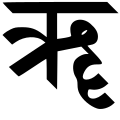
Ṝ (ॠ) is a vowel of the Devanagari abugida. It ultimately arose from the Brahmi letter . Letters that derive from it are the Gujarati letter ૠ, and the Modi letter 𑘇.
Devanagari Using Languages
The Devanagari script is used to write the Hindi language, Sanskrit and the majority of Indo-Aryan languages. In most of these languages, ॠ is pronounced as Hindi pronunciation: [riː][dubious – discuss]. Like all Indic scripts, Devanagari vowels come in two forms: an independent vowel form for syllables that begin with a vowel sound, and a vowel sign attached to base consonant to override the inherent /ə/ vowel.
Bengali Ṝ

Ṝ (ৠ) is a vowel of the Bengali abugida. It is derived from the Siddhaṃ letter , and is marked by the lack of horizontal head line and less geometric shape than its Devanagari counterpart, ॠ.
Bengali Script Using Languages
The Bengali script is used to write several languages of eastern India, notably the Bengali language and Assamese. In most languages, ৠ is pronounced as [ṝ]. Like all Indic scripts, Bengali vowels come in two forms: an independent vowel form for syllables that begin with a vowel sound, and a vowel sign attached to base consonant to override the inherent /ɔ/ vowel.
Gujarati Ṝ

Ṝ (ૠ) is a vowel of the Gujarati abugida. It is derived from the Devanagari Ṝ , and ultimately the Brahmi letter .
Gujarati-using Languages
The Gujarati script is used to write the Gujarati and Kutchi languages. In both languages, ૠ is pronounced as [ṝ]. Like all Indic scripts, Gujarati vowels come in two forms: an independent vowel form for syllables that begin with a vowel sound, and a vowel sign attached to base consonant to override the inherent /ə/ vowel.
Telugu Ṝ

Ṝ (ౠ) is a vowel of the Telugu abugida. It ultimately arose from the Brahmi letter Ṝ. It is closely related to the Kannada letter ೠ. Like in other Indic scripts, Telugu vowels have two forms: and independent letter for word and syllable-initial vowel sounds, and a vowel sign for changing the inherent "a" of Telugu consonant letters. Ṝ is a non-attaching vowel sign, and does not alter the underlying consonant or contextually shape itself in any way.

Malayalam Ṝ

Ṝ (ൠ) is a vowel of the Malayalam abugida. It ultimately arose from the Brahmi letter , via the Grantha letter rr. Like in other Indic scripts, Malayalam vowels have two forms: an independent letter for word and syllable-initial vowel sounds, and a vowel sign for changing the inherent "a" of consonant letters. Vowel signs in Malayalam usually sit adjacent to its base consonant - below, to the left, right, or both left and right, but are always pronounced after the consonant sound. Some vowel signs, such as Ṝ, can also form a ligature with some consonants, although this is much more common in old-style paḻaya lipi texts than in the modern reformed paḻaya lipi orthography.

Odia Ṝ
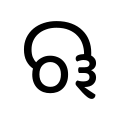
Ṝ (ୠ) is a vowel of the Odia abugida. It ultimately arose from the Brahmi letter , via the Siddhaṃ letter rr. Like in other Indic scripts, Odia vowels have two forms: an independent letter for word and syllable-initial vowel sounds, and a vowel sign for changing the inherent "a" of consonant letters. Vowel signs in Odia usually sit adjacent to its base consonant - below, to the left, right, or both left and right, but are always pronounced after the consonant sound. No base consonants are altered in form when adding a vowel sign, and there are no consonant+vowel ligatures in Odia.
Tirhuta Ṝ
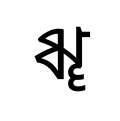
Ṝ (𑒈) is a vowel of the Tirhuta abugida. It ultimately arose from the Brahmi letter , via the Siddhaṃ letter rr. Like in other Indic scripts, Tirhuta vowels have two forms: an independent letter for word and syllable-initial vowel sounds, and a vowel sign for changing the inherent "a" of consonant letters. Vowel signs in Tirhuta usually sit adjacent to its base consonant - below, to the left, right, or both left and right, but are always pronounced after the consonant sound. No consonants are altered in form when adding the Ṝ vowel mark, although there are some consonant+vowel ligatures in Tirhuta.
Comparison of Ṝ
The various Indic scripts are generally related to each other through adaptation and borrowing, and as such the glyphs for cognate letters, including Ṝ, are related as well.
Character encodings of Ṝ
Most Indic scripts are encoded in the Unicode Standard, and as such the letter Ṝ in those scripts can be represented in plain text with unique codepoint. Ṝ from several modern-use scripts can also be found in legacy encodings, such as ISCII.
| Preview | ౠ | ୠ | ೠ | ൠ | ૠ | |||||||||
|---|---|---|---|---|---|---|---|---|---|---|---|---|---|---|
| Unicode name | DEVANAGARI LETTER VOCALIC RR | BENGALI LETTER VOCALIC RR | TELUGU LETTER VOCALIC RR | ORIYA LETTER VOCALIC RR | KANNADA LETTER VOCALIC RR | MALAYALAM LETTER VOCALIC RR | GUJARATI LETTER VOCALIC RR | |||||||
| Encodings | decimal | hex | dec | hex | dec | hex | dec | hex | dec | hex | dec | hex | dec | hex |
| Unicode | 2400 | U+0960 | 2528 | U+09E0 | 3168 | U+0C60 | 2912 | U+0B60 | 3296 | U+0CE0 | 3424 | U+0D60 | 2784 | U+0AE0 |
| UTF-8 | 224 165 160 | E0 A5 A0 | 224 167 160 | E0 A7 A0 | 224 177 160 | E0 B1 A0 | 224 173 160 | E0 AD A0 | 224 179 160 | E0 B3 A0 | 224 181 160 | E0 B5 A0 | 224 171 160 | E0 AB A0 |
| Numeric character reference | ॠ | ॠ | ৠ | ৠ | ౠ | ౠ | ୠ | ୠ | ೠ | ೠ | ൠ | ൠ | ૠ | ૠ |
| ISCII |
| Preview | AshokaKushanaGupta | 𑍠 | ||||
|---|---|---|---|---|---|---|
| Unicode name | BRAHMI LETTER VOCALIC RR | SIDDHAM LETTER VOCALIC RR | GRANTHA LETTER VOCALIC RR | |||
| Encodings | decimal | hex | dec | hex | dec | hex |
| Unicode | 69644 | U+1100C | 71047 | U+11587 | 70496 | U+11360 |
| UTF-8 | 240 145 128 140 | F0 91 80 8C | 240 145 150 135 | F0 91 96 87 | 240 145 141 160 | F0 91 8D A0 |
| UTF-16 | 55300 56332 | D804 DC0C | 55301 56711 | D805 DD87 | 55300 57184 | D804 DF60 |
| Numeric character reference | 𑀌 | 𑀌 | 𑖇 | 𑖇 | 𑍠 | 𑍠 |
| Preview | 𑐇 | 𑰇 | 𑆊 | |||
|---|---|---|---|---|---|---|
| Unicode name | NEWA LETTER VOCALIC RR | BHAIKSUKI LETTER VOCALIC RR | SHARADA LETTER VOCALIC RR | |||
| Encodings | decimal | hex | dec | hex | dec | hex |
| Unicode | 70663 | U+11407 | 72711 | U+11C07 | 70026 | U+1118A |
| UTF-8 | 240 145 144 135 | F0 91 90 87 | 240 145 176 135 | F0 91 B0 87 | 240 145 134 138 | F0 91 86 8A |
| UTF-16 | 55301 56327 | D805 DC07 | 55303 56327 | D807 DC07 | 55300 56714 | D804 DD8A |
| Numeric character reference | 𑐇 | 𑐇 | 𑰇 | 𑰇 | 𑆊 | 𑆊 |
| Preview | ၓ | |
|---|---|---|
| Unicode name | MYANMAR LETTER VOCALIC RR | |
| Encodings | decimal | hex |
| Unicode | 4179 | U+1053 |
| UTF-8 | 225 129 147 | E1 81 93 |
| Numeric character reference | ၓ | ၓ |
| Preview | ឬ | |
|---|---|---|
| Unicode name | KHMER INDEPENDENT VOWEL RYY | |
| Encodings | decimal | hex |
| Unicode | 6060 | U+17AC |
| UTF-8 | 225 158 172 | E1 9E AC |
| Numeric character reference | ឬ | ឬ |
| Preview | ඎ | ꢉ | ||
|---|---|---|---|---|
| Unicode name | SINHALA LETTER IRUUYANNA | SAURASHTRA LETTER VOCALIC RR | ||
| Encodings | decimal | hex | dec | hex |
| Unicode | 3470 | U+0D8E | 43145 | U+A889 |
| UTF-8 | 224 182 142 | E0 B6 8E | 234 162 137 | EA A2 89 |
| Numeric character reference | ඎ | ඎ | ꢉ | ꢉ |
| Preview | 𑘇 | 𑦧 | ||
|---|---|---|---|---|
| Unicode name | MODI LETTER VOCALIC RR | NANDINAGARI LETTER VOCALIC RR | ||
| Encodings | decimal | hex | dec | hex |
| Unicode | 71175 | U+11607 | 72103 | U+119A7 |
| UTF-8 | 240 145 152 135 | F0 91 98 87 | 240 145 166 167 | F0 91 A6 A7 |
| UTF-16 | 55301 56839 | D805 DE07 | 55302 56743 | D806 DDA7 |
| Numeric character reference | 𑘇 | 𑘇 | 𑦧 | 𑦧 |
| Preview | 𑒈 | |
|---|---|---|
| Unicode name | TIRHUTA LETTER VOCALIC RR | |
| Encodings | decimal | hex |
| Unicode | 70792 | U+11488 |
| UTF-8 | 240 145 146 136 | F0 91 92 88 |
| UTF-16 | 55301 56456 | D805 DC88 |
| Numeric character reference | 𑒈 | 𑒈 |
| Preview | ᬌ | |
|---|---|---|
| Unicode name | BALINESE LETTER RA REPA TEDUNG | |
| Encodings | decimal | hex |
| Unicode | 6924 | U+1B0C |
| UTF-8 | 225 172 140 | E1 AC 8C |
| Numeric character reference | ᬌ | ᬌ |