Rayo Vallecano
In-game article clicks load inline without leaving the challenge.
Rayo Vallecano de Madrid, S.A.D. (Spanish pronunciation:[ˈraʝoβaʎeˈkanoðemaˈðɾið]), often abbreviated to Rayo (Spanish for "thunderbolt"), is a Spanish professional football club based in the Puente de Vallecas district of Madrid. The club competes in La Liga, the top flight of Spanish football.
Founded on 29 May 1924, the club is known for its sociocultural tradition, recognized for representing the barrio-local culture and its working-class status. Its home matches have been played at the 14,708-capacity Campo de Fútbol de Vallecas stadium since 1976.

During its history, Rayo has spent 22 seasons in the top-flight, and has played in two European competitions, the UEFA Cup in the 2000–01 season and the 2025–26 UEFA Conference League. The club won the 2017–18 Segunda División. By historical performance, Rayo is the third best club in Community of Madrid, after Real Madrid and Atlético Madrid.
History
Establishment and early years
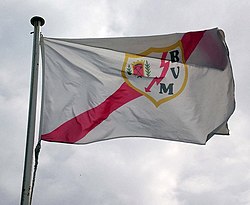
Rayo Vallecano was founded on 29 May 1924 in the hometown of Prudencia Priego, wife of the club's first president Julián Huerta. Greatly inspired by Argentina's River Plate, in 1949, after an agreement with Atlético Madrid, a red diagonal stripe was added to the team's kit, and the club reached Tercera División for the first time in its history.
Yo-yo years
One of the perennial yo-yo clubs of Spanish football, and always in the shadow of the two biggest clubs in the city (Real Madrid and Atlético Madrid), Rayo Vallecano spent many years during the 1980s and 1990s moving back and forth between La Liga and Segunda División. The 1983–84 season was the worst during the 1980s. The club finished in the last position in Segunda División and was relegated to Segunda División B.
Due to a tragedy Rayo Vallecano turned out to be Laurie Cunningham's last club; he was killed in a car crash just outside Madrid in 1989, after a sole season. He had recently won an F.A. Cup winners medal with Wimbledon F.C. in England the previous year and had also represented neighbours Real Madrid for four years.
They appeared to have consolidated their top flight status after gaining promotion in 1999, and the team's most successful season came in 2000–01 when they reached the quarter-finals of the UEFA Cup, going out only to eventual runners-up Alavés; Rayo finished ninth in the previous campaign, but entered the competition via the fair play draw.
2003–11: Segunda División and below

However, the club shortly thereafter fell on hard times, enduring successive relegations in 2003 and 2004. For 2005–06 manager Míchel, a Real Madrid legend in the 1980s and '90s, was hired.
Rayo finished the 2006–07 season in second place in Segunda División B, winning the promotion play-off semifinal but losing in the final to Eibar (1–2 aggregate). The following campaign, the team returned to division two after a four-year absence after a victorious run in the playoffs, disposing of Benidorm in the semi-final and Zamora in the last game 2–1 on aggregate.
In its first seasons back in the second tier of Spanish football, Rayo finished comfortably, often either in or just outside the promotion places. In 2010–11, the team ranked in second position and returned to the top flight after an eight-year absence, only trailing champions Real Betis in spite of very serious economic problems.
2011–: La Liga and Segunda División yo-yo, and European football


In March 2014, Huawei agreed to sponsor Rayo Vallecano for two league matches against Real Madrid and Athletic Bilbao.
In August 2015, Rayo Vallecano purchased the majority of Oklahoma City FC, a NASL expansion franchise which had yet to officially play a game renaming the club to Rayo OKC, despite the stadium increasingly needing work. It was the first ever entry of a Spanish club into the American sports market and mirrored a 2013 sponsorship agreement with Qbao in terms of expanding the club's profile overseas. Rayo OKC folded after a year due to Rayo Vallecano's relegation from La Liga and a dispute between the co-owners led to less finance for the U.S. side.
In May 2016, Rayo Vallecano were relegated to the Segunda División, finishing 18th in the 2015–16 La Liga season. This ended their five-year streak in La Liga, their longest ever stay in the top-flight. Their first season back in the second division was a poor one, with both problems on the field and off, and they finished in 12th position. Rayo went through three managers in the 2016–17 Segunda División season before finally settling on club legend Míchel. He revived the club from the relegation places to 12th, almost making the playoffs.
At the start of the 2017–18 Segunda División season, the club appointed their recently retired goalkeeper David Cobeño as the sporting director of the club. They secured their promotion with a 1–0 over CD Lugo with one game remaining. That season the club won Segunda División with 76 points in 42 games.

On 20 March 2019, the club appointed Paco Jémez as head coach, and on 4 May, Rayo was relegated back to the Segunda División after losing 4–1 to Levante UD, eventually finishing last.
In August 2020, the club appointed Andoni Iraola as head coach. They finished sixth and won promotion in the playoffs against Girona FC; despite losing the first leg at home 1–2, the team came back to win the second leg 2–0 away to claim a place in La Liga for 2021–22. In February 2022, Iraola's side defeated RCD Mallorca to make the semi-finals of the Copa del Rey; it was the second time in club history and first since 1982. The club finished 12th in La Liga. This was a big achievement as they were by far the league's smallest team, and most had predicted that they would be relegated. They once again qualified for European football after 24 years, entering into the UEFA Conference League play-offs by finishing 8th in 2024-25 season. They went on to make their debut appearances in a major UEFA competition group or league phase by reaching the 2025–26 UEFA Conference League league phase. They finished the league phase in fifth place (out of 36) qualifying directly to the round of 16, and subsequently qualified for their first-ever European semi-final and final.
On 27 May 2026 in their first ever European final, they lost 1-0 to Crystal Palace.
Previous names
- Agrupación Deportiva El Rayo (29 May 1924 – 13 November 1947)
- Agrupación Deportiva Rayo Vallecano (13 November 1947 – 1995)
- Rayo Vallecano de Madrid (1995–present)
N.B. Affiliate of Atlético Madrid in 1949–50
Club culture and supporters
Rayo Vallecano is a football club based in the Vallecas neighbourhood of Madrid, traditionally considered a working-class area with a strong leftist identity. Vallecas was a Republican stronghold during the Spanish Civil War and grew significantly under the Franco regime as it received migrants from other parts of Spain, many of whom had experienced economic hardship or political repression. The club is closely associated with the local community, and both the neighbourhood and the club maintain a distinct identity, often emphasised through the alternative spelling "Vallekas".
Consequently, Rayo Vallecano’s supporters, particularly the ultras group Bukaneros, are often left-wing, anti-fascist, and politically active. In the stands, they regularly display banners, flags, and visual displays expressing opposition to racism, fascism, homophobia, and the commercialisation of football, while also supporting women's rights, workers' rights, and international solidarity, including pro-Palestine messaging. Chants often carry political content, and fans have a tradition of imaginative collective protest, such as mocking league decisions on match scheduling or highlighting perceived exploitation of supporters. Republican flags, Che Guevara images, and the Spanish Civil War slogan "¡No pasarán!" are commonly displayed at games. In 2014 the club and fan base aided Carmen Martinez Ayudo, an 85-year-old local woman, after she was evicted from her home, and flew banners reading "The evictions of a sick state, the solidarity of a working-class neighbourhood" displayed at the following match.
In late March 2012, the Rayo squad took one day off training to join demonstrations supporting the 2011–12 Spanish protests.
The fanbase actively enforces its political views; In February 2017, Ukrainian player Roman Zozulya left the club after one training session due to chants by Rayo fans accusing him of far-right affiliations; Zozulya denied any such associations and returned to his parent club Real Betis. Following the training ground incident, Rayo Vallecano fans continued to target Roman Zozulya in December 2019 during a Segunda División match against Albacete Balompié, whom Zozulya eventually moved to. The match was abandoned at half-time after home supporters chanted "Zozulya, you are a Nazi!". The league, both clubs, and the referee agreed to suspend the game to protect players and uphold competition values. Rayo's president, Raúl Martín Presa, publicly condemned the chants and met with Zozulya to express support and respect.
Supporters of the club have come into conflict with clubs of opposing ideologies: Rayo Vallecano fans have violently clashed with right-wing nationalist supporters, including Polish clubs Jagiellonia Białystok and Lech Poznań, during encounters that both occurred in 2025.
In September 2025, members of the Bukaneros were reported to have acted as part of a security detail escorting Podemos leaders Ione Belarra and Irene Montero during pro-Palestinian protests at the end of a stage of Vuelta a España in Madrid. The group was coordinated by lawyer Erlantz Ibarrondo, a long-standing figure on the Spanish radical left, and included other Bukaneros supporters. The protests involved clashes with police, with 22 officers injured and two people arrested, and led to the suspension of the stage finish and award ceremony in Plaza de Cibeles. The Bukaneros and legal team were present to prevent the political leaders from being crowded or attacked by other demonstrators.
The fanbase is independent and frequently opposes the club's management. Rayo Vallecano's fans do not have a good relationship with the current owner Raúl Martín Presa and regularly chant for him to leave. In July 2015, Rayo Vallecano unveiled a new kit featuring a rainbow, with each colour representing a different social cause: red for those fighting cancer, orange for disability integration, yellow for hope, green for environmental protection, blue against child abuse, indigo against domestic abuse, and violet for LGBTQ+ equality. Part of the proceeds from kit sales were pledged to these causes. While broadly praised by the public, the Bukaneros criticised it as cynical and superficial move by management and accused management of not genuinely supporting those causes.
Anthems and songs
Although most people recognise the supporting songs by ska-punk band Ska-P (Rayo Vallecano and Como un rayo), Rayo Vallecano has an official anthem which played at their home stadium before matches.
The club is also known for chanting the song "La Vida Pirata" (English:"The Pirate Life"), a song about pirates, which the Bukaneros are named after.
Honours
League
- Segunda División (2nd tier) Winners (1): 2017–18 Runners-up (4): 1988–89, 1991–92, 1994–95, 2010–11
- Tercera División / Segunda División B (3rd tier) Winners (4): 1955–56, 1964–65, 1984–85, 2007–08
European
- UEFA Conference League Runners-up (1): 2025–26
Regional
- Workers Federation of Soccer (1): 1931–32
- First Regional Division (1): 1948–49
- Second Regional Division (1): 1940–41
- Copa de Castilla (5): 1952–53, 1967–68, 1970–71, 1972–73, 1981–82
- Madrid Cup (2): 1952–53, 1966–67
- Copa Ramón Triana (2): 1971–72, 1973–74
Season to season
| Season | Tier | Division | Place | Copa del Rey |
|---|---|---|---|---|
| Season Tier Division Place Copa del Rey 2020–21 2 2ª 6th Round of 16 2021–22 1 1ª 12th Semi-finals 2022–23 1 1ª 11th Round of 32 2023–24 1 1ª 17th Round of 16 2024–25 1 1ª 8th Round of 16 2025–26 1 1ª 8th Round of 16 2026–27 1 1ª TBD | ||||
| 2020–21 | 2 | 2ª | 6th | Round of 16 |
| 2021–22 | 1 | 1ª | 12th | Semi-finals |
| 2022–23 | 1 | 1ª | 11th | Round of 32 |
| 2023–24 | 1 | 1ª | 17th | Round of 16 |
| 2024–25 | 1 | 1ª | 8th | Round of 16 |
| 2025–26 | 1 | 1ª | 8th | Round of 16 |
| 2026–27 | 1 | 1ª | TBD |
- 24 seasons in La Liga
- 38 seasons in Segunda División
- 5 seasons in Segunda División B
- 11 seasons in Tercera División (third level before 1977–78)
European history
| Season | Round | Opponent | Home | Away | Aggregate |
|---|---|---|---|---|---|
| 2000–01 UEFA Cup | Qualifying round | Andorra Constel·lació Esportiva | 6–0 | 10–0 | 16–0 |
| First round | Norway Molde | 1–1 | 1–0 | 2–1 | |
| Second round | Denmark Viborg | 1–0 | 1–2 | 2–2 (a) | |
| Third round | Russia Lokomotiv Moscow | 2–0 | 0–0 | 2–0 | |
| Fourth round | France Bordeaux | 4–1 | 2–1 | 6–2 | |
| Quarter-finals | Spain Alavés | 2–1 | 0–3 | 2–4 | |
| 2025–26 UEFA Conference League | Play-off round | Belarus Neman Grodno | 4–0 | 1–0 | 5–0 |
| League phase | North Macedonia Shkëndija | 2–0 | —N/a | 5th | |
| Sweden BK Häcken | —N/a | 2–2 | |||
| Poland Lech Poznań | 3–2 | —N/a | |||
| Slovakia Slovan Bratislava | —N/a | 1–2 | |||
| Poland Jagiellonia Białystok | —N/a | 2–1 | |||
| Kosovo Drita | 3–0 | —N/a | |||
| Round of 16 | Turkey Samsunspor | 0–1 | 3–1 | 3–2 | |
| Quarter-finals | Greece AEK Athens | 3–0 | 1–3 | 4–3 | |
| Semi-finals | France Strasbourg | 1–0 | 1–0 | 2–0 | |
| Final | England Crystal Palace | 0–1 (N) |
Current squad
As of 22 July 2026
Note: Flags indicate national team as defined under FIFA eligibility rules; some limited exceptions apply. Players may hold more than one non-FIFA nationality.
Reserve team
Note: Flags indicate national team as defined under FIFA eligibility rules; some limited exceptions apply. Players may hold more than one non-FIFA nationality.
| No. | Pos. | Nation | Player |
|---|---|---|---|
| No. Pos. Nation Player 15 MF ESP Iván Alonso 26 DF ESP Marco de las Sías 27 MF ESP Marco Román 28 MF ESP Samu Becerra | No. Pos. Nation Player 29 DF ESP Sergio Lozano 40 GK ESP Adrián Molina — FW MAR Ayman el Hahaoui | ||
| 15 | MF | ESP | Iván Alonso |
| 26 | DF | ESP | Marco de las Sías |
| 27 | MF | ESP | Marco Román |
| 28 | MF | ESP | Samu Becerra |
| No. | Pos. | Nation | Player |
| 29 | DF | ESP | Sergio Lozano |
| 40 | GK | ESP | Adrián Molina |
| — | FW | MAR | Ayman el Hahaoui |
Other players under contract
Note: Flags indicate national team as defined under FIFA eligibility rules; some limited exceptions apply. Players may hold more than one non-FIFA nationality.
| No. | Pos. | Nation | Player |
|---|---|---|---|
| No. Pos. Nation Player — FW ESP Raúl de Tomás | |||
| — | FW | ESP | Raúl de Tomás |
Current technical staff
| Position | Staff |
|---|---|
| Head coach | Spain Beñat San José |
| Assistant coach | Spain Adrián López |
| Technical assistant | Spain Alejandro Hernández |
| Equipment manager | Spain José Vargas Spain Kiko Jiménez |
| Delegate | Spain Miguel Ortiz |
| Goalkeeper coach | Spain Alberto González Spain Pedro Moncayo |
| Fitness coach | Spain Javier Mallo |
| Analyst | Spain Ángel Dongil Spain Óscar Díaz |
| Rehab fitness coach | Spain Eduardo Sánchez Spain Sergio Vázquez |
| Physiotherapist | Spain Javier Torrijos Spain Miguel Ángel Martín Aruba Marcos Marín |
| Doctor | Spain Giovanni Mazzocca Aruba Carlos Beceiro |
Last updated: September 2022 Source:
Notable players

Note: this list includes players that have played at least 100 league games and/or have reached international status.
- Andorra Ildefons Lima
- Argentina Francisco Cerro
- Argentina Franco Di Santo
- Argentina Alejandro Domínguez
- Argentina Leonel Galeano
- Argentina Paulo Gazzaniga
- Argentina Sebastián Saja
- Argentina Óscar Trejo
- Armenia Aras Özbiliz
- Angola Manucho
- Austria Toni Polster
- Bosnia and Herzegovina Elvir Baljić
- Bosnia and Herzegovina Elvir Bolić
- Brazil Guilherme
- Chile Jorge Valdivia
- Chile Fernando Vergara
- China Zhang Chengdong
- Colombia Johan Mojica
- Costa Rica Hernán Medford
- Croatia Stjepan Andrijašević
- Democratic Republic of the Congo Gaël Kakuta
- Denmark Søren Andersen
- Denmark Nicki Bille
- England Laurie Cunningham
- Equatorial Guinea Sergio Akieme
- Equatorial Guinea Iván Zarandona
- Ghana Derek Boateng
- Guinea Lass Bangoura
- Indonesia Jordi Amat
- Israel Idan Tal
- Mali Ousseynou Cissé
- Mexico Javier Aquino
- Mexico Nery Castillo
- Mexico Guillermo Mendizábal
- Mexico Hugo Sánchez
- Montenegro Andrija Delibašić
- Netherlands Dave van den Bergh
- Nigeria Uche Agbo
- Nigeria Wilfred Agbonavbare
- North Macedonia Stole Dimitrievski
- Norway Jan Berg
- Peru Luis Advíncula
- Peru Christian Cueva
- Portugal Licá
- Portugal Paulo Torres
- Portugal Zé Castro
- Saudi Arabia Abdulmajeed Al-Sulaiheem
- Romania Răzvan Raț
- Russia Viktor Onopko
- Senegal Abdoulaye Ba
- Senegal Mohamed Diamé
- Serbia Ivan Tomić
- Serbia Josip Višnjić
- Spain Miguel Albiol
- Spain Antonio Amaya
- Spain Gregorio Benito
- Spain Bolo
- Spain Raúl Bravo
- Spain Antonio Calderón
- Spain Rubén Cano
- Spain Luis Cembranos
- Spain David Cobeño
- Spain Coke
- Spain Juan José Collantes
- Spain Pedro Contreras
- Spain Diego Costa
- Spain Cota
- Spain Ramón de Quintana
- Spain Adri Embarba
- Spain Felines
- Spain Patxi Ferreira
- Spain Javi Fuego
- Spain Ricardo Gallego
- Spain Antonio García Navajas
- Spain Antonio Guzmán
- Spain Pablo Hernández
- Spain Carlos Llorens
- Spain Diego Llorente
- Spain Julen Lopetegui
- Spain Míchel
- Spain Michu
- Spain José María Movilla
- Spain Juan Muñiz
- Spain Álvaro Negredo
- Spain Saúl Ñíguez
- Spain Pepín
- Spain Roberto Peragón
- Spain Piti
- Spain Abel Resino
- Spain Onésimo Sánchez
- Spain Pablo Sanz
- Spain Mario Suárez
- Spain Raúl Tamudo
- Spain Roberto Trashorras
- Spain Toni Jiménez
- Spain José Luis Veloso
- Ukraine Roman Zozulya
- United States Kasey Keller
- Uruguay Sebastián Fernández
- Uruguay Álvaro Gutiérrez
- Uruguay Josemir Lujambio
- Uruguay Fernando Morena
- Uruguay Emiliano Velázquez
- Venezuela Julio Álvarez
- Venezuela Dani Hernández
- Venezuela Miku
- Venezuela Daniel Noriega
Coaches
| Dates | Name | |
|---|---|---|
| Dates Name 1944–46 Spain Cayetano Sardinero 1946–47 Spain Julián Antón 1947–48 Spain Luis Pérez 1948–49 Spain Tomás Rodríguez Rubio 1949–50 Spain Ramón de la Fuente 1950–51 Spain Anselmo Nogales 1951–52 Spain Félix Huete 1952–53 Spain Lorenzo Sánchez Villar 1954–55 Spain Cándido Machado 1953–54 Spain Patricio Sánchez Calleja 1954–55 Spain Manuel Alepuz 1955–56 Spain Cándido Machado 1956–58 Spain Ramón Colón 1958 Spain Cándido Machado 1958–59 Argentina Lino Taioli 1959 Paraguay Heriberto Herrera 1959–60 Spain Ramón Colón 1960 Spain Alfonso Aparicio 1960–61 Spain Martín Camino 1961 Spain Ramón Cobo 1961 Spain Joseíto 1961–64 Spain Herrero 1964–67 Spain Pedro Eguiluz July 1967 – June 1969 Spain José Antonio Olmedo July 1969 – Feb 1971 Spain Manuel Peñalva Feb 1971 – Jun 1972 Spain Enrique Orizaola | Dates Name Jul 1972 – Jan 1973 Spain Manuel Vences Jan 1973 – Jun 1974 Spain José Antonio Olmedo Jun 1974 – Jun 1975 Uruguay Héctor Núñez Jun 1975 – Feb 1976 Argentina Spain Alfredo Di Stéfano Feb – Jun 1976 Spain José Antonio Olmedo Jul 1976 – Jun 1977 Spain García Verdugo Jun 1977 – Jun 1978 Uruguay Héctor Núñez Jul 1978 – Jun 1979 Spain Eduardo González Jun 1979 – Feb 1980 Uruguay Héctor Núñez Feb – Jun 1980 Spain Rafael Iriondo Jun 1980 – Dec 1981 Spain Eduardo González Dec 1981 – Jun 1982 Spain Manuel Peñalva Jun 1982 – Jun 1983 Spain Juanjo García Jul – Nov 1983 Spain Máximo Hernández Nov 1983 – Jun 1984 Spain Antonio Ruiz 1984–85 Spain Eduardo Caturla 1985–87 Uruguay Héctor Núñez Jul 1987 – Jan 1990 Spain Felines Jan – Jun 1990 Spain Emilio Cruz Jul 1990 – Feb 1992 Spain Eusebio Ríos Feb 1992 – Jun 1993 Spain José Antonio Camacho Jul – Nov 1993 Spain Felines Nov 1993 – Feb 1994 Spain Fernando Zambrano Feb – Nov 1994 Spain David Vidal Nov 1994 – Jun 1995 Spain Paquito Jun – Oct 1995 Spain Pedro Mari Zabalza | Dates Name Oct 1995 – Apr 1996 Spain Marcos Alonso July 1996 – Feb 1997 Spain Paquito Feb – Mar 1997 Spain Fernando Zambrano Mar – Jun 1997 Spain Máximo Hernández 1997–98 Spain Josu Ortuondo Jul 1998 – Jun 2001 Spain Juande Ramos Jul – Oct 2001 Spain Andoni Goikoetxea Oct 2001 – Jun 2002 Spain Gregorio Manzano July 2002 – Jan 2003 Spain Fernando Vázquez Feb – Apr 2003 Paraguay Gustavo Benítez Apr – Jun 2003 Spain Antonio Iriondo Jun – Nov 2003 Spain Julen Lopetegui Nov 2003 – Feb 2004 Argentina Jorge D'Alessandro Feb – Jun 2004 Spain Txetxu Rojo Jun 2004 – Jun 2005 Spain Carlos Orúe Jul 2005 – Jun 2006 Spain Míchel Jun 2006 – Feb 2010 Spain Pepe Mel Feb – Jun 2010 Spain Felipe Miñambres Jul 2010 – Jun 2012 Spain José Ramón Sandoval Jul 2012 – May 2016 Spain Paco Jémez Jun – Nov 2016 Spain José Ramón Sandoval Nov 2016 – Feb 2017 Spain Rubén Baraja Feb 2017 – Mar 2019 Spain Míchel Mar 2019 – Aug 2020 Spain Paco Jémez Aug 2020 – Jun 2023 Spain Andoni Iraola Jul 2023 – Feb 2024 Spain Francisco |
| 1944–46 | Spain Cayetano Sardinero | |
| 1946–47 | Spain Julián Antón | |
| 1947–48 | Spain Luis Pérez | |
| 1948–49 | Spain Tomás Rodríguez Rubio | |
| 1949–50 | Spain Ramón de la Fuente | |
| 1950–51 | Spain Anselmo Nogales | |
| 1951–52 | Spain Félix Huete | |
| 1952–53 | Spain Lorenzo Sánchez Villar | |
| 1954–55 | Spain Cándido Machado | |
| 1953–54 | Spain Patricio Sánchez Calleja | |
| 1954–55 | Spain Manuel Alepuz | |
| 1955–56 | Spain Cándido Machado | |
| 1956–58 | Spain Ramón Colón | |
| 1958 | Spain Cándido Machado | |
| 1958–59 | Argentina Lino Taioli | |
| 1959 | Paraguay Heriberto Herrera | |
| 1959–60 | Spain Ramón Colón | |
| 1960 | Spain Alfonso Aparicio | |
| 1960–61 | Spain Martín Camino | |
| 1961 | Spain Ramón Cobo | |
| 1961 | Spain Joseíto | |
| 1961–64 | Spain Herrero | |
| 1964–67 | Spain Pedro Eguiluz | |
| July 1967 – June 1969 | Spain José Antonio Olmedo | |
| July 1969 – Feb 1971 | Spain Manuel Peñalva | |
| Feb 1971 – Jun 1972 | Spain Enrique Orizaola | |
| Dates | Name | |
| Jul 1972 – Jan 1973 | Spain Manuel Vences | |
| Jan 1973 – Jun 1974 | Spain José Antonio Olmedo | |
| Jun 1974 – Jun 1975 | Uruguay Héctor Núñez | |
| Jun 1975 – Feb 1976 | Argentina Spain Alfredo Di Stéfano | |
| Feb – Jun 1976 | Spain José Antonio Olmedo | |
| Jul 1976 – Jun 1977 | Spain García Verdugo | |
| Jun 1977 – Jun 1978 | Uruguay Héctor Núñez | |
| Jul 1978 – Jun 1979 | Spain Eduardo González | |
| Jun 1979 – Feb 1980 | Uruguay Héctor Núñez | |
| Feb – Jun 1980 | Spain Rafael Iriondo | |
| Jun 1980 – Dec 1981 | Spain Eduardo González | |
| Dec 1981 – Jun 1982 | Spain Manuel Peñalva | |
| Jun 1982 – Jun 1983 | Spain Juanjo García | |
| Jul – Nov 1983 | Spain Máximo Hernández | |
| Nov 1983 – Jun 1984 | Spain Antonio Ruiz | |
| 1984–85 | Spain Eduardo Caturla | |
| 1985–87 | Uruguay Héctor Núñez | |
| Jul 1987 – Jan 1990 | Spain Felines | |
| Jan – Jun 1990 | Spain Emilio Cruz | |
| Jul 1990 – Feb 1992 | Spain Eusebio Ríos | |
| Feb 1992 – Jun 1993 | Spain José Antonio Camacho | |
| Jul – Nov 1993 | Spain Felines | |
| Nov 1993 – Feb 1994 | Spain Fernando Zambrano | |
| Feb – Nov 1994 | Spain David Vidal | |
| Nov 1994 – Jun 1995 | Spain Paquito | |
| Jun – Oct 1995 | Spain Pedro Mari Zabalza | |
| Dates | Name | |
| Oct 1995 – Apr 1996 | Spain Marcos Alonso | |
| July 1996 – Feb 1997 | Spain Paquito | |
| Feb – Mar 1997 | Spain Fernando Zambrano | |
| Mar – Jun 1997 | Spain Máximo Hernández | |
| 1997–98 | Spain Josu Ortuondo | |
| Jul 1998 – Jun 2001 | Spain Juande Ramos | |
| Jul – Oct 2001 | Spain Andoni Goikoetxea | |
| Oct 2001 – Jun 2002 | Spain Gregorio Manzano | |
| July 2002 – Jan 2003 | Spain Fernando Vázquez | |
| Feb – Apr 2003 | Paraguay Gustavo Benítez | |
| Apr – Jun 2003 | Spain Antonio Iriondo | |
| Jun – Nov 2003 | Spain Julen Lopetegui | |
| Nov 2003 – Feb 2004 | Argentina Jorge D'Alessandro | |
| Feb – Jun 2004 | Spain Txetxu Rojo | |
| Jun 2004 – Jun 2005 | Spain Carlos Orúe | |
| Jul 2005 – Jun 2006 | Spain Míchel | |
| Jun 2006 – Feb 2010 | Spain Pepe Mel | |
| Feb – Jun 2010 | Spain Felipe Miñambres | |
| Jul 2010 – Jun 2012 | Spain José Ramón Sandoval | |
| Jul 2012 – May 2016 | Spain Paco Jémez | |
| Jun – Nov 2016 | Spain José Ramón Sandoval | |
| Nov 2016 – Feb 2017 | Spain Rubén Baraja | |
| Feb 2017 – Mar 2019 | Spain Míchel | |
| Mar 2019 – Aug 2020 | Spain Paco Jémez | |
| Aug 2020 – Jun 2023 | Spain Andoni Iraola | |
| Jul 2023 – Feb 2024 | Spain Francisco |
Club presidents
| Dates | Name | ||
|---|---|---|---|
| Dates Name 1924–26 Julián Huerta 1926–27 José Montoya 1927–28 Galo Andrés 1929–30 José Antonio Sánchez 1930–31 Anastasio Sánchez 1931–36 Ángel Martínez | Dates Name 1939–43 Miguel Rodríguez Alzola 1943–46 Ezequiel Huerta 1946–48 José Rodríguez Rubio 1948–55 Miguel Rodríguez Alzola 1955–58 Jerónimo Martínez 1958–61 Tomás Esteras | Dates Name 1961–65 Iván Roiz 1965–73 Pedro Roiz 1973–78 Marcelino Gil 1978–80 Francisco Encinas 1980–81 Luis Quer 1981–89 Francisco Fontán | Dates Name 1989–91 Pedro García Jiménez 1991–94 José María Ruiz Mateos 1994–2011 Teresa Rivero 2011– Raúl Martín Presa |
| 1924–26 | Julián Huerta | ||
| 1926–27 | José Montoya | ||
| 1927–28 | Galo Andrés | ||
| 1929–30 | José Antonio Sánchez | ||
| 1930–31 | Anastasio Sánchez | ||
| 1931–36 | Ángel Martínez | ||
| Dates | Name | ||
| 1939–43 | Miguel Rodríguez Alzola | ||
| 1943–46 | Ezequiel Huerta | ||
| 1946–48 | José Rodríguez Rubio | ||
| 1948–55 | Miguel Rodríguez Alzola | ||
| 1955–58 | Jerónimo Martínez | ||
| 1958–61 | Tomás Esteras | ||
| Dates | Name | ||
| 1961–65 | Iván Roiz | ||
| 1965–73 | Pedro Roiz | ||
| 1973–78 | Marcelino Gil | ||
| 1978–80 | Francisco Encinas | ||
| 1980–81 | Luis Quer | ||
| 1981–89 | Francisco Fontán | ||
| Dates | Name | ||
| 1989–91 | Pedro García Jiménez | ||
| 1991–94 | José María Ruiz Mateos | ||
| 1994–2011 | Teresa Rivero | ||
| 2011– | Raúl Martín Presa |
Stadium

Campo de Fútbol de Vallecas is a football stadium located on Calle Payaso Fofó 1, Vallecas. Opened on 10 May 1976, at first it was called "New Stadium Vallecas", but in January 2004, 13 years after the arrival of the Ruiz-Mateos family in 1991, it changed denominations, as the wife was also named by her husband, businessman José María, the first woman president of an elite football team.
It has a capacity of 14,708 spectators in an all-seated format and dimensions of 100×67 m. after the enlargement of the width and the reduction of the length of the pitch after the remodelling of the grandstands, compulsory due to the elimination of the fences surrounding the pitch. The pitch is one the smallest in La Liga. Additionally, one of the goal ends does not have a grandstand, just a big wall with information panels.
In June 2009, the club announced plans for the construction of a new stadium. Nevertheless, the Autonomous Community of Madrid, owner of the stadium, has not any plan as far as it is known in 2023.
Notes
External links
- (in Spanish)
- (in Spanish)
- (in Spanish)
- (in Spanish)
- 2020-06-16 at theWayback Machine (in Spanish)