Soviet Union national football team
In-game article clicks load inline without leaving the challenge.
The Soviet Union national football team (Russian: сбо́рная СССР по футбо́лу, romanized:sbórnaya SSSR po futbólu) was the national football team who represented the Soviet Union from 1922 to 1991.
After the breakup of the Union the team was transformed into the CIS national football team. FIFA and UEFA considers the CIS national football team (and ultimately, the Russia national football team) as the Soviet successor team allocating its former records to them (except for the Olympic records which are not combined due to the IOC policy); nevertheless, a large percentage of the team's former players came from outside the Russian SFSR, mainly from the Ukrainian SSR, and following the breakup of the Soviet Union, some, such as Andrei Kanchelskis from the former Ukrainian SSR, continued to play in the new Russia national football team.
The Soviet Union failed to qualify for the World Cup only twice, in 1974 and 1978, and attended seven finals tournaments in total. Their best finish was fourth in 1966, when they lost to West Germany in the semifinals, 2–1. The Soviet Union qualified for five European Championships, winning the inaugural competition in 1960 when they beat Yugoslavia in the final, 2–1. They finished second three times (1964, 1972, 1988), and fourth once (1968), when, having drawn with Italy in the semi-final, they were sent to the third-place playoff match by the loss of a coin toss. The Soviet Union national team also participated in a number of Olympic tournaments earning the gold medal in 1956 and 1988. The Soviet team continued to field its national team players in Olympic tournaments despite the prohibition of FIFA in 1958 to field any national team players in Olympics (players in the Olympics were required to be amateurs at the time, the Soviets effectively bent the rules by listing their best players in the military).
History
First games

Because of the circumstances, surrounding October Revolution and later the 1917–1922 Russian Civil War, Soviet Russia was internationally diplomatically isolated, making it unable to participate in the international competitions. In 1922, founded the Bolshevik state of the Soviet Union. After the civil war, the Soviet Union managed to establish international communication with politically similar factions in Europe and around the globe. The Soviet Union joined the Red Sport International proclaiming any sports events outside of the RSI to be "part of the bourgeoisie".
The first international match played by a Soviet team (as the Russian SFSR) came in September 1922, when the Finnish Workers' Sports Federation football team toured Russia (Russia formed the Soviet Union at the end of December 1922, Treaty on the Creation of the USSR). The Soviet Russia XI scored a 4–1 victory over the Finns in Petrograd. This was also the first international contact for Soviet sports after the 1917 October Revolution. In May 1923, the Soviet team visited Finland and beat the Finnish squad 5–0. The first match against national team was played in August 1923, nine months after the establishment of the Soviet Union, when a Russian SFSR team beat Sweden 2–1 in Stockholm.
The first match as the actual Soviet Union football team took place a year later, a 3–0 win over Turkey. This and a return match in Ankara were the only officially recognised international matches played by the Soviet Union prior to the 1952 Summer Olympics, though several unofficial friendlies against Turkey took place in the 1930s. The 1952 Olympics was the first competitive tournament entered by the Soviet Union. In the preliminary round, Bulgaria were defeated 2–1, earning a first-round tie against Yugoslavia. Before the match, both Tito and Stalin sent telegrams to their national teams, which showed just how important it was for the two heads of state. Yugoslavia led 5–1, but a Soviet comeback in the last 15 minutes resulted in a 5–5 draw. The match was replayed, Yugoslavia winning 3–1. The defeat to the archrivals hit Soviet football hard, and after just three games played in the season, CSKA Moscow, who had made up most of the USSR squad, was forced to withdraw from the league and later disbanded. Furthermore, Boris Arkadiev, who coached both USSR and CSKA, was stripped of his Merited Master of Sports of the USSR title.
Sweden trials and the triumph
The Soviet Union, coached by Gavriil Khachalin, entered the World Cup for the first time at the 1958 tournament, following a qualification playoff against Poland. Drawn in a group with Brazil, England, and Austria, they collected three points in total, one from England and two from Austria. The Soviet Union and England went to a playoff game, in which Anatoli Ilyin scored in the 67th minute to knock England out. The Soviet Union was then eliminated by the hosts of the tournament, Sweden, in the quarter-finals.
The inaugural European Championships in 1960 marked the pinnacle of Soviet footballing achievement. Easily progressing to the quarter-finals, the team were scheduled to face Spain, but due to the tensions of the Cold War, Spain refused to travel to the Soviet Union, resulting in a walkover. In the semi-final, the Soviet team defeated Czechoslovakia 3–0 and reached the final, where they faced Yugoslavia.
In the final, Yugoslavia scored first, but the Soviet Union, led by legendary goalkeeper Lev Yashin, equalized in the 49th minute. After 90 minutes the score was 1–1, and Viktor Ponedelnik scored with seven minutes left in extra time to give the Soviets the inaugural European Championship.
The end of Kachalin's dream-team

In the 1962 World Cup, the Soviet team was in Group 1 with Yugoslavia, Colombia, and Uruguay. The match between the Soviet Union and Colombia ended 4–4; Colombia scored a series of goals (68', 72', 86'). The Soviets topped the group, but again were knocked out by the hosts on the quarter finals. Star goalkeeper Lev Yashin was in poor form both against Colombia and Chile. His form was considered one of the main reasons why the Soviet Union team did not gain more success in the tournament.
In 1964, the Soviet Union attempted to defend their European Championship title, defeating Italy in the last 16 (2–0, 1–1) and to reach the quarter-finals. After two matches against Sweden, the Soviet side won on aggregate (1–1, 3–1). The Soviet Union team went to Spain where the finals were held. In the semi-finals, the Soviet Union defeated Denmark 3–0 in Barcelona but their dreams of winning the title again were dashed in the final when Spain, the host, scored a late goal, winning 2–1.
The late 1960s: Semi-finals at World Cup and European Championships
The 1966 FIFA World Cup was the tournament in which the Soviet Union team reached their best result by finishing in fourth place. The Soviet Union was in Group 4 with North Korea, Italy and Chile. In all three matches, the Soviet Union team managed to defeat their rivals. The Soviet team then defeated Hungary in the quarter-finals thanks to the effective performance of their star, Lev Yashin but their success was ended by two defeats on 25 and 28 July, against West Germany in the semi-finals and Portugal in the third-place playoff match, respectively. The 1966 squad was the second-best scoring Soviet team in World Cup history, with 10 goals.
For the Euro 1968, the qualification competition was played in two stages; a group stage (taking place from 1966 until 1968) and the quarter-finals (played in 1968). Again, only four teams could reach the finals which were held in Italy. The semi-final match between the Soviet Union and Italy ended 0–0. It was decided to toss a coin to see who reached the final, rather than play a replay. Italy won, and went on to become European champions. On 8 June 1968, the Soviets were defeated by England in the third-place match.
Kachalin's second attempt
The 1970 World Cup started with the match between Mexico and the Soviet Union. The Soviet team became the first team to make a substitution in World Cup history in this match. Other opponents in their group were Belgium and El Salvador. The Soviet team easily qualified to the quarter-final where they lost against Uruguay in extra time. This was the last time the Soviet Union reached the quarter-finals.
The final tournament of the 1972 European Championships took place between 14 and 18 June 1972. Again, only four teams were in the finals. The Soviets defeated Hungary 1–0, with a second-half goal. The final was between West Germany and the Soviet Union. The match ended with a victory of the German side thanks to the effective football of Gerd Müller. This tournament was one of the two tournaments in which the Soviet Union finished as runner-up.
Failures to qualify in the 1970s
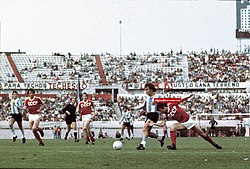
After being runners up at Euro 1972, the rest of the 1970s were bleak for the Soviets, who were disqualified from the 1974 World Cup as a result of a refusal to play Chile in the aftermath of the 1973 Chilean coup d'état and failed to qualify for the 1978 World Cup or the 1976 and 1980 European Championships.
Beskov recovers the team

The 1982 World Cup was the Soviet Union's first major tournament appearance for a decade. The Soviet Union was in Group 6 with Brazil, Scotland, and New Zealand. Goals by Sócrates and Éder Aleixo marked the defeat of the Soviet side against Brazil in the first group match and they were eventually eliminated in the second round by finishing the group in second place when they defeated Belgium only 1–0 and drew against Poland with an 0–0 results. In 1984, the Soviets again failed to qualify for the European Championships, but succeeded in qualifying for the 1986 World Cup. The Soviet Union was in Group C with Hungary, France, and Canada. The Soviets used Irapuato, Guanajuato as their training ground in the World Cup.
The Soviet team enjoyed a successful group stage by scoring nine goals and finishing the group in first place. Ultimately, however, they lost to Belgium 3–4 after extra time in the round of 16. Despite their poor performance in the cup, this team was the best scoring Soviet team in World Cup history, with 12 goals.
Lobanovsky era and demise of Soviet Union
After failing to qualify for three consecutive European Cups (1976, 1980, 1984), the Soviets managed to qualify for the 1988 competition, the last time the Soviet Union national football team took part in the European Football Championship. The finals were held in West Germany, with eight teams participating. Soviet Union finished Group B as leaders above the Netherlands and defeated Italy 2–0 in the semi-final. In the final against the Netherlands, another team from Group B, the Netherlands avenged their group stage defeat, winning by a score of 2–0 to be crowned European champions.
The final major championship contested by the Soviet team was the 1990 FIFA World Cup, where they were drawn in Group B with Argentina, Romania and Cameroon. The only success for the Soviets came when they defeated group leaders Cameroon 4–0. The Soviets lost their other matches and failed to qualify from the group, the only time in their World Cup history this happened. The Soviet Union qualified for Euro 1992, but the breakup of the Soviet Union meant that their place was instead taken by the CIS national football team, composed of newly independent Soviet republics. After the tournament, the former Soviet republics competed as separate independent nations, with FIFA allocating the Soviet team's record to Russia.
Kit evolution

The Soviet Union traditionally wore red jerseys with white shorts and red socks.
Home stadium
From the Soviet Union's first fixture (16 November 1924 vs. Turkey) they played their home games at various stadiums.
| Venue | City | Played | Won | Drawn | Lost | GF | GA | Points per game | |
|---|---|---|---|---|---|---|---|---|---|
| Central Lenin Stadium | Moscow | 1956–1992 | 78 | 50 | 18 | 10 | 151 | 50 | 2.15 |
| Central Stadium | Kiev | 1969–1990 | 12 | 10 | 1 | 1 | 27 | 6 | 2.58 |
| Lenin Dynamo Stadium | Tbilisi | 1967–1987 | 10 | 6 | 1 | 3 | 19 | 9 | 1.9 |
| Dynamo Stadium | Moscow | 1954–1971 | 9 | 7 | 2 | 0 | 41 | 8 | 2.56 |
| Lokomotiv Stadium | Simferopol | 1979–1989 | 4 | 4 | 0 | 0 | 11 | 1 | 3 |
| Kirov Stadium | Leningrad | 1967–1984 | 3 | 3 | 0 | 0 | 8 | 1 | 3 |
| Hrazdan Stadium | Yerevan | 1978 | 2 | 2 | 0 | 0 | 12 | 2 | 3 |
| Central Lokomotiv Stadium | Moscow | 1979–1988 | 2 | 2 | 0 | 0 | 5 | 1 | 3 |
| Central Stadium | Volgograd | 1977 | 1 | 1 | 0 | 0 | 4 | 1 | 3 |
| Pakhtakor Central Stadium | Tashkent | 1975 | 1 | 1 | 0 | 0 | 2 | 1 | 3 |
| Vorovsky Stadium | Moscow | 1924 | 1 | 1 | 0 | 0 | 3 | 0 | 0 |
| Black Sea Shipping Stadium | Odessa | 1974 | 1 | 0 | 0 | 1 | 0 | 1 | 0 |
| Totals | 1924–1992 | 123 | 86 | 22 | 15 | 281 | 80 | 2.28 |
Statistics include official FIFA-recognised matches only.
Note:
- Although never used by either the Soviet Union national football team nor Soviet Union Olympic football team, Dinamo Stadium in Minsk was designated as the official stadium for the 1980 Summer Olympics.
Coaching history
Notes:
- The game that took place on 21 November 1973 between the national team of Chile and missing side did not go on record of Yevgeny Goryansky.
- The 1980 USSR Olympic roster (coach – Beskov) was identical with the senior team that competed in qualification tournaments in 1979–1981.
- In 1985–1989 the national team competed in the annual Nehru Cup (India).
- The 1st coaching staff consisted of Valeriy Lobanovsky (leading), Yuri Morozov and Sergei Mosyagin.
- The 2nd coaching staff consisted of Anatoly Byshovets (leading), Vladimir Salkov and Gadzhi Gadzhiyev.
Player records

| Rank | Player | Caps | Goals | Career |
|---|---|---|---|---|
| 1 | Oleg Blokhin | 112 | 42 | 1972–1988 |
| 2 | Rinat Dasayev | 91 | 0 | 1979–1990 |
| 3 | Albert Shesternev | 90 | 0 | 1961–1971 |
| 4 | Anatoliy Demyanenko | 80 | 6 | 1981–1990 |
| 5 | Volodymyr Bezsonov | 79 | 4 | 1977–1990 |
| 6 | Lev Yashin | 78 | 0 | 1954–1967 |
| 7 | Sergei Aleinikov | 77 | 6 | 1984–1991 |
| 8 | Murtaz Khurtsilava | 69 | 6 | 1965–1973 |
| 9 | Oleg Protasov | 68 | 28 | 1984–1991 |
| 10 | Valeriy Voronin | 66 | 5 | 1960–1968 |
| Rank | Player | Goals | Caps | Ratio | Career |
|---|---|---|---|---|---|
| 1 | Oleg Blokhin | 42 | 112 | 0.38 | 1972–1988 |
| 2 | Oleg Protasov | 29 | 68 | 0.43 | 1984–1991 |
| 3 | Valentin Ivanov | 26 | 59 | 0.44 | 1956–1965 |
| 4 | Eduard Streltsov | 25 | 38 | 0.66 | 1955–1968 |
| 5 | Viktor Kolotov | 22 | 55 | 0.4 | 1970–1978 |
| 6 | Viktor Ponedelnik | 20 | 29 | 0.69 | 1960–1966 |
| Igor Chislenko | 20 | 53 | 0.38 | 1959–1968 | |
| 8 | Anatoliy Banishevskiy | 19 | 50 | 0.38 | 1965–1972 |
| 9 | Anatoliy Ilyin | 16 | 31 | 0.52 | 1952–1959 |
| 10 | Anatoliy Byshovets | 15 | 39 | 0.38 | 1966–1972 |
Competitive record
FIFA World Cup record
Champions Runners-up Third place Fourth place
| FIFA World Cup record | Qualification Record | ||||||||||||||
|---|---|---|---|---|---|---|---|---|---|---|---|---|---|---|---|
| Year | Round | Position | Pld | W | D | L | GF | GA | Squads | Pld | W | D | L | GF | GA |
| Uruguay 1930 | Not a FIFA member | Not a FIFA member | |||||||||||||
| Italy 1934 | |||||||||||||||
| France 1938 | |||||||||||||||
| Brazil 1950 | Did not enter | Did not enter | |||||||||||||
| Switzerland 1954 | |||||||||||||||
| Sweden 1958 | Quarter-final | 7th | 5 | 2 | 1 | 2 | 5 | 6 | Squad | 5 | 4 | 0 | 1 | 18 | 3 |
| Chile 1962 | Quarter-final | 6th | 4 | 2 | 1 | 1 | 9 | 7 | Squad | 4 | 4 | 0 | 0 | 11 | 3 |
| England 1966 | Fourth place | 4th | 6 | 4 | 0 | 2 | 10 | 6 | Squad | 6 | 5 | 0 | 1 | 19 | 6 |
| Mexico 1970 | Quarter-final | 5th | 4 | 2 | 1 | 1 | 6 | 2 | Squad | 4 | 3 | 1 | 0 | 8 | 1 |
| West Germany 1974 | Did not qualify | 6 | 3 | 1 | 2 | 5 | 4 | ||||||||
| Argentina 1978 | 4 | 2 | 0 | 2 | 5 | 3 | |||||||||
| Spain 1982 | Second Group stage | 7th | 5 | 2 | 2 | 1 | 7 | 4 | Squad | 8 | 6 | 2 | 0 | 20 | 2 |
| Mexico 1986 | Round of 16 | 10th | 4 | 2 | 1 | 1 | 12 | 5 | Squad | 8 | 4 | 2 | 2 | 13 | 8 |
| Italy 1990 | Group stage | 17th | 3 | 1 | 0 | 2 | 4 | 4 | Squad | 8 | 4 | 3 | 1 | 11 | 4 |
| Total | Fourth place | 7/14 | 31 | 15 | 6 | 10 | 53 | 34 | — | 53 | 35 | 9 | 9 | 110 | 34 |
UEFA European Championship record
Champions Runners-up Third Place Fourth Place
| UEFA European Championship record | Qualification Record | ||||||||||||||
|---|---|---|---|---|---|---|---|---|---|---|---|---|---|---|---|
| Year | Round | Position | Pld | W | D | L | GF | GA | Squads | Pld | W | D | L | GF | GA |
| France 1960 | Champions | 1st | 2 | 2 | 0 | 0 | 5 | 1 | Squad | 2 | 2 | 0 | 0 | 4 | 1 |
| Spain 1964 | Runners-up | 2nd | 2 | 1 | 0 | 1 | 4 | 2 | Squad | 4 | 2 | 2 | 0 | 7 | 3 |
| Italy 1968 | Fourth place | 4th | 2 | 0 | 1 | 1 | 0 | 2 | Squad | 8 | 6 | 0 | 2 | 19 | 8 |
| Belgium 1972 | Runners-up | 2nd | 2 | 1 | 0 | 1 | 1 | 3 | Squad | 8 | 5 | 3 | 0 | 16 | 4 |
| Socialist Federal Republic of Yugoslavia 1976 | Did not qualify | 8 | 4 | 1 | 3 | 12 | 10 | ||||||||
| Italy 1980 | 6 | 1 | 3 | 2 | 7 | 8 | |||||||||
| France 1984 | 6 | 4 | 1 | 1 | 11 | 2 | |||||||||
| West Germany 1988 | Runners-up | 2nd | 5 | 3 | 1 | 1 | 7 | 4 | Squad | 8 | 5 | 3 | 0 | 14 | 3 |
| Sweden 1992 | Qualified, but dissolved and replaced by CIS national football team | 8 | 5 | 3 | 0 | 13 | 2 | ||||||||
| Total | 1 title | 5/8 | 13 | 7 | 2 | 4 | 17 | 12 | — | 58 | 34 | 16 | 8 | 103 | 41 |
Summer Olympics record
| Olympic record | |||||||||
|---|---|---|---|---|---|---|---|---|---|
| Year | Round | Position | Pld | W | D | L | GF | GA | Squads |
| 1896–1912 | Preceded with Russian Empire | ||||||||
| 1920–1948 | Did not enter | ||||||||
| Finland 1952 | Round 1 | 14th | 3 | 1 | 1 | 1 | 8 | 9 | Squad |
| Australia 1956 | Gold medalists | 1st | 5 | 4 | 1 | 0 | 9 | 2 | Squad |
| Italy 1960 | Did not qualify | ||||||||
| Japan 1964 | |||||||||
| Mexico 1968 | |||||||||
| West Germany 1972 | Bronze medalists | 3rd | 7 | 5 | 1 | 1 | 17 | 6 | Squad |
| Canada 1976 | Bronze medalists | 3rd | 5 | 4 | 0 | 1 | 10 | 4 | Squad |
| Soviet Union 1980 | Bronze medalists | 3rd | 6 | 5 | 0 | 1 | 19 | 3 | Squad |
| United States 1984 | Did not enter | ||||||||
| South Korea 1988 | Gold medalists | 1st | 6 | 5 | 1 | 0 | 14 | 4 | Squad |
| Total | Gold medalists | 4/20 | 32 | 24 | 4 | 4 | 77 | 28 | — |
Honours
Global
Continental
- UEFA European Championship Champions (1): 1960 Runners-up (3): 1964, 1972, 1988
Friendly
- Nehru Cup Champions (1): 1985
Awards
- Gazzetta Sports World Team of the Year: 1979
Summary
| Competition | Total | |||
|---|---|---|---|---|
| FIFA World Cup | 0 | 0 | 0 | 0 |
| Olympic Games | 2 | 0 | 3 | 5 |
| UEFA European Championship | 1 | 3 | 0 | 4 |
| Total | 3 | 3 | 3 | 9 |
See also
- Russia national football team
- CIS national football team
- Soviet Union national under-21 football team
- Soviet Union national under-18 football team
- Soviet Union national under-16 football team
- Soviet Union women's national football team
- Soviet Union national football team all-time record
Notes
External links
| Preceded byInaugural champions | European champions 1960 (first title) | Succeeded by1964 Spain |