Sydney Trains
In-game article clicks load inline without leaving the challenge.
Sydney Trains is the brand name and operator of suburban and intercity train services in and around Greater Sydney in New South Wales, Australia.
The inner part of the network is a suburban rail system with a central underground core. It covers 369 km (229 mi) of route length over 919 km (571 mi) of track, with 169 stations on nine lines.
Sydney Trains also operates the NSW intercity train network, with regional electric and diesel services reaching farther away destinations, including Newcastle, Bathurst, Goulburn, Bomaderry, Scone, and Dungog
The suburban network has frequencies of 5–10 minutes at peak-time at most inner-city and major stations, and 15 minutes off-peak at most minor stations. During the weekday peak, train services are more frequent. Frequencies on the intercity network vary by line, but they generally run at least four trains per direction in the peak hour, and at least one train per hour in off-peak times.
Nearly all rolling stock consists of double-deck electric multiple unit trains, but some single-deck diesel multiple units are run on the intercity network.
Sydney trains are labelled with a "T" on station signs and timetables. Additionally, each suburban service is given a number 1 through 9 (T1, T2, etc.). Intercity services are sometimes shown with three-letter abbreviations.
The network is managed by Transport for NSW and is integrated with its Opal ticketing system. In 2024–25, 270 million passenger journeys were made on the suburban network, making it the most-used rail network in Australia.
History
In May 2012, the Minister for Transport announced a restructure of RailCorp, the organisation that owned and managed the suburban rail network and operated passenger services throughout New South Wales. Two new organisations were created to take over the operation of the services from July 2013. Sydney Trains acquired all suburban services in the Sydney metropolitan area bounded by Berowra, Emu Plains, Macarthur and Waterfall from RailCorp's CityRail division. Intercity and regional train services previously operated by CityRail were taken over by NSW Trains, branded as NSW TrainLink.
RailCorp remained the owner of the network infrastructure. When first created as subsidiaries of RailCorp, Sydney Trains and NSW Trains were not controlled entities of RailCorp, but were instead controlled by Transport for NSW. They later ceased to be subsidiaries of RailCorp, becoming independent standalone agencies in July 2017.
Network changes
Sydney trains began operation with 11 lines, just on the suburban network. This was nominally reduced to 7 lines following a reorganization in the October 2013 timetable.
In 2015, the first expansion of the Sydney suburban network after the restructuring of CityRail into Sydney Trains occurred when the South West Rail Link opened between Glenfield and Leppington.
In November 2017, an eighth line was created by splitting the T2 line into two separate lines — T2 and T8 — reversing their merger in 2013. Additionally, T5 services no longer travelled to Campbelltown, instead starting and terminating at Leppington.
In September 2018, the Epping to Chatswood Rail Link between Chatswood and Epping was closed for conversion to form part of the Sydney Metro Northwest project, which opened as the Metro North West Line in May 2019.
In April 2019, the section of the T1 line between Gordon and Hornsby via Strathfield was renumbered as T9 — restoring a similar pre-2009 route. The portion between Berowra and Richmond or Emu Plains via Chatswood and Parramatta remained as T1.
In January 2020, the Carlingford Line between Clyde and Carlingford closed, becoming part of the Parramatta Light Rail network in December 2024. The adjacent section of track between Clyde and Camellia, including Rosehill railway station, became disused.
In August 2023, it was announced that the majority of NSW TrainLink's intercity operations would be transferred to Sydney Trains, including rolling stock, maintenance, operations, stations, and staff. This would include the modifications, testing, and introduction of the New Intercity Fleet (NIF). This process was completed by July 2024
In October 2024, the T6 Line became the Bankstown to Lidcombe shuttle (Lidcombe & Bankstown Line), with commuters interchanging at Regents Park or Lidcombe for connecting services to Liverpool or City Circle.
The section of the Bankstown Line between Sydenham and Bankstown will form part of Sydney Metro City & Southwest project, which is due to open as the Metro North West & Bankstown Line in 2026.
Operations
Suburban network

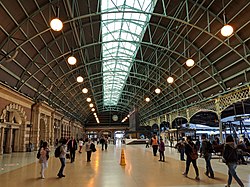
Sydney Trains operates nine electric suburban lines across Sydney. All lines are electrified at 1,500 volt DC overhead.
The main hub of the Sydney Trains system is Central Station, which most lines pass through. Central is also the terminus of most NSW TrainLink lines. After leaving Central, trains coming from the T2 Leppington & Inner West Line, T3 Liverpool and Inner West Line and T8 Airport & South Line then travel through the City Circle – a ring line beneath the Sydney central business district.
After completing the City Circle, these trains pass through Central for a second time and return to the suburbs. The T1 North Shore & Western, T4 Eastern Suburbs & Illawarra and T9 Northern lines pass through the central business district and continue to other areas of Sydney.
The T5 Cumberland Line serves Western Sydney and provides access to the major centre of Parramatta from the southwest of the city without requiring a change of trains at Granville. The T6 Lidcombe & Bankstown Line, and the T7 Olympic Park Line are suburban shuttle services.[citation needed]
Lines
| Line colour, number and name | Between | |
|---|---|---|
| T1 | North Shore & Western Line | Berowra and Emu Plains or Richmond. |
| T2 | Leppington & Inner West Line | City Circle and Parramatta or Leppington via Granville. |
| T3 | Liverpool & Inner West Line | City Circle and Liverpool via Lidcombe and Regents Park. |
| T4 | Eastern Suburbs & Illawarra Line | Bondi Junction and Waterfall or Cronulla via Central. |
| T5 | Cumberland Line | Schofields and Leppington. Limited services continue from Schofields to Richmond. |
| T6 | Lidcombe & Bankstown Line | Bankstown and Lidcombe |
| T7 | Olympic Park Line | Lidcombe and Olympic Park. Some services operate between Central and Olympic Park, particularly during special events, such as the Sydney Royal Easter Show. |
| T8 | Airport & South Line | City Circle and Macarthur via Revesby and either Sydenham (peak) or Airport |
| T9 | Northern Line | Hornsby and Gordon via Strathfield and City |
Rolling stock
Sydney Trains operates a fleet of double-deck electric multiple units. The trainsets are divided into the following classes:
| Class | Image | Type | Service speed | Carriages | Entered service | Formation | Routes | |
|---|---|---|---|---|---|---|---|---|
| km/h | mph | |||||||
| K sets | Electric multiple unit | 115 | 71 | 160 | 1981–1985 | 8 cars | T2T3T8 | |
| T sets | 115 | 71 | 447 | 1988–1995 | T1T2T4T5T8T9 | |||
| M sets | 130 | 81 | 140 | 2002–2005 | T2T3T5T6T7T8 | |||
| H sets | 130 | 81 | 220 | 2006–2012 | T1T4T9 | |||
| A sets | 130 | 81 | 626 | 2011–2014 | T1T2T3T5T7T8T9 | |||
| B sets | 130 | 81 | 328 | 2018–2021 | T1T2T3T7T8T9 |
Though primarily operated on intercity lines, some H sets are also used on suburban services. With the delivery of the D sets for operations on intercity lines in 2024, most of the sets will be transferred to suburban services.[citation needed]
Intercity network


Sydney Trains also operate intercity services to a distance approximately 200 kilometres (124 mi) from Sydney, bounded by Dungog in the north, Scone in the north-west, Bathurst to the west, Goulburn in the south-west and Bomaderry to the south.
Electric services extend from Sydney north to Newcastle, west to Lithgow and south to Port Kembla and Kiama. Most electric services originate from or terminate at Central.[citation needed]
Diesel trains serve the more distant or less populated parts of the Intercity network. Hunter Line services operate from Newcastle to Telarah with some extending to Dungog and Scone. Southern Highlands Line services operate between Campbelltown and Moss Vale with a limited number extending to Sydney and Goulburn. Diesel services operate on the South Coast Line between Kiama and Bomaderry. The Bathurst Bullet provides a twice daily, limited stop service between Sydney and Bathurst.[citation needed]
Lines
| Line colour and name | Between | Electric services | Map |
|---|---|---|---|
| Blue Mountains Line | Central and Lithgow with limited services to Bathurst | to Lithgow | |
| Central Coast & Newcastle Line | Central and Newcastle | ||
| Hunter Line | Newcastle and Telarah with limited services to Dungog or Scone | — | |
| South Coast Line | Centrala and Bomaderry or Port Kembla | to Kiama and Port Kembla | |
| Southern Highlands Line | Campbelltownb and Moss Vale with limited services to Goulburn | — |
^a Some peak services and most weekend services on the South Coast Line run to/from Bondi Junction
^b Some peak services on the Southern Highlands Line run to/from Central. At other times, a change of train is required at Campbelltown
Rolling stock
| Class | Image | Type | Service speed | Carriages | Lines | Built | |
|---|---|---|---|---|---|---|---|
| km/h | mph | ||||||
| Endeavour railcar | Diesel multiple unit | 145 | 90 | 28 | Blue Mountains Line (Bathurst Bullet and between Lithgow and Bathurst)Hunter Line South Coast Line (between Kiama and Bomaderry) Southern Highlands Line | 1994–1996 | |
| Hunter railcar | 14 | Hunter Line | 2006–2007 | ||||
| H set | Electric multiple unit | 130 | 81 | 221 (being converted to suburban trains) | South Coast Line Central Coast & Newcastle Line (Some peak hour services via the North Shore) | 2006–2012 | |
| D set | 610 (being built) | Central Coast & Newcastle Line Blue Mountains Line South Coast Line | 2019–2024 |
Future rolling stock
| Class | Image | Type | Service Speed | Carriages | Lines | Built | |
|---|---|---|---|---|---|---|---|
| km/h | mph | ||||||
| R set | Bi-mode multiple unit | 160 | 99 | 117 (to be built) | Blue Mountains Line (Bathurst Bullet and between Lithgow and Bathurst)South Coast Line (between Kiama and Bomaderry)Southern Highlands Line | 2020–present |
A fleet of 610 D set carriages will be introduced to the intercity network. They will replace the V sets and allow the H sets to be transferred to suburban services. The first was delivered in December 2019. The D sets will be maintained at a new facility at Kangy Angy. The R sets will run on the entirety of the regional rail network.
A fleet of 30 R Set carriages are being built to replace the Endeavour railcar used on the non-electrified sections of the network. They are expected to enter service in 2026–2027. The R sets will be maintained at a new facility in Dubbo.[citation needed]
NightRide
NightRide bus services replace suburban trains between midnight and 4:30 am, leaving the tracks clear of trains for maintenance work. Such bus services mainly stop near stations, operating typically at hourly intervals. Some routes depart more frequently on weekends. Many services depart the city from bus stops near Town Hall station. NightRide services are contracted to external bus operators and are identified by route numbers beginning with "N".[citation needed]
Maintenance
In addition to operating suburban train services, Sydney Trains maintains the New South Wales Metropolitan Rail Area and maintains all but a handful of operational railway stations in the state.[citation needed]
The Sydney Trains network is divided into three sectors, based around three maintenance depots. Trainsets are identified by target plates, which are exhibited on the front lower nearside of driving carriages.[not specific enough to verify] Each target plate includes the letter of the class the set belongs to and the number of the individual set. Waratahs do not have a target plate, having the information written directly on the front of the train. The composition and formations of train sets and the target designations are subject to alteration. M sets and H sets carry green target plates.[citation needed]
All A, B and M sets are maintained by Downer Rail. From June 2017, their contract for the M sets was extended by 10 years. All other types of trains including the V and H sets are maintained by UGL Unipart. The contract with UGL Unipart was extended for two years from July 2019.
| Sector # | Depot | Serviced lines | Target plate | Sets being maintained |
|---|---|---|---|---|
| 1 | Mortdale | T4 Eastern Suburbs & Illawarra Line Intercity services on the South Coast Line | Red (T) | T, H |
| Green (H) | ||||
| 2 | Flemington | T2 Inner West & Leppington, T3 Bankstown, T5 Cumberland, T7 Olympic Park and T8 Airport & South Lines Intercity services on Blue Mountains Line (V sets only) | Blue | K, V |
| 3 | Hornsby | T1 North Shore & Western and T9 Northern Lines Intercity services on the Central Coast & Newcastle Line (H sets only) | Black (T) | T, H, A |
| Green (H) | ||||
| —N/a | Auburn Maintrain | UGL Unipart carry out maintenance at the various depots to which the trains are allocated but major work may be carried out at Auburn Maintrain. | —N/a | All except A, B and M |
| Auburn | All A, B and M sets are stabled at the depot for the sector in which they operate but are maintained at Auburn by Downer Rail. | Stickers only (A, B) | A, B, M | |
| Green (M) |
Quiet carriages
Quiet carriages are designated carriages where noise made by passengers is requested to be kept to a minimum. Passengers are asked to place mobile phones on silent, move carriages in order to have a conversation with another passenger and use headphones when listening to music.
Quiet carriages are on Intercity services are located in four carriages on eight car sets, two carriages on four car sets and one carriage on two car sets.
Quiet carriages were introduced on the Central Coast & Newcastle Line in early 2012 as a three-month trial. In September 2012, quiet carriages were permanently introduced and expanded to all intercity services operating on the Blue Mountains and South Coast Line.
Performance
Punctuality
Intercity services are considered on-time if they operate within six minutes of their scheduled time. The target is for 92 percent of services to operate on-time.
| Network | Year | |||||||
|---|---|---|---|---|---|---|---|---|
| 2019 | 2020 | 2021 | 2022 | 2023 | 2024 | 2025 | 2026 | |
| Suburban | 91.3% | 92.5% | 95.0% | 92.1% | 85.1% | 88.8% | 84.0% | 91.0% |
| Intercity | 88.9% | 86.2% | 88.5% | 85.4% | 78.2% | 80.3% | 70.5% | 76.5% |
Patronage

The following table lists patronage figures for the network during the corresponding year.
| Network | Year | ||||||
|---|---|---|---|---|---|---|---|
| 2019 | 2020 | 2021 | 2022 | 2023 | 2024 | 2025 | |
| Suburban | 362.2 | 186.6 | 147.3 | 191.3 | 265.3 | 292.1 | 266.5 |
| Intercity | 41.0 | 20.0 | 15.7 | 18.8 | 27.7 | 29.0 | 26.3 |
| T1 | 79,614,028 | |
| T2 | 57,130,048 | |
| T3 | 16,358,380 | |
| T4 | 63,204,024 | |
| T5 | 7,724,243 | |
| T6 | 1,355,008 | |
| T7 | 2,546,800 | |
| T8 | 52,668,568 | |
| T9 | 37,085,826 |
| Mode | Patronage | % of total |
|---|---|---|
| Sydney Metro Metro | 63,708,783 | 10.26 |
| Sydney Trains Train | 272,792,709 | 43.91 |
| Buses in Sydney Bus | 224,926,815 | 36.21 |
| Sydney Ferries Ferry | 17,165,666 | 2.76 |
| Light rail in Sydney Light rail | 42,600,487 | 6.86 |
| Total | 621,194,460 | 100.00 |
The following table shows the patronage of each line of the NSW TrainLink Intercity network for the year ending 30 June 2025, based on Opal tap on and tap off data.
| Blue Mountains Line | 6,482,450 |
| Central Coast & Newcastle Line | 12,051,510 |
| Hunter Line | 778,193 |
| South Coast Line | 7,155,584 |
| Southern Highlands Line | 515,035 |
Ticketing and costs

Sydney Trains uses the Opal card ticketing system, which was introduced in April 2014, replacing an earlier magnetic stripe ticketing system. Passengers pay by tapping on at their origin, and tapping off at their destination. The fare system is fully integrated – trips involving suburban, metro and intercity services are calculated as a single fare and there is no interchange penalty. Students who use the Sydney Trains network to get to and from schools can apply for a free school Opal card. Opal is valid on bus, ferry, and light rail services. Separate fares apply for these modes. The following table lists Opal fares for reusable smartcards and single-trip tickets:
| vte As of 14 July 2025 | 0–10 km | 10–20 km | 20–35 km | 35–65 km | 65 km+ |
|---|---|---|---|---|---|
| Adult cards & contactless (peak) | $4.33 | $5.38 | $6.20 | $8.28 | $10.66 |
| Adult cards & contactless (off-peak) | $3.03 | $3.76 | $4.34 | $5.79 | $7.46 |
| Other cards (peak) | $2.16 | $2.69^ | $3.10^ | $4.14^ | $5.33^ |
| Other cards (off-peak) | $1.51 | $1.88 | $2.17 | $2.89^ | $3.73^ |
| Adult single trip | $5.20 | $6.50 | $7.40 | $9.90 | $12.80 |
| Child/Youth single trip | $2.60 | $3.20 | $3.70 | $4.80 | $6.40 |
^ = $2.50 for Senior/Pensioner cardholders
A surcharge is levied when using the two privately operated stations serving Sydney Airport:
| vte As of 14 July 2025 | Adult cards | Other cards |
|---|---|---|
| Domestic or International Airport to/from all other stations | $17.92 | $16.03 |
| Domestic or International Airport to/from Green Square | $12.05 | $12.05 |
| Domestic or International Airport to/from Mascot | $9.65 | $9.65 |
| Domestic to/from International | $5.00 | $5.00 |
As there are no return or periodical options available, reusable Opal cards include several caps to reduce the cost for frequent travellers:
| vte As of 14 July 2025 | Adult cards | Other concession cards | Senior/pensioner cards |
|---|---|---|---|
| Daily Monday–Thursday | $19.30 | $9.65 | $2.50 |
| Daily Friday, Saturday and Sunday | $9.65 | $4.80 | $2.50 |
| Weekly | $50.00 | $25.00 | $17.50 |
| Weekly airport station access fee | $36.36 | $32.58 | $32.58 |
See also
- Commuter rail in Australia
- NSW TrainLink
- Railways in Sydney List of Sydney Trains railway stations Proposed railways in Sydney Sydney Metro
Further reading
- Churchman, Geoffrey B. (1995). Railway Electrification in Australia and New Zealand. Sydney & Wellington: IPL Books. pp. 78–105. ISBN 0-908876-79-3.
External links
| Preceded byCityRail | Operator of Sydney's suburban rail network 2013–present | Incumbent |