Nagoya Grampus
In-game article clicks load inline without leaving the challenge.
Nagoya Grampus, formerly known as Nagoya Grampus Eight, is a Japanese association football club based in Nagoya, Aichi. The club plays in the J1 League, and has been in the league for all but one season since the league's inauguration, following promotion from the J2 League in 2017.
It was founded as the company team of the Toyota Motor Corp. in 1939, the club shared its home games between Mizuho Athletic Stadium (capacity 27,000 and the J.League's oldest serving stadium) and the much larger Toyota Stadium in the city of Toyota (capacity 45,000).
Nagoya Grampus had its most successful season up to 1996 when it was managed by Arsène Wenger, well known for his subsequent exploits at Arsenal. They won the Emperor's Cup and finished second in the J.League, with their FR Yugoslavia captain Dragan Stojković being named J.League MVP. The 1995 success was eclipsed on November 20, 2010, when the club won its first J.League trophy, under the management of Stojković.
The club's name was derived from two prominent symbols of Nagoya. The first is the shachihoko (tiger-headed carp) statues atop Nagoya Castle, also called shachi; this word is a homophone with the Japanese word for orca, a species formerly referred to as "grampus". The second is the maru-hachi (circle-eight), Nagoya's official emblem. The team's mascot is Grampus-kun, an orca.
Nagoya Grampus have won 1 J1 League, 2 Emperor's Cup, 2 J.League Cup and 2 Japanese Super Cup in the club history.
History
Early years as Toyota Motor SC (1939–1991)
The club was founded as Toyota Motor Soccer Club, the company team of the automobile manufacturer Toyota. During the early decades of Japanese corporate football, the team competed mainly in regional competitions and company leagues. Toyota Motor SC was overshadowed by its colleague Toyota Automated Loom Works SC (founded in 1946 and which was one of the founding members of the Japan Soccer League). When Toyota ALW were relegated to regional leagues in 1968, Toyota Motor saw an opportunity to rise at their expense.
In 1972, Toyota Motor SC was one of the founding members of the JSL's Second Division and its inaugural champions. They remained in the JSL until the J.League's founding in 1993. They were relegated to the JSL Division 2 in 1977.
Toyota Motor SC returned to the top tier after finishing as runners-up in the 1989–90 season. As Japanese football prepared to transition into professionalism, the club underwent restructuring and in 1990 adopted the name 'Nagoya Grampus Eight', reflecting its connection to the city of Nagoya and local cultural symbols. The name “Grampus” refers to the golden shachihoko (often interpreted as dolphin-like creatures) that decorate the roof of Nagoya Castle, while “Eight” derives from the stylised symbol of Nagoya city, which resembles the character for the number eight.
Founding member of the J.League (1992–1999)
Nagoya Grampus Eight was an original member ("Original Ten") of the J.League in 1993. The club initially struggled in the early years of the new professional era, finishing near the bottom of the league standings in 1993 and 1994.
However in 1995, Nagoya Grampus Eight fortunes improved dramatically following the appointment of future Arsenal manager Arsène Wenger led Grampus to the 1995 Emperor's Cup final defeating Sanfrecce Hiroshima 3–0 winning their first major silverware in the club history and also finishing as the J1 League runnners-up in the 1995 season.
In 1999, Nagoya Grampus Eight then continued to establish itself as a competitive club by winning the 1999 Emperor’s Cup defeating Sanfrecce Hiroshima 2–0.
Consolidation and rebuilding (2000–2007)
During the early 2000s, Nagoya Grampus Eight remained a regular participant in the top division but struggled to consistently challenge for major titles. The club maintained a stable presence in the J.League with notable players such as Seigo Narazaki, who became one of the most prominent goalkeepers in Japanese football.
Despite occasional strong league finishes, Nagoya Grampus Eight experienced a downturn in the mid-2000s, finishing 14th in the 2005 season. This prompted a rebuilding period aimed at returning the club to competitiveness.
League champions under Dragan Stojković (2008–2013)
A new era began in 2008 where the club's name "Nagoya Grampus Eight" was shorten to just "Nagoya Grampus" at the start of the 2008 season. Nagoya Grampus then started off the season appointing former player Dragan Stojković as manager. Under his leadership, Nagoya adopted a more attacking style of play and quickly improved its league performances. They finished in third place in the 2008 season and qualified for the AFC Champions League for the first time.
In the 2009 AFC Champions League, Nagoya Grampus was drawn in Group E alongside Australian club Newcastle Jets, Korean club Ulsan Hyundai and Chinese club Beijing Guoan. The club then went to top the group stage with 12 points thus advancing to the knockout stage. In the round of 16, Nagoya Grampus face against another Korean club Suwon Samsung Bluewings winning them 2–1 thus advancing to the quarter-finals facing off Kawasaki Frontale. Both team was leveled 3–3 on aggregate where Joshua Kennedy went on to scored in the 88th minute to put Nagoya Grampus 4–3 on aggregate seeing them advanced to the semi-finals. However, Nagoya Grampus ended up losing 8–3 on aggregate to Saudi Arabian club Al-Ittihad thus bowing out from the competition.
First top flight league title
Nagoya Grampus reached the peak of its history in the 2010 season when it won its first top flight league title. Stojković has since led the club to winning the J1 League, featuring a squad consisting of Marcus Tulio Tanaka, Mu Kanazaki, Seigo Narazaki, Yoshizumi Ogawa, Keiji Tamada and Joshua Kennedy. Joshua Kennedy went on to finished as the league’s top-joint goalscorer with 17 goals alongside Júbilo Iwata player Ryoichi Maeda. The victory was followed by further success in 2011, when Nagoya won the 2011 Japanese Super Cup, defeating Kashima Antlers 3–1 on penalties shootout.
Decline and managerial changes (2014–2015)
Following several competitive seasons, Nagoya Grampus entered a period of decline during the mid-2010s. After the departure of long-time manager Dragan Stojković at the end of the 2013 season, the club appointed Akira Nishino as head coach ahead of the 2014 season. During the 2014 season, Nagoya struggled with inconsistent form despite possessing experienced players. The club finished in the lower half of the table finishing in 10th place.
The difficulties continued in 2015 as Nagoya failed to significantly improve their league performance. The team again finished 10th in the league standings, and Nishino left the club at the end of the season after two years in charge. The period marked the beginning of a broader decline that ultimately culminated in the club’s relegation from the J1 League the following year.
Relegation and return (2016–2018)
After a poor 2016 season, Grampus were relegated to J2 League for the first time in their history. Boško Gjurovski left his post as manager. On 4 January 2017, Yahiro Kazama was appointed as the club's new manager. On 3 December 2017, Nagoya Grampus drew 0–0 against Avispa Fukuoka in the promotion play-offs final, securing promotion back to J1 League at the first time of asking due to their higher regular season position than Avispa Fukuoka.
Return to competitiveness and silverware (2019–pres ent )
After stabilising in the top flight following their 2017 promotion, Nagoya Grampus entered a period of rebuilding and gradual improvement from 2019 onward. On 23 September 2019, Massimo Ficcadenti was appointed as the club's new manager. In the 2020 season, Nagoya Grampus finished third in the J1 League, marking their highest league placement in nearly a decade and securing qualification for the 2021 AFC Champions League.

In the 2021 AFC Champions League, Nagoya Grampus was drawn in Group G alongside Korean club Pohang Steelers, Malaysian club Johor Darul Ta'zim and Thailand club Ratchaburi. Nagoya Grampus went on to have a good record in the group stage with 5 wins, 1 draw and 0 lost finishing with 16 points to top the group thus advancing to the knockout stage. Nagoya Grampus then face off against another Korean club Daegu in the round of 16 winning them 4–2 which Nagoya Grampus advance to the quarter-finals, however, they lost 3–0 to eventual finalist Pohang Steelers thus knocked out from the competition. Domestically in the same year, proved historic as Nagoya Grampus ended an 11-year trophy drought by winning the 2021 J.League Cup with Ficcadenti guiding the club to a 2–0 victory over Cerezo Osaka. However, Nagoya Grampus didn't renew a contract with Ficcadenti, and appointed Kenta Hasegawa as their new manager.
In subsequent seasons, the club has maintained a position near the top of the J1 League table, continuing to compete in domestic and continental competitions while emphasizing youth development and tactical consistency under the current managerial team.
The 2024 season marked Nagoya Grampus seventh consecutive year in the J1 League, continuing under manager Kenta Hasegawa. In the league, Nagoya Grampus finished in 11th place, ending the season with a mix of wins, draws, and losses as the team sought consistency in its domestic campaign. Nagoya Grampus’s J.League Cup campaign was significantly more successful. The club reached the final of the J.League Cup. Nagoya Grampus then went on to defeat Albirex Niigata 5–4 on penalties shootout to win the J.League Cup, securing their second J.League Cup in three years.
Team image
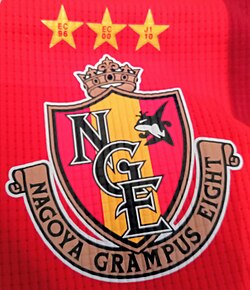
Crest
The redesign was unveiled Nagoya Grampus introduced a redesigned club crest ahead of the 2021 season, modernising the emblem while retaining the symbolic golden shachihoko associated with Nagoya Castle and the club’s identity. The modern crest also prominently features the letter 'G', representing “Grampus,” along with the club’s colours of red, gold, and black. These elements together reflect both the club’s competitive spirit and its heritage within Japanese football.
Supporters

Nagoya Grampus supporters are known for their passionate displays in the stands, often featuring coordinated chants, banners, and flag-waving during matches at Toyota Stadium and occasionally at Paloma Mizuho Stadium. Organised fan groups, such as the 'Red Sharks' and 'Ultras Grampus', play a central role in creating matchday atmosphere, including choreographed tifo displays and vocal support.
In popular culture
In the Captain Tsubasa manga series, one character was player of Nagoya Grampus and is the goalkeeper Ken Wakashimazu which was player of Yokohama Flügels before the closing of the Yokohama team. In 2013, the midfielder Shingo Aoi wear the Nagoya Grampus jersey in a Yoichi Takahashi tribute to the 20 years of J.League.
Stadium

Nagoya Grampus plays its home matches primarily at Toyota Stadium, located in Aichi Prefecture, Japan. Opened in 2001, the stadium has a seating capacity of approximately 45,000 and features a modern design with a retractable roof and natural grass pitch. It is one of the largest and most advanced football-specific stadiums in Japan, regularly hosting domestic league matches as well as international fixtures.
Before moving to Toyota Stadium, Nagoya Grampus used Paloma Mizuho Stadium in Nagoya as their home ground. Paloma Mizuho Stadium, which opened in 1941, is a multi-purpose venue with a capacity of around 27,000, and served as the club’s primary stadium during the early J.League years.
Nagoya occasionally uses Paloma Mizuho Stadium for special matches, including high-profile league games or when Toyota Stadium is unavailable to host a football match. The club also conducts training sessions and youth development programs at nearby facilities in Aichi Prefecture.
Kit suppliers and shirt sponsors
Sponsors
| Year | Kit manufacturer | Main sponsor |
|---|---|---|
| 1992 | France Le Coq Sportif | No main sponsor |
| 1993−1996 | Japan Mizuno | |
| 1997−2000 | France Le Coq Sportif | |
| 2001−2016 | Japan Toyota | |
| 2017−2020 | Japan Mizuno | |
| 2021 | Japan Toyota (home kit) Japan Yaris (away kit) | |
| 2022 | Japan Toyota (Yaris) | |
| 2023 | Japan Toyota (86) | |
| 2024−2025 | Japan Toyota (Yaris) | |
| 2026−present | Japan Toyota (Corolla) |
Kit evolution
| Home kit - 1st | ||||
|---|---|---|---|---|
| 1992 | 1993 | 1994 - 1996 | 1997 | 1998 |
| 1999 - 2000 | 2001 - 2002 | 2003 - 2004 | 2005 - 2006 | 2007 - 2008 |
| 2009 - 2010 | 2011 - 2012 | 2013 - 2014 | 2015 | 2016 |
| 2017 | 2018 | 2019 | 2020 | 2021 |
| 2022 | 2023 | 2024 | 2025 | 2026 - |
| Away kit - 2nd | ||||
|---|---|---|---|---|
| 1992 | 1993 | 1994 - 1996 | 1997 | 1998 |
| 1999 - 2000 | 2001 - 2002 | 2003 - 2004 | 2005 - 2006 | 2007 - 2008 |
| 2009 - 2010 | 2011 - 2012 | 2013 - 2014 | 2015 | 2016 |
| 2017 | 2018 | 2019 | 2020 | 2021 |
| 2022 | 2023 | 2024 | 2025 | 2026 - |
| Alternative Kits | ||||
|---|---|---|---|---|
| 2001 - 2002 3rd | 2011 1st ACL | 2012 1st ACL | 2012 20th Anniversary | 2013 20th Anniversary |
| 2014 Nagoya TV Tower 60th Anniversary | 2017 25th Anniversary | 2018 J.League 25th Anniversary | 2019 Shachi Festival | 2021 Shachi Festival |
| 2022 Great Celebration of Tai | 2023 Great Celebration of Tuna | 2024 Great Celebration of Tuna | 2025 Shachi Festival |
Affiliated clubs
On 25 November 2022, Nagoya Grampus sign partnership with Serie A club, AS Roma.
On 21 August 2025, Nagoya Grampus signed a similar partnership with Premier League club, Everton.
Players
First-team squad
As of 30 April 2026.
Note: Flags indicate national team as defined under FIFA eligibility rules; some limited exceptions apply. Players may hold more than one non-FIFA nationality.
Out on loan
Note: Flags indicate national team as defined under FIFA eligibility rules; some limited exceptions apply. Players may hold more than one non-FIFA nationality.
| No. | Pos. | Nation | Player |
|---|---|---|---|
| No. Pos. Nation Player — DF JPN Ei Gyotoku (at Nagano Parceiro) — MF JPN Gen Kato (at RB Omiya Ardija) — MF JPN Keiya Shiihashi (at Avispa Fukuoka) | No. Pos. Nation Player — FW JPN Ryōga Kida (at Argentina Argentinos Juniors) — MF JPN Ken Masui (at Belgium Beerschot) | ||
| — | DF | JPN | Ei Gyotoku (at Nagano Parceiro) |
| — | MF | JPN | Gen Kato (at RB Omiya Ardija) |
| — | MF | JPN | Keiya Shiihashi (at Avispa Fukuoka) |
| No. | Pos. | Nation | Player |
| — | FW | JPN | Ryōga Kida (at Argentina Argentinos Juniors) |
| — | MF | JPN | Ken Masui (at Belgium Beerschot) |
Management and staff
Club staff in 2026
| Position | Name |
|---|---|
| Manager | Serbia Mihailo Petrović |
| Head coach | Japan Kosuke Takeya |
| Coaches | Japan Tsuyoshi Yoshitake Japan Keiji Yoshimura |
| Analytical coach | Japan Ryosuke Sato Japan Shuta Tsukamoto |
| Goalkeeper coach | Japan Kazumasa Kawano |
| Assistant goalkeeper coach | Japan Seigo Narazaki |
| Performance coach | Japan Daisuke Uematsu |
| Physical coach | Japan Kaito Yamada |
| Chief doctor | Japan Shinya Ishizuka |
| Physiotherapist | Japan Masakazu Mizutani Japan Toru Fujii |
| Chief trainer | Japan Kento Fujita |
| Trainer | Japan Hiroki Kondo Japan Kohei Baba |
| Team side manager | Japan Minoru Mita |
| Side affairs | Japan Shinichi Kitano Japan Shinnosuke Ishizaka Japan Yasuhiro Tanigawa |
| Interpreter | Japan Kota Kurosu Japan Takashi Kurokawa South Korea Moon Keon-ho |
Honours
As Toyota Motor SC (1939–1991) and as Nagoya Grampus (1991–present)
| Type | Honours | Titles | Season |
|---|---|---|---|
| League | J1 League | 1 | 2010 |
| Japan Soccer League Division 2 | 1 | 1972 | |
| Cup | Emperor's Cup | 2 | 1995, 1999 |
| J.League Cup | 2 | 2021, 2024 | |
| Japanese Super Cup | 2 | 1996, 2011 | |
| All Japan Senior Football Championship | 2 | 1968, 1970 | |
| Konica Cup | 1 | 1991 | |
| Worldwide | Sanwa Bank Cup | 1 | 1997 |
Bold is for those competition that are currently active.
Record and statistics
As of 27 March 2026.
| Rank | Player | Years | Club appearance |
|---|---|---|---|
| 1 | Japan Seigo Narazaki | 1999–2018 | 660 |
| 2 | Japan Naoshi Nakamura | 2001–2014 | 442 |
| 3 | Japan Yoshizumi Ogawa | 2007–2016 | 375 |
| 4 | Japan Tetsuya Okayama | 1992–2004 | 353 |
| 5 | Japan Keiji Tamada | 2006–2014 | 351 |
| 6 | Japan Kensuke Nagai | 2011–2012, 2013–2016, 2022–present | 348 |
| 7 | Japan Takahiro Masukawa | 2005–2013 | 315 |
| 8 | Japan Shohei Abe | 2006–2013 | 295 |
| 9 | Japan Masahiro Koga | 1997–2006 | 288 |
| 10 | Japan Keiji Yoshimura | 2002–2012 | 287 |
| Rank | Player | Club appearance | Total goals |
|---|---|---|---|
| 1 | Brazil Ueslei | 151 | 100 |
| 2 | Japan Keiji Tamada | 351 | 89 |
| 3 | Japan Kensuke Nagai | 348 | 81 |
| 4 | Australia Joshua Kennedy | 155 | 72 |
| 5 | Japan Tetsuya Okayama | 353 | 69 |
| 7 | Japan Yasuyuki Moriyama | 217 | 68 |
| Serbia Dragan Stojković | 225 | ||
| 8 | Japan Takashi Hirano | 261 | 55 |
| 9 | Brazil Mateus Castro | 178 | 54 |
| 10 | Japan Yoshizumi Ogawa | 255 | 52 |
- Biggest wins: 12–0 vs Toyota SC (12 July 2014)
- Heaviest defeats: 0–9 vs Shonan Bellmare (21 January 1978)
- Youngest ever debutant: Ryotaro Ishida ~ 16 years 8 months 9 days old (On 22 August 2018 vs Sanfrecce Hiroshima)
- Oldest ever player: Seigo Narazaki ~ 41 years 5 months 2 days old (On 17 August 2019 vs Zweigen Kanazawa)
- Youngest goal scorers: Ryōga Kida ~ 17 years 9 months 4 days old (On 19 April 2023 vs Yokohama FC)
- Oldest goal scorers: Keiji Tamada ~ 38 years 6 months 23 days old (On 3 November 2018 vs Vissel Kobe)
Award winners
As of the end of the 2025 season.
Federal Republic of Yugoslavia Dragan Stojković (1995) Japan Seigo Narazaki (2010)
Brazil Ueslei (2003) Australia Joshua Kennedy (2010, 2011) Brazil Jô (2018)
Federal Republic of Yugoslavia Dragan Stojković (1995, 1996, 1999) Brazil Ueslei (2003) Japan Seigo Narazaki (2003, 2008, 2010, 2011) Brazil Marques (2004) Japan Yoshizumi Ogawa (2008) Australia Joshua Kennedy (2010, 2011) Colombia Danilson Córdoba (2010) Japan Marcus Tulio Tanaka (2010, 2011, 2012) Japan Takahiro Masukawa (2010) Japan Jungo Fujimoto (2011) Brazil Jô (2018) Australia Mitchell Langerak (2021) Japan Sho Inagaki (2021, 2025)
Japan Yoshizumi Ogawa (2008)
- J.League Goal of the Year:
Japan Taishi Taguchi against Kashima Antlers (21 May 2016) Japan Yoichiro Kakitani against Cerezo Osaka (27 November 2021)
France Arsène Wenger (1995) Serbia Dragan Stojković (2010)
FIFA World Cup players
The following players have been selected by their country in the FIFA World Cup, while playing for Nagoya Grampus:
- Japan Takashi Hirano (1998)
- Federal Republic of Yugoslavia Dragan Stojković (1998)
- Japan Seigo Narazaki (2002, 2006, 2010)
- Japan Keiji Tamada (2006, 2010)
- Australia Joshua Kennedy (2010)
- Japan Marcus Tulio Tanaka (2010)
Managerial history
| Manager | Period | Honours |
|---|---|---|
| Japan Tatsuya Shiji | 1 July 1965–31 January 1975 | – 1968 All Japan Senior Football Championship – 1970 All Japan Senior Football Championship– 1972 Japan Soccer League Division 2 |
| Japan Masahiro Ozawa | 1 February 1975–31 January 1978 | |
| Japan Kenji Sogami | 1 February 1978–39 June 1987 | |
| Brazil Marcos Falopa | 1991–1992 | – 1991 Konica Cup |
| Japan Ryuzo Hiraki | 1 July 1992–31 January 1993 | |
| England Gordon Milne | 1 February 1994–14 November 1994 | |
| Japan Tetsuro Miura (caretaker) | 15 November 1994–8 December 1994 | |
| France Arsène Wenger | 1 February 1995–30 September 1996 | – 1995 Emperor's Cup – 1996 Japanese Super Cup |
| Portugal José Costa (caretaker) | 30 September 1996–21 November 1996 | |
| Portugal Carlos Queiroz | 21 November 1996–31 January 1998 | – 1996–97 Asian Cup Winners' Cup runners-up – 1997 Sanwa Bank Cup |
| Japan Koji Tanaka | 1 February 1998–15 April 1999 | |
| France Daniel Sanchez | 15 April 1999–23 August 1999 | |
| Brazil Mazarópi (caretaker) | 27 August 1999–5 September 1999 | – 1999 Emperor's Cup |
| Brazil João Carlos | 7 September 1999–31 July 2001 | |
| Japan Tetsuro Miura (2) | 1 August 2001–31 January 2022 | |
| Slovenia Zdenko Verdenik | 1 February 2002–4 August 2003 | |
| Brazil Nelsinho Baptista | 29 July 2003–20 September 2005 | |
| Japan Hitoshi Nakata (caretaker) | 21 September 2005–31 December 2005 | |
| Netherlands Sef Vergoossen | 1 January 2006–31 December 2007 | |
| Serbia Dragan Stojković | 22 January 2008–7 December 2013 | – 2010 J1 League – 2011 Japanese Super Cup |
| Japan Akira Nishino | 25 December 2013–22 November 2015 | |
| Japan Takafumi Ogura | 24 November 2015–23 August 2016 | |
| North Macedonia Boško Gjurovski (caretaker) | 23 August 2016–6 November 2016 | |
| Japan Yahiro Kazama | 4 January 2017–23 September 2019 | |
| Italy Massimo Ficcadenti | 23 September 2019–9 December 2021 | |
| Japan Kenta Hasegawa | 9 December 2021–31 December 2025 | – 2021 J.League Cup – 2024 J.League Cup |
| Serbia Mihailo Petrović | 1 January 2026–present |
- Notes:
Nationality is indicated by the corresponding FIFA country code(s).
Season by season record
| Position | Season | Position | Div. | Position | Teams | Position | Pos. | Position | Attendance/G | Position | J.League Cup | Position | Emperor's Cup | Position | Asia |
|---|---|---|---|---|---|---|---|---|---|---|---|---|---|---|---|
| 1992 | – | – | – | – | Semi-final | 1st round | Did not qualify | Did not qualify | |||||||
| 1993 | J1 | 10 | 9th | 19,858 | Group stage | Quarter-final | |||||||||
| 1994 | 12 | 11th | 21,842 | First round | 2nd round | ||||||||||
| 1995 | 14 | 3rd | 21,463 | – | Winners | ||||||||||
| 1996 | 16 | 2nd | 21,699 | Group stage | 3rd round | ||||||||||
| 1997 | 17 | 9th | 14,750 | Semi-final | 3rd round | CWC | Runners-up | ||||||||
| 1998 | 18 | 5th | 13,993 | Group stage | Semi-final | Did not qualify | Did not qualify | ||||||||
| 1999 | 16 | 4th | 14,688 | Semi-final | Winners | ||||||||||
| 2000 | 16 | 9th | 14,114 | Semi-final | Round of 16 | ||||||||||
| 2001 | 16 | 5th | 16,974 | Semi-final | 3rd round | CWC | Quarter-finals | ||||||||
| 2002 | 16 | 6th | 16,323 | Group stage | Round of 16 | Did not qualify | Did not qualify | ||||||||
| 2003 | 16 | 7th | 16,768 | Semi-final | Round of 16 | ||||||||||
| 2004 | 16 | 7th | 15,712 | Semi-final | Round of 16 | ||||||||||
| 2005 | 18 | 14th | 13,288 | Group stage | Round of 16 | ||||||||||
| 2006 | 18 | 7th | 14,924 | Group stage | Round of 16 | ||||||||||
| 2007 | 18 | 11th | 15,585 | Group stage | Round of 16 | ||||||||||
| 2008 | 18 | 3rd | 16,555 | Semi-final | Quarter-final | ||||||||||
| 2009 | 18 | 9th | 15,928 | Quarter-final | Runners-up | CL | Semi-final | ||||||||
| 2010 | 18 | 1st | 19,979 | Group stage | Quarter-final | Did not qualify | Did not qualify | ||||||||
| 2011 | 18 | 2nd | 16,741 | Semi-final | Quarter-final | CL | Round of 16 | ||||||||
| 2012 | 18 | 7th | 17,155 | Quarter-final | Quarter-final | CL | Round of 16 | ||||||||
| 2013 | 18 | 11th | 16,135 | Group stage | Second round | Did not qualify | Did not qualify | ||||||||
| 2014 | 18 | 10th | 16,734 | Group stage | Quarter-final | ||||||||||
| 2015 | 18 | 9th | 16,240 | Quarter-final | Second round | ||||||||||
| 2016 | 18 | 16th | 17,729 | Group stage | Second round | ||||||||||
| 2017 | J2 | 22 | 3rd | 15,365 | Not eligible | Round of 16 | |||||||||
| 2018 | J1 | 18 | 15th | 24,961 | Group stage | 3rd round | |||||||||
| 2019 | 18 | 13th | 27,612 | Quarter-final | Second round | ||||||||||
| 2020 † | 18 | 3rd | 8,537 | Quarter-final | Not eligible | ||||||||||
| 2021 † | 20 | 5th | 11,080 | Winners | Quarter-final | CL | Quarter-final | ||||||||
| 2022 | 18 | 8th | 18,813 | Quarter-final | Round of 16 | Did not qualify | Did not qualify | ||||||||
| 2023 | 18 | 6th | 27,504 | Semi-final | Quarter-final | ||||||||||
| 2024 | 20 | 11th | 27,650 | Winners | 2nd round | ||||||||||
| 2025 | 20 | 16th | 32,263 | 2nd round | Quarter-final | ||||||||||
| 2026 | 10 | TBD | N/A | N/A | |||||||||||
| 2026-27 | 20 | TBD | TBD | TBD |
Key
- Pos. = Position in league
- Attendance/G = Average league attendance
- † 2020 & 2021 seasons attendances reduced by COVID-19 worldwide pandemic.
- Source:
League history
- Regional League (Tokai Adult Soccer League): 1966–71
- Division 2 (JSL Div. 2): 1972
- Division 1 (JSL Div. 1): 1973–77
- Division 2 (JSL Div. 2): 1978–86
- Division 1 (JSL Div. 1): 1987
- Division 2 (JSL Div. 2): 1988–89
- Division 1 (JSL Div. 1): 1990–91
- Division 1 (J.League Div. 1): 1992–2016
- Division 2 (J2 League): 2017
- Division 1 (J.League Div. 1): 2018
As of 2025: 41 seasons in the top tier, 13 seasons in the second tier and 6 seasons in the Regional Leagues.
See also
- Grampus-kun (The team mascot)
Notes
External links
- (in Japanese)
- on X (in Spanish)