Ferencvárosi TC
In-game article clicks load inline without leaving the challenge.
Ferencvárosi Torna Club, commonly known as Ferencváros (Hungarian: [ˈfɛrɛnt͡svaːroʃ]), Fradi, FTC is a Hungarian professional football club based in Budapest, that competes in the Nemzeti Bajnokság I, the top flight of Hungarian football. Ferencváros was founded in 1899 by Ferenc Springer and a group of local residents of Budapest's ninth district, Ferencváros. Domestically, the club has won the Nemzeti Bajnokság I 36 times, Magyar Kupa 24 times and Szuperkupa 6 times—all competition records. Internationally, they won the 1964–65 edition of the Inter-Cities Fairs Cup after defeating Juventus 1–0 in Turin in the final. Ferencváros also reached the final in the same competition in 1968, when they lost to Leeds United, as well as the final in the 1974–75 season of the European Cup Winners' Cup, losing to Dynamo Kyiv.
The best-known part of the club is the well-supported men's football team. The parent multisport club Ferencvárosi TC divisions include women's football, women's handball, men's futsal, men's ice hockey, men's handball, men's water polo, cycling, gymnastics, athletics, wrestling, curling and swimming teams.
The club colours are green and white, and the club's mascot is a green eagle, hence another of the club's nicknames, The Green Eagles.
History
On 3 May 1899, Ferencvárosi TC was founded by citizens of the 9th district of Budapest. With the exception of three seasons between 2006 and 2009, Ferencváros have played in the Nemzeti Bajnokság I since its inception in 1901. The club's financial problems in 2006 resulted in the Hungarian Football Federation (MLSZ) withdrawing the club's licence; a withdrawal that was eventually deemed unauthorized. Following this, Fradi were promoted back to the first division in 2009.
Ferencváros are the most successful Hungarian team both domestically and internationally. They won the 1964–65 Inter-Cities Fairs Cup and have also won the Nemzeti Bajnokság I 36 times and the Magyar Kupa 24 times.
They qualified for the renewed Champions League, the first Hungarian club to do so, in the 1995–1996 season. Since then, the club have also taken part in the 2004–05 UEFA Cup, 2019–20 Europa League, 2020–21 Champions League, and 2021–22 Europa League group stages.
On 3 December 1900 the football section of the club was established. Two months later, on 10 February, the first Hungarian championship match took place between Ferencváros and Budapesti TC, though it was not officially recognized by the Hungarian Football Federation. The first official championship match was played on 21 April 1901, when Ferencváros suffered a 5–3 defeat against MUE. Borbás Gáspár, then 17 years old, scored Ferencváros' first official championship goal. The first point was earned in a 2–2 draw against Műegyetem, and the first victory came on 16 June 1901 (FTC-Budapesti SC 5–1).
Interestingly, Ferencváros made its international debut earlier than in domestic competitions. On 25 March 1901, the Viennese Cricketer defeated the Hungarian team 9–0. On 5 May, against the Old Cricketer (5–0, the first Ferencváros victory in international competition), the players wore the first badge with five green and four white stripes and three inverted E's in a green shield at the bottom – a design that still references the club's motto: morals, strength, unity.
In 1902, Ferencváros suffered its heaviest defeat, losing 16–0 against the English team Oxford FC. The club secured its first championship title in 1903 and the second in 1905, followed by three more in the 1900s (1906/07, 1908/09, 1909/10). On 6 June 1909 FTC permanently won the first Hungarian football challenge trophy, capturing the silver ball for the fifth time.
On 12 February 1911 Ferencváros inaugurated its new stadium on Üllői Road, Ferencváros Stadion, where it still plays today. Schlosser Imre scored the first green-and-white goal in the new facility. In 1911, the club won its third consecutive championship title, remaining unbeaten in 21 matches that season. In 1912, Ferencváros defeated Working FC, winning against an English team in England for the first time. In the same year, they beat the III. district team 11–3, with Schlosser scoring eight goals in one match, a record that still stands for goals scored in a single match. The 1911/12 championship brought another Ferencváros title, marking the club's seventh.
In 1913, Ferencváros achieved not only the championship title but also won the Hungarian Cup for the first time in its history.
In 1914, World War I broke out, bringing a somber year for Ferencváros football players. Almost every member of the team received military service call-ups, and many of them never returned home.
Crest and colours
The colours of the club are green and white. The nine stripes on the club badge, five green and four white, symbolise the district of Ferencváros, Budapest's ninth district. The three E's on Ferencváros' badge represent the club's motto of Erkölcs, Erő, Egyetértés (English: Morality, Strength, Understanding).
Naming history
Ferencvárosi TC has changed names various times throughout their history:
- 1899–1950: Ferencvárosi Torna Club
- 1950–1951: ÉDOSZ SE
- 1951–1956: Kinizsi
- 1956–present: Ferencvárosi Torna Club
Kit suppliers and shirt sponsors
The following table shows in detail Ferencvárosi TC kit manufacturers and shirt sponsors by year:
| Period | Kit manufacturer | Shirt sponsor |
|---|---|---|
| 1979−1987 | Adidas | Márka |
| 1987–1990 | Pepsi | |
| 1990–1991 | Hargita Kft. | |
| 1991–1992 | Postabank RT | |
| 1992–1993 | Umbro | |
| 1993–1995 | West | |
| 1995–1996 | Adidas | |
| 1996–1999 | Symphonia | |
| 1999–2000 | AVIS | |
| 2000–2001 | Dunapack | |
| 2002 | Arany Ászok | |
| 2002–2003 | Westel | |
| 2003–2004 | Nike | |
| 2004–2007 | T-Mobile | |
| 2007–2008 | Orangeways / Interwetten | |
| 2008–2009 | Orangeways | |
| 2009–2010 | Unibet | |
| 2010–2011 | FantasticLeague.com | |
| 2011–2014 | Groupama Garancia | |
| 2015 | Fő Taxi | |
| 2015–2024 | T-Mobile | |
| 2024– | Macron |
Current sponsorships:
- Official Sport Clothing Manufacturer: Macron
- Main Sponsor: T-Mobile
- Naming Right Partner: Groupama
- Exclusive Partners: Group MvM, Penny Market, Tippmix, Groupama, Hsa Group
Stadium

The first stadium of the club started being built in the autumn of 1910. On 12 February 1911, Ferencváros played their first match against Budapest rival MTK Budapest which was won by the club. The starting line-up consisted of Fritz, Rumbold, Magnlitz, Weinber, Bródy, Payer, Szeitler, Weisz, Koródy, Schlosser, Borbás. The first stadium could host 40,000 spectators.

In 1971 the stands were demolished and a new stadium began to be built. The new stadium was inaugurated on the 75th anniversary of the club. On 19 May 1974, the first match was played against Vasas. The new stadium could host 29,505 spectators (including 10,771 seats and 18,734 standing). In the 1990s the stadium was redesigned to meet the UEFA requirements therefore its capacity was reduced to 18,100. When Ferencváros qualified for the 1995–96 UEFA Champions League group stage, a new journalist stand was built over the main stand.
On 21 December 2007, the stadium's name was changed from Üllői úti Stadion to Stadion Albert Flórián. Flórián Albert, the former Ferencváros icon, was present at the inauguration ceremony. There were many plans on how to increase the capacity of the stadium in case the Hungarian Football Federation won the bid for the UEFA Euro 2008 or the Euro 2012. However, the Federation did not win any bids therefore the reconstruction of the stadium was delayed.
When Kevin McCabe became the owner of the club the reconstruction was on schedule again. Later, McCabe sold his team to the Hungarian state and the reconstruction did not take place.

Ferencváros Stadion, multi-purpose stadium, is the third home of the club. It has a capacity of 20,000 spectators in UEFA matches and 23,700 in Hungarian League matches.
When Gábor Kubatov was elected as president of the club, he and Pál Orosz managed to raise enough funds for the construction of a new stadium. The new stadium was rotated by 90 degrees in order to meet UEFA requirements. Therefore, the main stand which was parallel to the Üllői út became parallel to the Hungária körút. As part of the national stadium reconstruction programme the new stadium was built between 2013 and 2014.
The stadium was designed by Ágnes Streit and Szabolcs Kormos and was built by Market Építő Zrt from 2013 to 2014. In the arena there can be found the Ferencváros Museum and a fan shop too. The stadium is cutting edge in its vein matching entrance system[further explanation needed]. On 10 August 2014, Ferencváros played the opening match against Chelsea.
After the demolition of the Puskás Ferenc Stadion, Hungary played their home matches at the new arena until the new Puskás Ferenc Stadion was opened in late 2019. The national team celebrated the victory against Norway after a 2–1 win at the UEFA Euro 2016 qualifying play-off.
Ownership
On 14 February 2008, Sheffield United public limited company chairman Kevin McCabe successfully acquired a tender to purchase Ferencváros. McCabe's Hungarian company, Esplanade Limited liability company bought Ferencváros' real estate for £8.45 million with a view to start paying off the £5 million debt. In April 2008, Ferencváros Torna Club officially agreed to sell the football club, Ferencváros Labdarúgó ZRt. to Esplanade Kft., McCabe's company in Hungary.
In 2011, McCabe relinquished his ownership of the club after describing a "strained relationship" with some minority shareholders.
On 25 February 2011, Gábor Kubatov, Hungarian MP, was appointed as the president of Ferencváros.
On 28 October 2014, Gábor Kubatov was re-elected to serve another four-year term as the president of the club.
Club identity, supporters and rivalries
Supporters of Ferencváros are mainly from the capital city of Hungary, Budapest. However, the club is popular all over Hungary. Ferencváros' nickname of Fradi is derived from Franzstadt, the German name for the area of Ferencváros, with the club carrying a "vague sense of German ethnicity", according to British sports journalist Jonathan Wilson.
20th century

Ferencváros has long been associated with right-wing nationalist sentiment. The roots of this alignment stretch back to the early 20th century, but intensified notably in the interwar period, particularly during Hungary’s drift toward fascism in the 1930s. As the country embraced authoritarian nationalism under Prime Minister Gyula Gömbös and later aligned with the Axis powers during the Second World War, Ferencváros supporters increasingly adopted an anti-cosmopolitan, often antisemitic outlook. In 1944, the club was taken over by Andor Jaross, a leading figure in Hungary’s fascist regime and organiser of the deportation of Hungarian Jews. This period cemented the club’s associations with far-right ideology.
After the war, under Communist rule, Ferencváros was regarded with suspicion by the Hungarian People's Republic government. The regime, aware of the symbolic power of football, attempted to suppress dissent by altering club identities: Ferencváros’ colours were changed, and the club was marginalised in favour of establishment-aligned teams such as Honvéd (army), MTK Budapest FC (state security), and Újpest (police). From 1949 to 1963, Ferencváros won no league titles, and state surveillance was frequently deployed at matches. Despite these efforts, the club’s identity as an outsider and nationalist bastion was preserved and even strengthened. Fans continued to voice right-wing slogans, and anti-Communist sentiment was rife on the terraces. Following the 1956 Hungarian Revolution, the regime relaxed its grip, allowing Ferencváros to reclaim its green and white colours and resume its traditional identity.
This liberalisation coincided with a resurgence of nationalism and antisemitism in Hungarian football culture. Ferencváros fans were again central: in the early 1960s, they chanted “we defeated Israel” after beating MTK, burned newspapers in front of a rabbinical college, and used chants referencing gas chambers. These actions were part of a broader trend in which far-right sentiment became a means of expressing group identity and defiance against both rival fans and the state. In the 1980s, as state control weakened, Ferencváros' ultra groups, especially the Green Monsters, helped normalise neo-fascist chants and physical violence. By the 1990s, after the collapse of Communism, this orientation was fully visible, with far-right symbolism and aggression spreading from Ferencváros to ultras across the country.
21st century

Since the 2010s, Ferencváros has become associated with Fidesz, Hungary’s ruling party. One of the party's central figures, Gábor Kubatov, is both the director of Fidesz and a prominent figure in Ferencváros’s management. His close ties with the club's ultra groups, especially the Green Monsters, allowed the party to co-opt a powerful subcultural identity. This alliance was notably visible during the 2006 protests against the Socialist government, when football ultras (including many Ferencváros supporters) took part in the siege of Magyar Televízió's headquarters, a pivotal moment that helped destabilise the opposition and laid the groundwork for Fidesz's return to power.
The club has also been used more directly in the party’s political operations. In 2016, a group of men linked to Ferencváros's private security blocked opposition MP István Nyakó from filing a referendum initiative at the National Election Office. The incident caused a national outcry and suggested that forces connected to the club were being used to physically suppress political dissent. This added to the perception of Ferencváros being associated with Fidesz.
Since the opening of the newly built Groupama Aréna, the spectators are scanned at the entrance. As a consequence, the main supporter group of the club, called B-közép, announced a boycott in 2014. Club chairman Kubatov said that he had wanted peace in the new stadium and the club had already paid a lot of fines and punishments due to the unacceptable behaviour of the B-közép. Kubatov had expected that the spectators could have been changed due to the new regulations. However, the number of spectators had not increased in the 2014–15 and 2015–16 seasons.
On 13 March 2016, 10,125 spectators watched the match between Ferencváros' second team against Csepel SC in the 2015–16 Nemzeti Bajnokság III season. The attendance was a protest by the B-közép to show how many spectators were missing from the Groupama Aréna.
On 24 March 2016, the representatives of the B-közép started negotiations with club leader, Gabor Kubatov. As a results of the negotiations they were allowed back to the stadium.
In the 2020s, tensions have also emerged between Ferencváros supporters and the party’s geopolitical leanings. In July 2023, following the club’s early elimination from the UEFA Champions League qualifiers, fans loudly chanted "Russians go home!", a message aimed at the club’s Russian manager Stanislav Cherchesov. While partly a reaction to the sporting failure, the chant also tapped into historic anti-Soviet sentiment embedded in Ferencváros's identity and was interpreted as a veiled criticism of the Hungarian government’s perceived closeness to Russia.
Friendships
The fans have friendships with fans of Rapid Wien and since both play in Green the alliance is nicknamed the "Green Brothers". They also have friendly relations in Hungary with fans of Zalaegerszeg, in Poland with Śląsk Wrocław and Lechia Gdańsk, and in England with Cambridge United.
Rivalries


Ferencváros have rivalry with several teams from Budapest including MTK Budapest, Újpest, Honvéd, Vasas SC, and several provincial clubs such as Debrecen and Diósgyőr. Since Ferencváros has been the most successful club in Hungarian Football history by winning 33 Hungarian League titles, 21 Hungarian Cup titles and 2 Hungarian League Cup titles and the most successful Hungarian club in the European football competitions by winning the Inter-Cities Fairs Cup 1964–65 season, every club in the Hungarian League wants to defeat them.
The biggest rivalry is with Újpest, which dates back to the 1930s when Újpest won their first Hungarian League title. Since then, the fixture between the two teams attracts the most spectators in the domestic league. The matches between the two teams often end in violence which causes big trouble for the Hungarian football. The proposal of personal registration was refused by both clubs.
The fixture between Ferencváros and MTK Budapest FC is called the Örökrangadó or Eternal derby. It is the oldest football rivalry in Hungary, which dates back as early as the 1903 season when Ferencváros first won the Hungarian League. In the following three decades either Ferencváros or MTK Budapest won the domestic league.
Honvéd are also considered fierce rivals as the clubs are in very close proximity to each other and in the past frequently competed for honours.
Hooliganism

On 26 November 2002, the UEFA Control and Disciplinary Committee fined Ferencváros €18,300 for fireworks and hooliganism-related offences committed by the fans of Ferencváros before and after the 2002-03 UEFA Cup second tie against VfB Stuttgart on 12 November 2002.
In 2004, Ferencváros were charged by UEFA with crowd trouble and racist abuse after playing Millwall in the 2004-05 UEFA Cup tie in Budapest, Hungary. Four fans of Millwall suffered stab wounds. The racist abuse was directed at Millwall's players of African origin, including Paul Ifill.
On 17 July 2013, Ferencváros fans fought with police after a friendly match against Leeds United, which ended in a 1–0 victory over the Championship club, in Murska Sobota, Slovenia.
On 19 July 2014, UEFA issued sanctions against Ferencváros and Diósgyőr and Slovakia's Spartak Trnava, following racist behaviour by their fans during 2014–15 UEFA Europa League qualifying matches against Maltese sides Sliema Wanderers, Birkirkara and Hibernians respectively. Ferencváros were the hardest hit by the UEFA measures as club were fined by €20,000 and the partial closure of their stadium following monkey chants and racist banners displayed in both legs in Malta and Hungary.
On 27 January 2015, Gábor Kubatov, president of the club, said that he would have the fines paid by the supporters. Kubatov aims to cease the racism and violence at the stadium.
On 9 February 2015, UEFA refused the appeal of Ferencváros in connection with the incidents before and after the 2014–15 UEFA Europa League qualifying match between NK Rijeka and Ferencváros. According to the verdict, Ferencváros supporters were not allowed to attend the following UEFA match at home.
Honours
| Type | Competition | Titles | Seasons |
|---|---|---|---|
| Domestic | Nemzeti Bajnokság I | 36 | 1903, 1905, 1906–07, 1908–09, 1909–10, 1910–11, 1911–12, 1912–13, 1925–26, 1926–27, 1927–28, 1931–32, 1933–34, 1937–38, 1939–40, 1940–41, 1948–49, 1962–63, 1964, 1967, 1968, 1975–76, 1980–81, 1991–92, 1994–95, 1995–96, 2000–01, 2003–04, 2015–16, 2018–19, 2019–20, 2020–21, 2021–22, 2022–23, 2023–24, 2024–25 |
| Nemzeti Bajnokság II | 1 | 2008–09 | |
| Magyar Kupa | 24 | 1912–13, 1921–22, 1926–27, 1927–28, 1932–33, 1934–35, 1941–42, 1942–43, 1943–44, 1955–58, 1971–72, 1973–74, 1975–76, 1977–78, 1990–91, 1992–93, 1993–94, 1994–95, 2002–03, 2003–04, 2014–15, 2015–16, 2016–17, 2021–22 | |
| Ligakupa | 2 | 2012–13, 2014–15 | |
| Szuperkupa | 6 | 1993, 1994, 1995, 2004, 2015, 2016 | |
| International | Inter-Cities Fairs Cup | 1 | 1964–65 |
| Mitropa Cup | 2 | 1928, 1937 | |
| Challenge Cup | 1 | 1908–09 |
- record
Individual awards
Domestic
Hungarian First League top scorers
Hungarian Second League top scorers
| Season | Name | Goals |
|---|---|---|
| 2008–09 NB II - Eastern group | Hungary István Ferenczi | 39 |
International
FIFA World Cup Best Young Player Award
European Championship Golden Boot
European Championship Team of the Tournament
Seasons
League positions
As of 13 July 2025
Club records
Top 10 most appearances of all-time
As of match played 5 October 2025
Bold: active player
| Rank. | Player | Period | Apps |
|---|---|---|---|
| 1 | Hungary Péter Lipcsei | 1990–1995; 1997–1998; 2000–2010 | 428 |
| 2 | Hungary György Sárosi | 1931–1948 | 384 |
| 3 | Hungary Sándor Mátrai | 1953–1967 | 356 |
| 4 | Hungary Flórián Albert | 1959–1974 | 351 |
| 5 | Hungary Máté Fenyvesi | 1953–1969 | 345 |
| 6 | Hungary Dénes Dibusz | 2014–present | 337 |
| 7 | Hungary József Keller | 1984–1995; 1996; 2000–2003; 2005 | 325 |
| 8 | Hungary Gyula Rákosi | 1957–1972 | 322 |
| 9 | Hungary László Bálint | 1968–1979 | 316 |
| 10 | Hungary Zoltán Ebedli | 1973–1984; 1985–1986 | 313 |
Top 10 scorers of all-time
| Rank. | Player | Period | Goals |
|---|---|---|---|
| 1 | Hungary György Sárosi | 1931–1948 | 351 |
| 2 | Hungary Imre Schlosser | 1906–1915; 1926–1927 | 269 |
| 3 | Hungary Flórián Albert | 1959–1974 | 256 |
| 4 | Hungary Géza Toldi | 1928–1939; 1942–1943 | 213 |
| 5 | Hungary József Takács | 1927–1934 | 209 |
| 6 | Hungary Tibor Nyilasi | 1973–1983 | 132 |
| 7 | Hungary Ferenc Deák | 1947–1950 | 121 |
| 8 | Hungary Mihály Pataki | 1910–1927 | 113 |
| 9 | Hungary Ferenc Weisz | 1902–1920 | 105 |
| 10 | Hungary Péter Lipcsei | 1990–1995; 1997–1998; 2000–2010 | 101 |
Players
Current squad
As of 30 March 2026
Note: Flags indicate national team as defined under FIFA eligibility rules; some limited exceptions apply. Players may hold more than one non-FIFA nationality.
Other players under contract
Note: Flags indicate national team as defined under FIFA eligibility rules; some limited exceptions apply. Players may hold more than one non-FIFA nationality.
| No. | Pos. | Nation | Player |
|---|---|---|---|
| No. Pos. Nation Player |
Out on loan
Note: Flags indicate national team as defined under FIFA eligibility rules; some limited exceptions apply. Players may hold more than one non-FIFA nationality.
| No. | Pos. | Nation | Player |
|---|---|---|---|
| No. Pos. Nation Player 7 FW AUS Daniel Arzani (at Melbourne City until 30 June 2026) 17 MF ARM Edgar Sevikyan (at Akron Tolyatti until 30 June 2026) 32 FW SRB Aleksandar Ćirković (at Lechia Gdańsk until 30 June 2026) | No. Pos. Nation Player 70 MF GHA Isaac Pappoe (at Dundee United until 30 June 2026) — FW BIH Kenan Kodro (at Real Zaragoza until 30 June 2026) | ||
| 7 | FW | AUS | Daniel Arzani (at Melbourne City until 30 June 2026) |
| 17 | MF | ARM | Edgar Sevikyan (at Akron Tolyatti until 30 June 2026) |
| 32 | FW | SRB | Aleksandar Ćirković (at Lechia Gdańsk until 30 June 2026) |
| No. | Pos. | Nation | Player |
| 70 | MF | GHA | Isaac Pappoe (at Dundee United until 30 June 2026) |
| — | FW | BIH | Kenan Kodro (at Real Zaragoza until 30 June 2026) |
Feeder club
Retired numbers
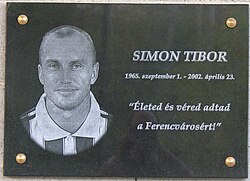
- 2 – Hungary Tibor Simon, Defender (1985–99) – posthumous honour.
- 12 – Hungary "The 12th man", reserved for club supporters. Number retired in 2007.
Notable former players
Had senior international caps for their respective countries. Players whose name is listed in bold represented their countries while playing for Ferencváros.
- Trinidad and Tobago Akeem Adams 12
- Hungary Flórián Albert 4 5
- Hungary Flórián Albert Jr.
- North Macedonia Aleksandar Bajevski
- Hungary László Bálint 6
- Hungary Zoltán Balogh
- Hungary Zsolt Bárányos
- Trinidad and Tobago Matthew Bartholomew
- Bosnia and Herzegovina Muhamed Bešić 10
- Hungary Mihály Bíró 2
- Hungary Dániel Böde
- Hungary Elemér Berkessy
- Slovenia Miha Blažič
- Hungary Zoltán Blum
- Hungary Gáspár Borbás
- Hungary Predrag Bošnjak
- Hungary Sándor Bródy
- Hungary László Budai
- Hungary Márton Bukovi
- Hungary Ákos Buzsáky
- Hungary Zoltán Bükszegi
- Bosnia and Herzegovina Eldar Ćivić
- Hungary Csaba Csizmadia
- Hungary László Czéh
- Hungary Zoltán Czibor
- Hungary Jenő Dalnoki
- Hungary Ferenc Deák
- Hungary Lajos Détári
- Northern Ireland Tommy Doherty
- Hungary Attila Dragóner
- Hungary József Eisenhoffer
- Hungary Márton Esterházy
- Hungary Tibor Fábián
- Nigeria Teslim Fatusi
- Hungary Gyula Feldmann
- Hungary Máté Fenyvesi 3 4 5
- Hungary István Ferenczi
- Hungary Pál Fischer
- Hungary Zoltán Friedmanszky 3
- Hungary Ákos Füzi
- Hungary Emil Gabrovitz
- Hungary Zoltán Gera
- Hungary Ádám Nagy
- Hungary István Géczi 5
- Hungary József Gregor
- Hungary Gyula Grosics
- Hungary Gábor Gyepes
- Hungary László Gyetvai
- Hungary Gábor Gyömbér
- Malta Justin Haber
- Hungary József Háda 1 2
- Hungary Attila Hajdu
- Hungary Tamás Hajnal
- Finland Juha Hakola
- Hungary Ferenc Hámori
- Czech Republic Marek Heinz
- Hungary Ferenc Horváth
- Hungary György Horváth
- Hungary János Hrutka
- Hungary Szabolcs Huszti
- Serbia Aleksandar Jović
- Hungary István Juhász
- Hungary Géza Kalocsay
- Slovenia Adem Kapič
- Hungary Tibor Kemény 1
- Hungary András Keresztúri
- Hungary Géza Kertész
- Ukraine Ihor Kharatin
- Hungary Béla Kiss
- Czech Republic Martin Klein
- Hungary Sándor Kocsis
- Hungary Lajos Korányi 2
- Hungary Béla Kovács
- Hungary János Kovács
- Hungary Attila Kriston
- Hungary Czechoslovakia Spain László Kubala
- Hungary Lajos Kű
- Hungary Zsolt Laczkó
- Tunisia Aïssa Laïdouni 11
- Hungary Károly Lakat
- Germany Benjamin Lauth
- Hungary Gyula Lázár 1 2
- Hungary Leandro
- Hungary Miklós Lendvai
- Hungary Zsolt Limperger
- Hungary Péter Lipcsei
- Hungary Krisztián Lisztes
- Hungary Antal Lyka
- Hungary István Magyar
- Slovakia Róbert Mak
- Hungary Gyula Mándi
- Hungary Sándor Mátrai 3 4 5
- Hungary Győző Martos 6
- Hungary János Máté
- Hungary János Mátyus
- Hungary József Mészáros
- Hungary Romania Vasile Miriuță
- Jamaica Jason Morrison
- Hungary Sándor Nemes
- Hungary Dezső Novák
- Hungary Elek Nyilas
- Hungary Tibor Nyilasi 6 7
- Hungary Gábor Obitz
- Hungary József Pálinkás
- Hungary Miklós Páncsics
- Hungary Mihály Pataki
- Slovakia Hungary Attila Pinte
- Hungary Attila Pintér
- Hungary Gyula Polgár 1 2
- Hungary Gábor Pölöskei 7
- Hungary László Pusztai 6
- Hungary Soviet Union Vasyl Rats 8 9
- Hungary Tibor Rab 6 7
- Hungary Gyula Rákosi 4 5
- Hungary László Répási
- Hungary István Rodenbücher
- Hungary Dénes Rósa
- Hungary Gyula Rumbold
- Hungary József Sándor
- Hungary Béla Sárosi 2
- Hungary György Sárosi 1 2
- Malta André Schembri
- Switzerland Kosovo Zenun Selimi
- Hungary Imre Schlosser
- Hungary Ernő Schwarz
- Hungary Geza Šifliš
- Hungary Tibor Simon
- Hungary Vilmos Sipos
- Hungary Illés Zsolt Sitku
- Hungary Nigeria Thomas Sowunmi
- North Macedonia Stefan Spirovski
- Hungary Imre Szabics
- Hungary Ferenc Szabó
- Hungary József Szabó
- Hungary László Szabó
- Hungary Ferenc Szedlacsek
- Hungary Tamás Szekeres
- Hungary István Szőke
- Hungary Lajos Szűcs
- Hungary Lajos Szűcs
- Hungary Ákos Takács
- Hungary József Takács
- Hungary Krisztián Timár
- Hungary Mihály Tóth
- Hungary István Tóth Potya
- Hungary Attila Tököli
- Hungary Géza Toldi 1 2
- Hungary Dániel Tőzsér
- Hungary József Turay
- Serbia Đorđe Tutorić
- Czech Republic Robert Vágner
- Hungary Zoltán Varga 5
- Hungary Zoltán Végh
- Hungary Gábor Vincze
- Hungary Ottó Vincze
- Serbia Dragan Vukmir
- Hungary Ferenc Weisz
- Trinidad and Tobago Jan-Michael Williams
- Jamaica Rafe Wolfe
- Jamaica Wolry Wolfe
- Hungary László Wukovics
- Hungary Gábor Zavadszky
- Hungary Zalán Zombori
- Ukraine Oleksandr Zubkov
Notes
- Note 1: played at the 1934 FIFA World Cup.
- Note 2: played at the 1938 FIFA World Cup.
- Note 3: played at the 1958 FIFA World Cup.
- Note 4: played at the 1962 FIFA World Cup.
- Note 5: played at the 1966 FIFA World Cup.
- Note 6: played at the 1978 FIFA World Cup.
- Note 7: played at the 1982 FIFA World Cup.
- Note 8: played at the 1986 FIFA World Cup.
- Note 9: played at the 1990 FIFA World Cup.
- Note 10: played at the 2014 FIFA World Cup.
- Note 11: played at the 2022 FIFA World Cup.
- Note 12: suffered heart attack after Ferencvárosi TC–Újpest FC derby on 27 September 2013 and died 30 December 2013. m
Non-playing staff
| Position | Name |
|---|---|
| Board of directors Position Name President Hungary Gábor Kubatov Vice-president Hungary Máté Kocsis Member of the Presidium Hungary András Sike Member of the Presidium Hungary József Farkas Member of the Presidium Hungary Miklós Kovács Member of the Presidium Hungary Beatrix Kökény Member of the Presidium Hungary György Rieb Member of the Presidium Hungary Miklós Dr. Springer Financial Manager Hungary Miklós Szalai | Board of Supervision Position Name President Hungary György Kassai Member of the Board of Supervision Hungary Péter Császár Member of the Board of Supervision Hungary Péter Burg Member of the Board of Supervision Hungary Gábor Dr. Balczó Member of the Board of Supervision Hungary Botond Kerényi |
| President | Hungary Gábor Kubatov |
| Vice-president | Hungary Máté Kocsis |
| Member of the Presidium | Hungary András Sike |
| Member of the Presidium | Hungary József Farkas |
| Member of the Presidium | Hungary Miklós Kovács |
| Member of the Presidium | Hungary Beatrix Kökény |
| Member of the Presidium | Hungary György Rieb |
| Member of the Presidium | Hungary Miklós Dr. Springer |
| Financial Manager | Hungary Miklós Szalai |
| Position | Name |
| President | Hungary György Kassai |
| Member of the Board of Supervision | Hungary Péter Császár |
| Member of the Board of Supervision | Hungary Péter Burg |
| Member of the Board of Supervision | Hungary Gábor Dr. Balczó |
| Member of the Board of Supervision | Hungary Botond Kerényi |
Coaches
First team
Former managers
Managers from 2010:
| Year | |
|---|---|
| Year Hungary László Prukner 2010–11 Hungary Tamás Nagy 2011 Hungary Lajos Détári 2011–12 Netherlands Ricardo Moniz 2012–13 Germany Thomas Doll 2013–18 Ukraine Serhii Rebrov 2018–21 Austria Peter Stöger 2021 Russia Stanislav Cherchesov 2021–23 Serbia Dejan Stanković 2023–24 Netherlands Pascal Jansen 2024 | |
| Hungary László Prukner | 2010–11 |
| Hungary Tamás Nagy | 2011 |
| Hungary Lajos Détári | 2011–12 |
| Netherlands Ricardo Moniz | 2012–13 |
| Germany Thomas Doll | 2013–18 |
| Ukraine Serhii Rebrov | 2018–21 |
| Austria Peter Stöger | 2021 |
| Russia Stanislav Cherchesov | 2021–23 |
| Serbia Dejan Stanković | 2023–24 |
| Netherlands Pascal Jansen | 2024 |
Former president
| Year | ||
|---|---|---|
| Year Hungary Ferenc Springer 1899–20 Hungary Aladár Mattyók 1920–23 Hungary Ernő Gschwindt 1923–31 Hungary Béla Mailinger 1931–44 Hungary Béla Usetty 1937–44 Hungary Andor Jaross 1944 Hungary Adolf Nádas 1944–50 Hungary Ferenc Münnich 1948–50 Hungary Árpád Nöhrer 1950–51 Hungary István Száraz 1951–52 Hungary Béla Komoretto 1953–55 Hungary Károly Weidemann 1956–58 Hungary János Bédi 1958–62 Hungary Aladár Végh 1962–65 Hungary István Kalmár 1966–70 Hungary János Harót 1970–71 Hungary Lajos Lénárt 1971–81 | Year Hungary Tibor Losonci 1980–85 Hungary Imre Kovács 1981–88 Hungary Károly Hargitai 1985–90 Hungary Ferenc Szabó 1988–89 Hungary István Debreczeny 1989–90 Hungary Lajos Harza 1990–94 Hungary István Szívós 1991–98 Hungary Péter Szerdahelyi 1994–96 Hungary Benedek Fülöp 1996–98 Hungary József Torgyán 1999–01 Hungary János Furulyás 2001–06 Hungary Miklós Inácsy 2006 Hungary Zsolt Dámosy 2006–07 Hungary György Rieb 2007–10 Hungary Miklós Kovács 2010–11 Hungary Gábor Kubatov 2011– | Gábor Kubatov is the current president of the club |
| Hungary Ferenc Springer | 1899–20 | |
| Hungary Aladár Mattyók | 1920–23 | |
| Hungary Ernő Gschwindt | 1923–31 | |
| Hungary Béla Mailinger | 1931–44 | |
| Hungary Béla Usetty | 1937–44 | |
| Hungary Andor Jaross | 1944 | |
| Hungary Adolf Nádas | 1944–50 | |
| Hungary Ferenc Münnich | 1948–50 | |
| Hungary Árpád Nöhrer | 1950–51 | |
| Hungary István Száraz | 1951–52 | |
| Hungary Béla Komoretto | 1953–55 | |
| Hungary Károly Weidemann | 1956–58 | |
| Hungary János Bédi | 1958–62 | |
| Hungary Aladár Végh | 1962–65 | |
| Hungary István Kalmár | 1966–70 | |
| Hungary János Harót | 1970–71 | |
| Hungary Lajos Lénárt | 1971–81 | |
| Year | ||
| Hungary Tibor Losonci | 1980–85 | |
| Hungary Imre Kovács | 1981–88 | |
| Hungary Károly Hargitai | 1985–90 | |
| Hungary Ferenc Szabó | 1988–89 | |
| Hungary István Debreczeny | 1989–90 | |
| Hungary Lajos Harza | 1990–94 | |
| Hungary István Szívós | 1991–98 | |
| Hungary Péter Szerdahelyi | 1994–96 | |
| Hungary Benedek Fülöp | 1996–98 | |
| Hungary József Torgyán | 1999–01 | |
| Hungary János Furulyás | 2001–06 | |
| Hungary Miklós Inácsy | 2006 | |
| Hungary Zsolt Dámosy | 2006–07 | |
| Hungary György Rieb | 2007–10 | |
| Hungary Miklós Kovács | 2010–11 | |
| Hungary Gábor Kubatov | 2011– |
See also
- History of Ferencvárosi TC
- List of Ferencvárosi TC seasons
- Ferencvárosi TC in European football
- List of Ferencvárosi TC managers
- List of Ferencvárosi TC records and statistics
Notes
External links
- (in Hungarian and English)
- (in Hungarian)
- (in Hungarian) (archived)
- (in Hungarian) (archived)
- (in Hungarian)