Sbai
In-game article clicks load inline without leaving the challenge.

Sbai (Khmer:ស្បៃ [sɓaj]; Lao:ສະໄບ [sā.bàj]; Malay: Sebai; Jawi: سباي; Thai:สไบ, RTGS:sabai [sā.bāj]) or phaa biang (Lao:ຜ້າບ່ຽງ [pʰȁːbīaŋ]; Thai:ผ้าเบี่ยง [pʰâːbìaŋ]) is a shawl-like garment worn by women in Cambodia, Laos, and Thailand to cover the breasts, while in Sumatra, Borneo and the Malay Peninsula, the same term is used to describe a cloth hanging from the shoulders. The sbai was derived from the Indian sari, the end of which is worn over one shoulder.
Etymology
The term sbai is the contracted form of vowels which has its ultimately original roots from the Austronesian term *cahebay, which was diversified as the first exodus in Taiwan as the Formosan term *sapay from south China between 5,000–4,500 BCE, and the second exodus to the Philippines, Indonesia, and others occurred around 3,000–2,000 BCE.
Its vowel sequence was contracted from south China to the first exodus: *cahebay→*cahbay→*cahpay→*sapay (meaning: 'to hang'). According to the Proto-Austronesian Phonology of Cornell University Southeast Asia Program (SEAP), there is the diversity of the term *cahebay or *sapay into subgroups of other languages families as follows:
- Austroasiatic languages: *lɓak (Dvaravati Old Mon and Nyah Kur), cambāy (Middle Mon), *jbaay (Mon), *sapay→sĕbai, sbai→sbāy, spai→spiey or *sapay→spai→spiey (Old Khmer and Modern Khmer), phìai (Kuy).
- Austronesian languages: *cahebay→łahpay, cahfay, cabfay. (Proto-Austronesian).
- Formosan languages: *sapay→sapai (Puyuma).
- Indo-European languages: *səmpay (Sangsari).
- Kra–Dai languages: *sapay→sĕbai, sbai→sabai, saphaay (Thai).
- Malayo-Polynesian languages: *sapay→sbai, sĕbai, sampai (Malay), sampai (Indonesian), sampay, sampayán (Tagalog), sampe (Makassarese, Serayar), sambay, sablay (Maranao), sumpáy (Ratahan), hafe-hafe (Tondarno), cave- (Filipinno), sappɛ (Buginese), sappɛ-sappɛ (Toba Batak), sampay-an (Ngaju), sampe-lao (Muna), sampi, mi-sampy, sampazana (Malagasy), sambay (Maranao).
- Indo-European languages: spāy (unverified Sanskrit religious vocabulary as assumed by French.) from the Sanskrit of Khmer inscription on the Tāmrakumbha Indian brass water jug (K.669C Line 18) aged 972 CE at Preah Vihear.
- Dravidian languages: calvai, cālvai, sālvai, sâlvai (Tamil), from Modern Persian šāl or Urdu and Persian chal, shal, shàl.
History
Sbai is derived from the Indian sari, which may have been introduced to Southeast Asia through the Indianized Kingdoms, the most notable being Funan, Srivijaya, and the Khmer Empire, which spread clothing and other traditions and elements of Indian culture.
Cambodia


In Khmer, the sbai (ស្បៃ) refers to an asymmetrical breast-sash, usually embroidered and of silk, worn for ballet performances and ceremonies. Chinese chronicles relay from the founding legend of Neang Neak and Preah Thong that the latter was unhappy with Neang Neak's nudity and he "folded a piece of material to make a garment through which he had her pass her head." Scholar and ballet teacher Prumsodun Ok writes that this describes how one wears a pre-sewn sbai.

The sbai is used in traditional Khmer weddings during the rite of Preah Thong Taong Sbai Neang Neak ("Preah Thong holding on to the sbai of Neang Neak"), which represents the legend of the foundation of the Khmer people: groom carries the bride's sbai from behind for a ritualistic walk to "symbolize their entering into her naga realm." At Angkor Wat, there are 12th century depictions of topless devatas (Khmer: tevoda ទេវតា) holding a sbai connected to their sampot, while the northern wall of Angkor Wat depicts a 16th-century group of Theravada Buddhist ladies wearing long sbai while holding various offerings.

For men, especially Brahmin and Buddhist monk, the sbai called sbong sbai trai chivor, and is considered the robe of Hindu and Buddhist monks. For women, sbai can be freely used and in different ways such as to wrapping it around the body, covering the shoulder, and commonly covering the breast and stomach over the left shoulder. Prumsodun Ok on etymology:
...Monosyllable Khmer loan words become bi‑syllable in Thai with phka (flower) to phaka, spean (bridge) to sapan, and sbai to sabai. Ancient Khmers also referred to this garment in Sanskrit terms such as kapata and uttarasanga.
In a village called Sampan Leu in the Sa’ang District of Kandal province, sbai embroidery is a tradition passed down over generations for some 40 families, and the commune chief says the practice goes back to ancient times for some villages. Villagers from teenagers to 60 year olds participate in the process. The designs themselves are decided by customers and the "predefined patterns" are passed on to the embroiderers. Pieces are often rented by those visiting Angkor Wat, for festivals, and also weddings, and material is not limited to silk. The in-demand sbais are crafted with authentic, traditional Khmer patterns by the artisans with the goal of preserving Khmer culture.
In June of 2026, Cambodia’s Ministry of Culture and Fine Arts responded to comments by Thai officials perceived as claiming ownership of the sbai by saying the sbai in Cambodia dates back to the Funan era and is an important part of Khmer women’s attire “preserved and practiced by Khmer people across generations up to the present day.”
Laos
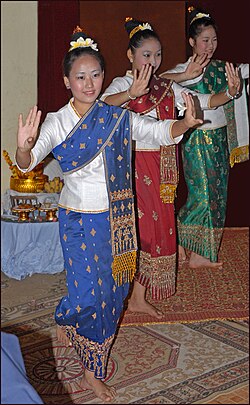
In Laos, this garment is known as phaa biang (Lao: ຜ້າບ່ຽງ) or sabai. It is common for Lao women to wear sabai/phaa biang as it is considered traditional clothing. A sabai can also be worn by men in weddings or when attending religious ceremonies. The type typically worn by Lao men often has checkered patterns. Sabai/phaa biang can also be a long piece of silk, about a foot wide, that is draped diagonally over the chest covering one shoulder with one end dropping behind the back. Important and sacred in Lao culture, phaa biang can be of various fabric and worn regardless of age. For occasions such as wedding ceremonies, visits to a pagoda, or New Year celebrations, the phaa biang is often draped over traditional outfits. Laywomen in Luang Prabang wear phaa biang to comply with Buddhist modesty rules. This secures the collar and keeps the upper body concealed. Women attending a Vat Manorom monk coronation laid their phaa biangs out on the hall floor to welcome the monks. The Lao sabai/phaa biang may bear a hybrid "dragon/serpent and ancient ship" image.
Malaysia
In Malaysia, sebai is a cloth wrapped around the neck to cover the shoulders with both ends hanging on the chest similar to a scarf hung over the shoulders. Sarong cloth in Malaysia may be made into a sebai, and it was Malay wedding tradition to gift a sarong to be fashioned into a sebai.
Myanmar

The ethnic Mon have a tradition of wearing the shawl-like sabai, called yat toot in Mon language and often made of silk, diagonally across the chest and over one shoulder with the garment's end flowing down behind the back like that worn by Lao women.[citation needed] The garment may be embellished with motifs from the Mon heritage, such as the mythical hongsa, a Mon water bird often represented as a duck or swan, and accented with Mon floral symbols. In 2024, University of the Philippines Open University (UPOU) Professor Emeritus Dr. Grace Javier Alfonso travelled to the Mon community of Bang Tanai in Thailand to help reinvigorate the Mon sabai/yat toot tradition through packaging that showcases Mon craftsmanship. This tradition distinguished them from other ethnic groups in Myanmar. The Mon people of Myanmar and Thailand today were the descendants of various Indianized polities, notably Dvaravati.[citation needed] Artifacts from Dvaravati sites in what is now Thailand depicted a group of ladies wearing what is similar to sabai.[citation needed]
Thailand

Artifacts found in ethnic Mon Dvaravati sites depict group of ladies wearing what is similar to sabai. Sabai (Thai:สไบ, RTGS:sabai, pronounced[sābāj]) or pha biang (Thai:ผ้าเบี่ยง pronounced[pʰâː.bìaŋ]) is shawl-like garment, or breast cloth. Sabais can be used by women or men. The sabai is also known as a long piece of silk, about a foot wide, draped diagonally around the chest by covering one shoulder which its end drops behind the back. Sabais could be worn around the naked chest or on top of another cloth. The practice of wearing Sabai along with Victorian cloth was a common practice during the reign of King Chulalongkorn and lasted until the reign of King Vajiravudh when Westernized clothing became more fashionable.
Gallery
- Khmer (Cambodian) Queen Ang Mey and her daughters wearing sbai in the 1800s
- Khmer (Cambodian) princess wearing a sbai for hair-cutting ceremony, circa 1928.
- Upper-class Khmer (Cambodian) women in sbais, 1800s.
- Khmer (Cambodian) Palace woman wearing sbai, 1874-1888.
- Khmer (Cambodian) women wearing sbais for ceremony at Angkor Wat, 2022.
- Khmer (Cambodian) guard for King Sisowath (1904-1928) wearing a sbai
- Young Khmer (Cambodian) girls wearing sbai, 1870-1900.
- Lady Pun Bunnag, Somdet Chaophraya Borom Maha Sri Suriwongse's wife wearing pha biang, 1866
- Siamese girl wearing pha biang, 1921
- Daughters of King Rama II and King Rama III wearing pha biang in the 1800s
- Queen Debsirindra wearing pha biang, 1855
- Thai children wearing pha nung and pha biang
- Cambodian bride wearing a sbai in a wedding ceremony
- Cambodian American dancer wearing sbai
See also
- Sampot Chang Kben
- Khmer Traditional Dress
- Culture of Cambodia
- Chut thai
- Sampot
- Sampot Samloy
- Kemben
- Malaysian cultural outfits
- Sari
- Traditional Thai clothing
External links
Media related toSbaiat Wikimedia Commons