Upcoming structural changes to local government in England
In-game article clicks load inline without leaving the challenge.
Proposed structural changes to local government in England were set out in the English Devolution White Paper published by the UK government on 16 December 2024. This wave of local government restructuring—following previous changes in 1995–1998, 2009 and 2019–2023—is referred to as Local Government Reorganisation (LGR) by the UK government. As with earlier waves of reorganisation, areas where services are provided by both county councils and district councils will instead be served by single-tier unitary authorities. It is intended that the first elections to the new councils will be on 6 May 2027, and the councils will begin operation on 1 April 2028. For Surrey, an accelerated timeline is planned, with elections on 7 May 2026, and the new councils beginning operation on 1 April 2027. The process runs alongside, but separate to, the expansion of combined authorities to more of the country as part of English devolution.
Background

Changes to local government structures, such as the replacement of district and county councils with unitary authorities, became possible with secondary legislation following the Local Government and Public Involvement in Health Act 2007. Prior to that there had been a Local Government Commission for England to recommend structural changes which took place between 1995 and 1998. Under the 2007 legislation, rounds of reorganisation took place in 2009 and 2019–2023. Several large unitary authorities were created in 13 ceremonial county areas, either by replacing a two-tier county council and its two-tier non-metropolitan district councils with a single unitary council (in Cornwall, County Durham, Northumberland, Shropshire, Wiltshire, Buckinghamshire, North Yorkshire, Somerset) or by dividing the county area into two or more new unitary councils (in Bedfordshire, Cheshire, Dorset, Northamptonshire, Cumbria).
Summary
As of March 2026[update], the status of local government reorganisation across the government's 19 invitation areas is as follows:
| Reorganisation area | Status | Consultation dates | S.I. | First election | Vesting day | Ref. | |
|---|---|---|---|---|---|---|---|
| Start | End | ||||||
| Surrey | Confirmed | 17 June 2025 | 5 August 2025 | 7 May 2026 | 1 April 2027 | ||
| Essex, Southend-on-Sea, and Thurrock | Decided | 19 November 2025 | 11 January 2026 | ||||
| Hampshire, Isle of Wight, Portsmouth, and Southampton | Decided | 19 November 2025 | 11 January 2026 | ||||
| Norfolk and Suffolk | Decided | 19 November 2025 | 11 January 2026 | ||||
| East Sussex, Brighton and Hove, and West Sussex | Awaiting further consultation | 19 November 2025 | 11 January 2026 | ||||
| TBC | TBC | ||||||
| Cambridgeshire and Peterborough | Awaiting ministerial decision | 5 February 2026 | 26 March 2026 | ||||
| Derbyshire and Derby | Awaiting ministerial decision | 5 February 2026 | 26 March 2026 | ||||
| Devon, Plymouth, and Torbay | Awaiting ministerial decision | 5 February 2026 | 26 March 2026 | ||||
| Gloucestershire | Awaiting ministerial decision | 5 February 2026 | 26 March 2026 | ||||
| Hertfordshire | Awaiting ministerial decision | 5 February 2026 | 26 March 2026 | ||||
| Kent and Medway | Awaiting ministerial decision | 5 February 2026 | 26 March 2026 | ||||
| Lancashire, Blackburn with Darwen, and Blackpool | Awaiting ministerial decision | 5 February 2026 | 26 March 2026 | ||||
| Leicestershire, Leicester, and Rutland | Awaiting ministerial decision | 5 February 2026 | 26 March 2026 | ||||
| Lincolnshire, North East Lincolnshire, and North Lincolnshire | Awaiting ministerial decision | 5 February 2026 | 26 March 2026 | ||||
| Nottinghamshire and Nottingham | Awaiting ministerial decision | 5 February 2026 | 26 March 2026 | . | |||
| Oxfordshire | Awaiting ministerial decision | 5 February 2026 | 26 March 2026 | ||||
| Staffordshire and Stoke-on-Trent | Awaiting ministerial decision | 5 February 2026 | 26 March 2026 | ||||
| Warwickshire | Awaiting ministerial decision | 5 February 2026 | 26 March 2026 | ||||
| Worcestershire | Awaiting ministerial decision | 5 February 2026 | 26 March 2026 |
Decided reorganisations
Reorganisation policy
The Labour Party returned to power following a landslide victory in the 2024 general election, and in her Autumn budget statement, Chancellor of the Exchequer Rachel Reeves outlined that a forthcoming English Devolution Bill would include plans for "working with councils to move to simpler structures that make sense for their local areas", suggesting that a new round of local government reorganisation could be likely.
The English Devolution White Paper indicated that, where possible, the remaining two-tier local government areas in England—where services are provided by both county councils and district councils—should be reorganised into a smaller number of unitary authorities, where local services are provided by a single council. New unitary councils would be expected to have "a population of 500,000 or more, but there may be exceptions to ensure new structures make sense for an area, including for devolution, and decisions will be on a case-by-case basis". The local government reorganisation programme would cover the 21 remaining ceremonial counties in England with two-tier local government. It would also include neighbouring unitary local government areas "where there is evidence of failure" or where the existing unitary council's "size or boundaries may be hindering their ability to deliver sustainable and high-quality public services".
In February 2026, the House of Commons Library published a local government reorganisation 2026 research briefing.
Priority programme
In November 2024, it was reported that Kent, Essex, Hertfordshire, Surrey, Norfolk, and Suffolk would be included in the first wave of local authority reorganisation with the two-tier system of county councils and district councils being replaced by unitary authorities. However, this turned out to be incorrect and in February 2025 the government announced that the following six areas would join the Devolution Priority Programme:
- Cheshire and Warrington
- Cumbria
- Greater Essex
- Hampshire and the Solent
- Norfolk and Suffolk
- Sussex and Brighton
The Cheshire and Warrington and Cumbria areas already have a fully unitary system of local government, following local government reorganisation in 2009 and 2023. They will both gain mayoral combined authorities.
All existing two-tier and unitary authorities in the Greater Essex, Hampshire and the Solent, Norfolk and Suffolk, and Sussex and Brighton areas were asked to submit final proposals for local government reorganisation to the Secretary of State for Housing, Communities and Local Government by the end of September 2025. The government held statutory consultations on these proposals from 19 November 2025 to 11 January 2026. Decisions on which proposals to implement were expected to be announced by March 2026. Secondary legislation would be required to implement these changes, followed by elections to the new shadow unitary authorities which would be expected to take place on 6 May 2027. The new authorities would then go live on 1 April 2028.
On 31 March 2026, the House of Commons Library published maps of the newly proposed unitary authorities in Essex, Hampshire, Norfolk, and Suffolk, along with a full list of the parishes that would be split from existing non-metropolitan districts under these proposals.
Greater Essex
Greater Essex was announced as part of the priority programme on 5 February 2025. The May 2025 local elections that would have taken place in Essex and Thurrock were cancelled. Some of the May 2026 local elections in Greater Essex were cancelled and then later reinstated.
Greater Essex Combined County Authority will be coterminous with the ceremonial county of Essex.
Essex, Southend-on-Sea, and Thurrock

Essex is administered by Essex County Council, twelve non-metropolitan districts and two unitary authorities:
- Uttlesford
- Braintree
- Colchester
- Tendring
- Harlow
- Epping Forest
- Chelmsford
- Maldon
- Brentwood
- Basildon
- Rochford
- Castle Point
- Southend-on-Sea (unitary)
- Thurrock (unitary)
Proposals

In early December 2024, Basildon councillors proposed a five unitary authority model for the county.
Later in December 2024, it was reported that the government would reorganise Essex into two or three local authorities with over 500,000 people each, with the unitary authorities of Thurrock and Southend-on-Sea to be abolished and merged with other areas of the county and local elections likely to be postponed until 2026. Essex County Council leader Kevin Bentley confirmed that his council would ask the government to postpone local elections for the unitary and two-tier authorities of Essex to prepare for the county's reorganisation.
Proposals to government were submitted by the following councils on 26 September 2025:
Southend-on-Sea City Council, Chelmsford City Council, Basildon Borough Council, Brentwood Borough Council, Castle Point Borough Council, Colchester City Council, Harlow District Council, Maldon District Council, Tendring District Council, and Uttlesford District Council proposed the following 5 council structure:
- South East Essex: Southend-on-Sea, Rochford, Castle Point
- South West Essex: Basildon, Thurrock
- West Essex: Harlow, Epping Forest, Uttlesford
- Mid Essex: Chelmsford, Brentwood, Maldon
- North East Essex: Colchester, Braintree, Tendring
Essex County Council, Braintree District Council, and Epping Forest District Council proposed the following 3 council structure:
- North Essex: Colchester, Tendring, Braintree, Uttlesford
- Mid Essex: Chelmsford, Harlow, Epping Forest, Brentwood, Maldon
- South Essex: Southend, Basildon, Thurrock, Castle Point, Rochford
Modelling by PwC suggests the county council–supported option will net a benefit of £86m.
Thurrock Council proposed the following 4 council structure:
- West Essex: Harlow, Epping Forest, Brentwood, Thurrock
- South Essex: Southend, Basildon, Castle Point, Rochford
- North Essex: Chelmsford, Braintree, Uttlesford
- East Essex: Colchester, Maldon, Tendring
Rochford District Council proposed the following alternative 4 council structure:
- West Essex: Harlow, Epping Forest, Uttlesford
- South Essex: Southend, Basildon, Castle Point, Thurrock
- Central Essex: Chelmsford, Brentwood, Maldon, Rochford
- North Essex: Colchester, Braintree, Tendring
Government consultation on these four proposals ran from 19 November 2025 to 11 January 2026.
Decision

On 25 March 2026, the Secretary of State for Housing, Communities and Local Government announced his decision that Essex would be reorganised into the following five unitary authorities.
- West Essex, comprising the areas currently covered by Epping Forest, Harlow, and Uttlesford (2024 population 331,000).
- North East Essex, comprising the areas currently covered by Braintree, Colchester, and Tendring (2024 population 521,000).
- Mid Essex, comprising the areas currently covered by Brentwood, Chelmsford, and Maldon (2024 population 337,000).
- South West Essex, comprising the areas currently covered by Basildon and Thurrock (2024 population 375,000).
- South East Essex, comprising the areas currently covered by Castle Point, Rochford, and Southend-on-Sea (2024 population 366,000).
Hampshire and the Solent
Hampshire and the Solent was announced as part of the priority programme on 5 February 2025. The May 2025 local elections that would have taken place in Hampshire and the Isle of Wight were cancelled.
Hampshire and the Solent Combined Authority will be coterminous with the ceremonial counties of Hampshire and the Isle of Wight.
Hampshire, Isle of Wight, Portsmouth, and Southampton

Hampshire is administered by Hampshire County Council, eleven non-metropolitan districts and two unitary authorities:
- Test Valley
- Basingstoke and Deane
- Hart
- Rushmoor
- Winchester
- East Hampshire
- New Forest
- Southampton (unitary)
- Eastleigh
- Fareham
- Gosport
- Portsmouth (unitary)
- Havant
The Isle of Wight is administered by a single unitary authority, Isle of Wight Council.
Proposals

In February 2025, the Hampshire County Council leader said that it is unlikely that the unitarisation of the county would follow current district boundaries. The interim proposal submitted by district councils on 21 March 2025 stated that the Isle of Wight should remain its own council rather than being merged with mainland authorities. It also set out analysis for the mainland authorities to be based on the economic geographies of Basingstoke, Winchester, Southampton, and Portsmouth, without making a decision on the number of unitaries.
Initially all 15 authorities (13 Hampshire districts, Hampshire County Council, Isle of Wight Council) formed a group to bring forward a single proposal, assessing eight options for between 2 and 5 unitary authorities across the two ceremonial counties. They ultimately agreed to base their proposals on four mainland councils for Hampshire, with the Isle of Wight remaining unchanged despite falling below the 500,000 mark. However, subsequent to this, Hampshire County Council, East Hampshire District Council, and Gosport Borough Council announced that they were leaving the joint process. Hampshire and East Hampshire began their own process. Gosport fully opposed the local government reorganisation process.
The remaining 12 councils ultimately agreed to work on a business case with three proposals. Each proposal included four Hampshire authorities and the Isle of Wight remaining separate, but they had differing plans for the New Forest. Option 1 and Option 2 were simple mergers of districts, whilst Option 1A included proposed boundary changes. Option 1A proposed including four parishes from the New Forest and three parishes from Test Valley in an authority based around the Southampton area and including three parishes from East Hampshire and one parish from Winchester in an authority based around the Portsmouth area. A shared vision entitled Close enough to be local big enough to stay strong was published by the 12 councils, with each district due to vote on their preferred option in September 2025. In July 2025, a local consultation opened on these three options.
Hampshire County Council and East Hampshire District Council meanwhile proposed three mainland authorities, with the Isle of Wight remaining unchanged.
Proposals to government were submitted by 13 of the 15 affected councils on 26 September 2025 (see table below for details). Gosport Borough Council and Isle of Wight Council did not submit proposals.
Government consultation on these four proposals ran from 19 November 2025 to 11 January 2026.
| Proposals | Option 1 | Option 2 | Option 1A | Proposals | HCC/EHDC Proposal | ||||
|---|---|---|---|---|---|---|---|---|---|
| Composition | Population | Composition | Population | Composition | Population | Composition | Population | ||
| North Hampshire | Basingstoke and Deane, Hart, Rushmoor | 407,465 | Basingstoke and Deane, Hart, Rushmoor | 407,465 | Basingstoke and Deane, Hart, Rushmoor | 407,465 | Mid-North | Basingstoke and Deane, East Hampshire, Hart, Rushmoor, Winchester | 655,528 |
| Mid Hampshire | East Hampshire, New Forest, Test Valley, Winchester | 598,823 | East Hampshire, Test Valley, Winchester | 417,159 | East Hampshire, New Forest, Test Valley, Winchester | 484,546 | |||
| South West Hampshire | Eastleigh, Southampton | 423,221 | Eastleigh, New Forest, Southampton | 604,885 | Eastleigh, New Forest*, Southampton, Test Valley* | 510,102 | West | Eastleigh, New Forest, Southampton, Test Valley | 706,919 |
| South East Hampshire | Fareham, Gosport, Havant, Portsmouth | 554,741 | Fareham, Gosport, Havant, Portsmouth | 554,741 | East Hampshire*, Fareham, Gosport, Havant, Portsmouth, Winchester* | 582,137 | South-East | Fareham, Gosport, Havant, Portsmouth | 532,519 |
| Isle of Wight | Isle of Wight | 146,351 | Isle of Wight | 146,351 | Isle of Wight | 146,351 | Isle of Wight | Isle of Wight | 140,906 |
| Support | Basingstoke and Deane Borough Council, New Forest District Council, Test Valley Borough Council | Winchester City Council | Eastleigh Borough Council, Fareham Borough Council, Hart Borough Council, Havant Borough Council, Portsmouth City Council, Rushmoor Borough Council, Southampton City Council | Support | East Hampshire District Council, Hampshire County Council | ||||
| Parishes from New Forest*: Totton and Eling, Marchwood, Hythe and Dibden, Fawley Parishes from Test Valley*: Valley Park, Nursling and Rownhams, Chilworth Parishes from East Hampshire*: Clanfield, Horndean, Rowlands Castle Parish from Winchester*: Newlands |
Decision

On 25 March 2026, the Secretary of State for Housing, Communities and Local Government announced his decision that Hampshire would be reorganised into the following four unitary authorities.
- North Hampshire, comprising the areas currently covered by Basingstoke and Deane, Hart, and Rushmoor (2024 population 402,000).
- Mid Hampshire, comprising the areas currently covered by East Hampshire (less 3 parishes), New Forest (less 4 parishes), Test Valley (less 3 parishes), and Winchester (less 1 parish) (2024 population 466,000).
- South West Hampshire, comprising the areas currently covered by Eastleigh, Southampton, 4 parishes from New Forest, and 3 parishes from Test Valley (2024 population 487,000).
- South East Hampshire, comprising the areas currently covered by Fareham, Gosport, Havant, Portsmouth, 3 parishes from East Hampshire, and 1 parish from Winchester (2024 population 566,000).
This decision confirms that the Isle of Wight unitary authority will remain unchanged.
Norfolk and Suffolk
Norfolk and Suffolk was announced as part of the priority programme on 5 February 2025. The May 2025 local elections that would have taken place in Norfolk and Suffolk were cancelled. The elections in May 2026 were initially cancelled, but were later reinstated.
Norfolk and Suffolk Combined County Authority will be coterminous with the ceremonial counties of Norfolk and Suffolk.
Norfolk

Norfolk is administered by Norfolk County Council and seven non-metropolitan districts:
Proposals

Proposals to government were submitted by the following councils on 26 September 2025:
Norfolk County Council proposed a single unitary authority covering the whole of the existing county council area.
Breckland District Council, Broadland District Council, Great Yarmouth Borough Council, King’s Lynn and West Norfolk Borough Council, North Norfolk District Council, and Norwich City Council proposed the following 3 council structure:
- West Norfolk: Breckland, King's Lynn and West Norfolk, 9 parishes from South Norfolk
- Greater Norwich: Norwich, 19 parishes from Broadland, 16 parishes from South Norfolk
- East Norfolk: Great Yarmouth, North Norfolk, Broadland (less 19 parishes), South Norfolk (less 25 parishes)
South Norfolk District Council proposed the following 2 council structure:
- West and North Norfolk: Breckland, King's Lynn and West Norfolk, North Norfolk
- Norwich and East Norfolk: Broadland, Great Yarmouth, Norwich, South Norfolk
Government consultation on these three Norfolk proposals ran from 19 November 2025 to 11 January 2026.
In February 2026, the leader of Norfolk County Council said the authority intended to withdraw from the reorganisation process.
Decision

On 25 March 2026, the Secretary of State for Housing, Communities and Local Government announced his decision that Norfolk would be reorganised into the following three unitary authorities.
- West Norfolk, comprising the areas currently covered by Breckland, King's Lynn and West Norfolk, and 9 parishes from South Norfolk (2024 population 310,000).
- East Norfolk, comprising the areas currently covered by Great Yarmouth, North Norfolk, Broadland (less 19 parishes), and South Norfolk (less 25 parishes) (2024 population 341,000).
- Greater Norwich, comprising the areas currently covered by Norwich, 19 parishes from Broadland, and 16 parishes from South Norfolk (2024 population 290,000).
Suffolk

Suffolk is administered by Suffolk County Council and five non-metropolitan districts:
Proposals

Proposals to government were submitted by the following councils on 26 September 2025:
Suffolk County Council proposed a single unitary authority covering the whole of the existing county council area, a proposal known as "".
Babergh District Council, East Suffolk District Council, Ipswich Borough Council, Mid Suffolk District Council, and West Suffolk District Council proposed the following 3 council structure:
- Ipswich and Southern Suffolk: Ipswich, 31 parishes from Babergh, 25 parishes from East Suffolk, 8 parishes from Mid Suffolk
- Western Suffolk: West Suffolk, Babergh (less 31 parishes), 21 parishes from Mid Suffolk
- Central and Eastern Suffolk: East Suffolk (less 25 parishes), Mid Suffolk (less 29 parishes)
Government consultation on these two Suffolk proposals ran from 19 November 2025 to 11 January 2026.
Decision

On 25 March 2026, the Secretary of State for Housing, Communities and Local Government announced his decision that Suffolk would be reorganised into the following three unitary authorities.
- Western Suffolk, comprising the areas currently covered by West Suffolk, Babergh (less 31 parishes), and 21 parishes from Mid Suffolk (2024 population 269,000).
- Central and Eastern Suffolk, comprising the areas currently covered by East Suffolk (less 25 parishes) and Mid Suffolk (less 29 parishes) (2024 population 261,000).
- Ipswich and South Suffolk, comprising the areas currently covered by Ipswich, 31 parishes from Babergh, 25 parishes from East Suffolk, and 8 parishes from Mid Suffolk (2024 population 257,000).
Sussex and Brighton
Sussex and Brighton was announced as part of the priority programme on 5 February 2025. The May 2025 local elections that would have taken place in East Sussex and West Sussex were cancelled. The elections in May 2026 were initially cancelled, but were later reinstated.
Sussex and Brighton Combined Authority will be coterminous with the ceremonial counties of East Sussex and West Sussex.
East Sussex and Brighton and Hove

East Sussex is administered by East Sussex County Council, five non-metropolitan districts and one unitary authority:
West Sussex
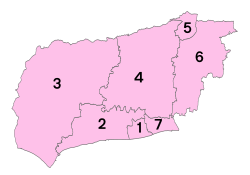
West Sussex is administered by West Sussex County Council and seven non-metropolitan districts:
Proposals (East Sussex, Brighton and Hove, and West Sussex)

East Sussex County Council covers a population of 550,000 and has proposed a direct replacement of the county council and five district councils with a single unitary authority. Brighton and Hove City Council, which is already a unitary authority with a population of 283,870, proposed that the border between itself and the new East Sussex unitary should be altered to include East Saltdean, Telscombe Cliffs, and Peacehaven within Brighton and Hove (the area coterminous with the Lewes parishes of Telscombe and Peacehaven). They consulted locally on whether to propose expanding further into either or both of the Lewes parish of Newhaven and the Lewes ward of Kingston (which comprises the parishes of Piddinghoe, Southease, Rodmell, Iford, Kingston near Lewes, St Ann (Without), and Falmer).
West Sussex County Council covers a population of 900,000 and originally proposed either one large or two smaller unitary authorities, dependent on whether Crawley remains in West Sussex or is moved to Surrey, and whether Brighton and Hove would expand its territory.
Proposals to government were submitted by the following councils on 26 September 2025:
West Sussex County Council proposed a single unitary authority covering the whole of the existing West Sussex County Council area.
Adur District Council, Arun District Council, Chichester District Council, Crawley Borough Council, Horsham District Council, Mid Sussex District Council, and Worthing Borough Council proposed the following 2 council structure for West Sussex:
- Unitary A: Adur, Arun, Chichester, Worthing
- Unitary B: Crawley, Horsham, Mid Sussex
East Sussex County Council, Eastbourne Borough Council, Hastings Borough Council, Lewes District Council, and Rother District Council proposed a 2 council structure for East Sussex comprising an unchanged Brighton and Hove and one authority covering the whole of the existing East Sussex County Council area.
Brighton and Hove City Council proposed the following 5 council structure across the whole Sussex area:
- Unitary A: Brighton and Hove, 3 parishes from Lewes (coterminous with 4 wards and 1 part-ward)
- Unitary B: Eastbourne, Hastings, Rother, 2 parishes from Lewes (coterminous with 7 wards), 11 parishes and 1 part-parish from Wealden (coterminous with 9 wards)
- Unitary C: Mid Sussex, Lewes (less 5 parishes), Wealden (less 11 parishes and 1 part-parish)
- Unitary D: Chichester, Crawley, Horsham
- Unitary E: Adur, Arun, Worthing
Wealden District Council did not submit a proposal.
Government consultation on these four proposals ran from 19 November 2025 to 11 January 2026.
Further technical consultation

On 25 March 2026, the Secretary of State for Housing, Communities and Local Government announced that he had not yet taken a decision on the proposals for East Sussex, Brighton and Hove, and West Sussex. The government will undertake a further technical consultation after the 2026 United Kingdom local elections. The Secretary of State will seek comments on a newly suggested proposal for the following 4 council structure across the whole Sussex area:
- Unitary A: Eastbourne, Hastings, Rother, Wealden, Lewes (less 3 parishes)
- Unitary B: Adur, Arun, Worthing
- Unitary C: Brighton and Hove, 3 parishes from Lewes (coterminous with 4 wards and 1 part-ward)
- Unitary D: Chichester, Crawley, Horsham, Mid Sussex
Surrey
Surrey was not part of the Devolution Priority Programme announced on 5 February 2025. However, the need to reorganise local government was considered urgent enough that the May 2025 local elections that would have taken place in Surrey were cancelled. The government intended that Surrey would move to a unitary structure faster than other areas, with the new councils becoming operational in 2027.
Surrey

Surrey is currently administered by Surrey County Council and eleven non-metropolitan districts:
- Spelthorne
- Runnymede
- Surrey Heath
- Woking
- Elmbridge
- Guildford
- Waverley
- Mole Valley
- Epsom and Ewell
- Reigate and Banstead
- Tandridge
Proposals

Proposals to government were submitted by the following councils on 9 May 2025:
Elmbridge Borough Council, Mole Valley District Council, and Surrey County Council proposed the following 2 council structure:
- West Surrey: Guildford, Runnymede, Spelthorne, Surrey Heath, Waverley, Woking
- East Surrey: Elmbridge, Epsom and Ewell, Mole Valley, Reigate and Banstead, Tandridge
Epsom and Ewell Borough Council, Guildford Borough Council, Reigate and Banstead Borough Council, Runnymede Borough Council, Spelthorne Borough Council, Surrey Heath Borough Council, Tandridge District Council, Waverley Borough Council, and Woking Borough Council proposed the following 3 council structure:
- North Surrey: Elmbridge, Runnymede, Spelthorne
- West Surrey: Guildford, Surrey Heath, Waverley, Woking
- East Surrey: Epsom and Ewell, Mole Valley, Reigate and Banstead, Tandridge
Government consultation on these two proposals ran from 17 June 2025 to 5 August 2025.
Decision

On 28 October 2025, the Secretary of State for Housing, Communities and Local Government announced his decision that Surrey would be reorganised into the following two unitary authorities:
- West Surrey, comprising the area currently covered by Guildford, Runnymede, Spelthorne, Surrey Heath, Waverley, and Woking (2021 population 657,309).
- East Surrey, comprising the area currently covered by Elmbridge, Epsom and Ewell, Mole Valley, Reigate and Banstead, and Tandridge (2021 population 545,798).
Outcome Secondary legislation was made on 9 March 2026. The first elections to the new authorities will be in May 2026, with vesting day on 1 April 2027.
Remaining two-tier areas
In July 2025, the government wrote to the councils in the 14 remaining 2-tier areas and neighbouring small unitary councils, asking for proposals to be submitted to the Secretary of State for Housing, Communities and Local Government by the end of November 2025. The government held statutory consultations on these proposals from 5 February 2026 to 26 March 2026. Decisions on which proposals to implement are expected to be announced before the summer of 2026. Secondary legislation would be required to implement these changes, followed by elections to the new shadow unitary authorities which would be expected to take place on 6 May 2027. The new authorities would then go live on 1 April 2028.
Cambridgeshire and Peterborough

Cambridgeshire is administered by Cambridgeshire County Council, five non-metropolitan districts and one unitary authority:
Proposals In November 2024, the former leader of Fenland District Council, and the leader of the Liberal Democrat group on East Cambridgeshire District Council urged that Cambridgeshire be included in the next round of local government reorganisation.
Following the English Devolution and Community Empowerment Bill in December 2024 and the subsequent invitation to councils to consider boundaries for the new Unitaries, councils began their deliberations as to their preferred models.
- On 21 October, Cambridgeshire County Council's decided on Option A.
- On 7 November, Fenland agreed to support Option D.
- On 12 November, the City of Peterborough Council also backed Option D, confirmed by its Cabinet meeting on 18 November.
- On 19 November, Huntingdonshire District Council agreed that Option E was its favoured choice. This is subject to a Council Cabinet meeting on 24 November.
- On 20 November City of Cambridge backed Option B.
- Also on 20 November East Cambridgeshire chose Option B.
- On 24 November South Cambridgeshire adopted Option B by 21 votes to 6.
While MPs are not part of the current consultation process, the MP for Huntingdon Ben Obese-Jecty raised the matter in Parliament and expressed his support for Option E.
Proposals to government were submitted by the following councils on 28 November 2025:
Cambridge City Council, East Cambridgeshire District Council, and South Cambridgeshire District Council proposed the following 2 council structure (referred to locally as Option B):
- North Cambridgeshire and Peterborough: Peterborough, Huntingdonshire, East Cambridgeshire, Fenland
- Greater Cambridge: Cambridge, South Cambridgeshire
Cambridgeshire County Council proposed the following 2 council structure (referred to locally as Option A):
- Northwest: Peterborough, Fenland, Huntingdonshire
- Southeast: Cambridge, East Cambridgeshire, South Cambridgeshire
Huntingdonshire District Council proposed the following 3 council structure (referred to locally as Option E):
- North: Peterborough, Fenland, East Cambridgeshire
- South: Cambridge, South Cambridgeshire
- Huntingdonshire: Huntingdonshire
Peterborough City Council and Fenland District Council proposed the following 3 council structure (referred to locally as Option D):
- Greater Peterborough: Peterborough, 9 wards from Huntingdonshire
- Mid Cambridgeshire: Fenland, East Cambridgeshire, Huntingdonshire (less 9 wards)
- Greater Cambridge: Cambridge, South Cambridgeshire
Government consultation on these four proposals ran from 5 February 2026 to 26 March 2026.
Derbyshire and Derby

Derbyshire is administered by Derbyshire County Council, eight non-metropolitan districts and one unitary authority:
- High Peak
- Derbyshire Dales
- South Derbyshire
- Erewash
- Amber Valley
- North East Derbyshire
- Chesterfield
- Bolsover
- Derby (unitary)
Proposals In August 2025, Derbyshire's district, borough, and city councils agreed on three options for further consideration, referred to as Option A, Option B, and Option C. All three proposals would see the area covered by two authorities, with one council covering the southern part of the county (including the city of Derby), and the other covering the northern part of the county.
Proposals to government were submitted by the following councils on 28 November 2025:
Derbyshire County Council proposed a single unitary authority covering the whole county area, including Derby.
Eight of the nine remaining councils proposed 2 unitary councils for Derbyshire, including Derby. They all agreed to propose the following:
- There should be a "Northern Derbyshire" authority including Bolsover, Chesterfield, Derbyshire Dales, High Peak, and North East Derbyshire.
- There should be a "Southern Derbyshire" authority including Derby, Erewash, and South Derbyshire.
This proposal included the following four sub-proposals, because the eight councils disagreed on plans for Amber Valley: Amber Valley Borough Council proposed that Amber Valley be included in "Northern Derbyshire" (referred to locally as Option A or Proposal A). South Derbyshire District Council proposed that Amber Valley be included in "Southern Derbyshire" (referred to locally as Option B or Proposal B). Bolsover District Council and North East Derbyshire District Council proposed that Amber Valley be split, with some parishes included in "Northern Derbyshire" and the remainder included in "Southern Derbyshire" (referred to locally as Option C or Proposal A1). Chesterfield Borough Council, Derby City Council, Erewash Borough Council, and High Peak Borough Council also proposed that Amber Valley be split between the two authorities, but using a different configuration of parishes (referred to locally as Proposal B1).
Derbyshire Dales District Council did not submit a proposal.
Government consultation on these five proposals (including all of the alternative options for Amber Valley) ran from 5 February 2026 to 26 March 2026.
Devon, Plymouth, and Torbay

Devon is administered by Devon County Council, eight non-metropolitan districts and two unitary authorities:
- North Devon
- Torridge
- Mid Devon
- East Devon
- Exeter
- West Devon
- Teignbridge
- Plymouth (unitary)
- South Hams
- Torbay (unitary)
Proposals In September 2025, Devon County Council proposed that the entire area covered by the county council become a single unitary authority, with Plymouth and Torbay remaining as unitary authorities on their existing borders. This plan was critisiced by Exeter City Council, who proposed that Exeter be expanded to become a unitary authority of its own. Plymouth City Council also proposed expanding into areas currently covered by the county council, whilst Torbay had yet to decide on a final proposal. Devon's other district councils proposed an alternative structure, known as the "1-4-5 plan", which envisages that Plymouth would continue as a unitary authority on its existing boundary, whilst the remainder of the county (including Torbay) would be divided two authorities.
Proposals to government were submitted by the following councils on 28 November 2025:
Devon County Council proposed a 3 council structure comprising an unchanged Plymouth, an unchanged Torbay, and one authority covering the whole of the existing county council area.
South Hams District Council, Teignbridge District Council, and West Devon Borough Council proposed the following 3 council structure:
- Exeter and Northern Devon: East Devon, Exeter, Mid Devon, North Devon, Torridge
- Plymouth (unchanged)
- Torbay and Southern Devon: South Hams, Teignbridge, Torbay, West Devon
East Devon District Council, Mid Devon District Council, North Devon Council, and Torridge District Council proposed the following 3 council structure:
- Exeter and Northern Devon: East Devon, Exeter, Mid Devon, North Devon, Torridge
- Plymouth (expanded): Plymouth, 4 part-parishes from South Hams
- Torbay and Southern Devon: Teignbridge, Torbay, West Devon, South Hams (less 4 part-parishes)
Torbay Council proposed the following 4 council structure:
- Exeter (expanded): Exeter, 28 parishes from East Devon, 6 parishes from Mid Devon, 15 parishes from Teignbridge
- Plymouth (expanded): Plymouth, 13 parishes from South Hams
- Torbay (unchanged)
- Rural Devon Coast and Countryside: North Devon, Torridge, West Devon, East Devon (less 28 parishes), Mid Devon (less 6 parishes), South Hams (less 13 parishes), Teignbridge (less 15 parishes)
Exeter City Council and Plymouth City Council proposed the following 4 council structure:
- Exeter (expanded): Exeter, 28 parishes from East Devon, 6 parishes from Mid Devon, 15 parishes from Teignbridge
- Plymouth (expanded): Plymouth, 13 parishes from South Hams
- Torbay (expanded): Torbay plus 22 parishes from within South Hams and Teignbridge
- Devon Coast and Countryside: North Devon, Torridge, West Devon, East Devon (remaining parishes), Mid Devon (remaining parishes), South Hams (remaining parishes), Teignbridge (remaining parishes)
Government consultation on these five proposals ran from 5 February 2026 to 26 March 2026.
Gloucestershire

Gloucestershire is administered by Gloucestershire County Council, six non-metropolitan districts and one unitary authority:
Proposals South Gloucestershire forms part of the West of England Combined Authority. It is outside of the government's invitation area and is not expected to undergo any changes. For the remainder of the county as of August 2025 three options were under consideration:
- One council covering the whole county council area.
- Two councils with an eastern authority and a western authority.
- Two councils with a "Greater Gloucester" authority and another authority covering the remainder of the county council area.
Proposals to government were submitted by the following councils on 28 November 2025:
Cotswold District Council, Gloucestershire County Council, Stroud District Council, and Tewkesbury Borough Council proposed a single unitary authority covering the whole of the existing county council area (not including South Gloucestershire unitary).
Cheltenham Borough Council proposed the following 2 council structure:
- East Gloucestershire: Cheltenham, Cotswold, Tewkesbury
- West Gloucestershire: Forest of Dean, Gloucester, Stroud
Gloucester City Council proposed the following 2 council structure:
- Greater Gloucester City: Gloucester, 12 parishes from Tewkesbury, 8 parishes from Stroud, 1 parish from Forest of Dean
- Gloucestershire: Cheltenham, Cotswold, Tewkesbury (less 12 parishes), Stroud (less 8 parishes), Forest of Dean (less 1 parish)
Forest of Dean District Council did not submit a proposal, nor did South Gloucestershire Council which is outside of the government's invitation area.
Government consultation on these three proposals ran from 5 February 2026 to 26 March 2026.
Hertfordshire
Hertfordshire did not bid to become part of the priority programme.

Hertfordshire is administered by Hertfordshire County Council and ten non-metropolitan districts:
- North Hertfordshire
- Stevenage
- East Hertfordshire
- Dacorum
- St Albans
- Welwyn Hatfield
- Broxbourne
- Three Rivers
- Watford
- Hertsmere
Proposals In May 2025, the Leaders of all eleven Hertfordshire councils jointly agreed that a single unitary authority covering the entire county – an area with a population of 1.2 million – would be too remote to maintain democratic accountability. The councils jointly proposed three options:
- Option A: Two authorities: West Hertfordshire, East Hertfordshire
- Option B: Three authorities: West Hertfordshire, Central Hertfordshire, East Hertfordshire
- Option C: Four authorities: West Hertfordshire, Southwest Hertfordshire, East Hertfordshire, Central Hertfordshire.
Proposals to government were submitted by the following councils on 28 November 2025:
Hertfordshire County Council and St Albans City and District Council proposed the following 2 council structure (referred to locally as Option A):
- West Hertfordshire: Dacorum, Hertsmere, St Albans, Three Rivers, Watford
- Eastern Hertfordshire: Broxbourne, East Hertfordshire, North Hertfordshire, Stevenage, Welwyn Hatfield
East Hertfordshire District Council, Three Rivers District Council, and Watford Borough Council proposed the following 3 council structure (referred to locally as Option B):
- West Hertfordshire: Dacorum, Three Rivers, Watford, 4 wards from Hertsmere
- Central Hertfordshire: St Albans, Welwyn Hatfield, Hertsmere (less 4 wards)
- Eastern Hertfordshire: Broxbourne, East Hertfordshire, North Hertfordshire, Stevenage
Broxbourne Borough Council, Dacorum Borough Council, Hertsmere Borough Council, North Hertfordshire District Council, Stevenage Borough Council, and Welwyn Hatfield Borough Council proposed the following 4 council structure (referred to locally as Option C):
- North West Hertfordshire: Dacorum, St Albans
- South West Hertfordshire: Hertsmere, Three Rivers, Watford
- Central Hertfordshire: Stevenage North Hertfordshire (less 6 wards), Welwyn Hatfield (less 1 ward)
- Eastern Hertfordshire: Broxbourne, East Hertfordshire, 6 wards from North Hertfordshire, 1 ward from Welwyn Hatfield
Government consultation on these three proposals ran from 5 February 2026 to 26 March 2026.
Kent and Medway

Kent is administered by Kent County Council, twelve non-metropolitan districts and one unitary authority:
- Sevenoaks
- Dartford
- Gravesham
- Tonbridge and Malling
- Medway (unitary)
- Maidstone
- Tunbridge Wells
- Swale
- Ashford
- Canterbury
- Folkestone and Hythe
- Thanet
- Dover
Kent County Council and Medway Council applied for a devolution deal in January 2025 which would include a Mayor of Kent above several unitary authorities. In February 2025 it was announced that Kent would not be part of the priority programme.
Proposals In July 2025, the county council suggested a split into three unitary authorities: West Kent, North Kent, and East Kent.
Medway Council suggested a four-authority plan including realignment of the existing Maidstone/Medway boundary.
Proposals to government were submitted by the following councils on 28 November 2025:
Kent County Council proposed a single unitary authority covering the whole county area, including Medway.
Folkestone and Hythe District Council, Maidstone Borough Council, Sevenoaks District Council, Tonbridge and Malling Borough Council, and Tunbridge Wells Borough Council proposed the following 3 council structure:
- North Kent: Dartford, Gravesham, Medway, Swale
- West Kent: Maidstone, Sevenoaks, Tonbridge and Malling, Tunbridge Wells
- East Kent: Ashford, Canterbury, Dover, Folkestone and Hythe, Thanet
Dover District Council, Swale Borough Council, and Thanet District Council proposed the following 4 council structure:
- North Kent: Dartford, Gravesham, Medway
- West Kent: Maidstone, Sevenoaks, Tonbridge and Malling, Tunbridge Wells
- Mid Kent: Swale, Ashford, Folkestone and Hythe
- East Kent: Canterbury, Dover, Thanet
Medway Council, Ashford Borough Council, and Canterbury City Council proposed the following 4 council structure:
- North Kent: Medway (98%), Gravesham (87%), Swale (81%), Dartford (78%), Tonbridge and Malling (3%), Maidstone (2%)
- West Kent: Sevenoaks, Tunbridge Wells, Tonbridge and Malling (61%), Dartford (22%), Gravesham (13%), Medway (2%)
- Mid Kent: Ashford, Maidstone (98%), Folkestone and Hythe (36%), Tonbridge and Malling (36%), Swale (3%)
- East Kent: Canterbury, Dover, Thanet, Folkestone and Hythe (64%), Swale (17%)
Dartford Borough Council and Gravesham Borough Council proposed the following 5 council structure:
- North Kent: Dartford, Gravesham, Medway (25%), Sevenoaks (18%)
- Mid Kent: Swale (76%), Medway (75%)
- East Kent: Canterbury, Thanet, Swale (24%)
- West Kent: Maidstone, Tonbridge and Malling, Tunbridge Wells, Sevenoaks (82%)
- South Kent: Ashford, Dover, Folkestone and Hythe
Government consultation on these five proposals ran from 5 February 2026 to 26 March 2026.
Lancashire, Blackburn with Darwen, and Blackpool

Lancashire is administered by Lancashire County Council, twelve non-metropolitan districts and two unitary authorities:
- Lancaster
- Wyre
- Blackpool (unitary)
- Fylde
- Preston
- Ribble Valley
- South Ribble
- Hyndburn
- Burnley
- Pendle
- West Lancashire
- Chorley
- Blackburn with Darwen (unitary)
- Rossendale
Proposals In November 2024, a group of Lancashire MPs called for the replacement of the current two-tier system with a smaller number of unitary authorities. Three and four authority models were proposed. In December 2024, the leaders of South Ribble Council and Chorley Council proposed forming a unitary authority together with West Lancashire Council. As of October 2025, five options were under consideration by the county's councils:
- Two councils, with a northern council and a southern council.
- Three councils, with a northern council, a western council, and an eastern council.
- Four councils, with a north-western council, a south-western council, a south-eastern council, and a north-eastern council.
- Four councils, with a different configuration.
- Five councils, with a mid-western council, a south-western council, a central council, a northern council, and an eastern council.
Proposals to government were submitted by the following councils on 28 November 2025:
Lancashire County Council proposed the following 2 council structure:
- North Lancashire: Blackpool, Fylde, Lancaster, Preston, Ribble Valley, Wyre
- South Lancashire: Blackburn with Darwen, Burnley, Chorley, Hyndburn, Pendle, Rossendale, South Ribble, West Lancashire
Blackburn with Darwen Borough Council, Fylde Borough Council, Hyndburn Borough Council, Rossendale Borough Council, and Wyre Borough Council proposed the following 3 council structure:
- Central Lancashire: Chorley, Preston, South Ribble, West Lancashire
- Coastal Lancashire: Blackpool, Fylde, Lancaster, Wyre
- Pennine Lancashire: Blackburn with Darwen, Burnley, Hyndburn, Pendle, Ribble Valley, Rossendale
Chorley Borough Council, Lancaster City Council, Preston City Council, Ribble Valley Borough Council, South Ribble Borough Council, and West Lancashire Borough Council proposed the following 4 council structure:
- Fylde Coast: Blackpool, Fylde, Wyre
- North Lancashire: Lancaster, Preston, Ribble Valley
- Pennine Lancashire: Blackburn with Darwen, Burnley, Hyndburn, Pendle, Rossendale
- South Lancashire: Chorley, South Ribble, West Lancashire
Blackpool Council proposed the following 4 council structure:
- Eastern: Blackburn with Darwen, Burnley, Hyndburn, Pendle, Rossendale, Ribble Valley (less 10 wards)
- Northern: Lancaster, 10 wards from Ribble Valley, 8 wards from Wyre
- Southern: Chorley, South Ribble, West Lancashire
- Western: Blackpool, Fylde, Preston, Wyre (less 8 wards)
Burnley Borough Council and Pendle Borough Council proposed the following 5 council structure:
- East: Burnley, Pendle, Rossendale
- Middle: Blackburn with Darwen, Hyndburn, Ribble Valley
- North: Lancaster, Wyre
- South: Chorley, South Ribble, West Lancashire
- West: Blackpool, Fylde, Preston
Government consultation on these five proposals ran from 5 February 2026 to 26 March 2026.
Leicestershire, Leicester, and Rutland

Leicestershire, Leicester, and Rutland is formed of the ceremonial counties of Leicestershire and Rutland.
Leicestershire is administered by Leicestershire County Council, seven non-metropolitan districts and one unitary authority:
- North West Leicestershire
- Charnwood
- Melton
- Harborough
- Oadby and Wigston
- Blaby
- Hinckley and Bosworth
- Leicester (unitary)
Rutland is administered by a single unitary authority, Rutland County Council.
Proposals Three rival plans emerged for Leicestershire, Leicester, and Rutland in 2025. Leicestershire County Council proposed a "doughnut" model with a large unitary authority covering the entire area currently served by Leicestershire County Council and Rutland County Council. The seven non-metropolitan Leicestershire districts and Rutland County Council jointly considered proposing two smaller unitary authorities; a "North Leicestershire and Rutland Council" and a "South Leicestershire Council". Neither of these two plans seeks to change the status or boundaries of the existing Leicester City Council unitary authority. A third proposal by Leicester City Council seeks to substantially expand the existing Leicester unitary authority boundary to include more of the built up areas surrounding Leicester (including Oadby, Wigston, Thurmaston, Syston, Birstall, Glen Parva, Glenfield).
Proposals to government were submitted by the following councils on 28 November 2025:
Leicester City Council proposed the following 2 council structure:
- Leicester (expanded): Leicester, Oadby and Wigston, 16 parishes from Blaby, 11 parishes and 1 part-parish from Charnwood, 7 parishes and 5 part-parishes from Harborough
- Unitary Authority 2: Hinckley and Bosworth, Melton, North West Leicestershire, Rutland, Blaby (less 16 parishes), Charnwood (less 11 parishes and 1 part-parish), Harborough (less 7 parishes and 5 part-parishes)
Leicestershire County Council proposed 2 unitary authorities comprising an unchanged Leicester City and one authority covering the remainder of Leicestershire and Rutland.
Blaby District Council, Charnwood Borough Council, Harborough District Council, Hinckley and Bosworth Borough Council, Melton Borough Council, North West Leicestershire District Council, Oadby and Wigston Borough Council, and Rutland County Council proposed the following 3 unitary council structure:
- Leicester (unchanged)
- North Leicestershire and Rutland: Charnwood, North West Leicestershire, Melton, Rutland
- South Leicestershire: Blaby, Harborough, Hinckley and Bosworth, Oadby and Wigston
Government consultation on these three proposals ran from 5 February 2026 to 26 March 2026.
Lincolnshire, North East Lincolnshire, and North Lincolnshire

Lincolnshire is administered by Lincolnshire County Council, seven non-metropolitan districts and two unitary authorities:
- Lincoln
- North Kesteven
- South Kesteven
- South Holland
- Boston
- East Lindsey
- West Lindsey
- North Lincolnshire (unitary)
- North East Lincolnshire (unitary)
Proposals In March 2025, three separate proposals for the future governance of Lincolnshire were published:
- A single council for the area that currently makes up Lincolnshire County Council and a merger of the current two unitary authorities of North East Lincolnshire and North Lincolnshire in the north of the county to make a single council however the proposed northern council would not be within the government's preferred minimum population quota of 500,000.
- Lincolnshire split into two separate unitary authorities on a north–south basis with North East Lincolnshire, North Lincolnshire, East Lindsey, and West Lindsey making up the northern council area and Lincoln, North Kesteven, South Kesteven, Boston, and South Holland making up the southern council area. Both proposed areas fall within the governments preferred minimum population quota of 500,000.
- Lincolnshire split up into three council areas, one covering Lincoln, West Lindsey, North Kesteven, and South Kesteven, the second covering East Lindsey, Boston, and South Holland, and the third covering North East Lincolnshire and North Lincolnshire. It is stated that this option is unlikely to proceed because none of the proposed areas would be within the minimum population quota.
Proposals to government were submitted by the following councils on 28 November 2025:
Boston Borough Council, East Lindsey District Council, and South Holland District Council proposed the following 2 council structure:
- Northern Lincolnshire: Lincoln, North East Lincolnshire, North Lincolnshire, West Lindsey
- Southern Lincolnshire: Boston, East Lindsey, North Kesteven, South Holland, South Kesteven
City of Lincoln Council proposed the following 4 council structure:
- Lincoln (expanded): Lincoln, 12 wards from North Kesteven, 7 wards from West Lindsey
- Rural Lincolnshire: Boston, East Lindsey, South Holland, South Kesteven, North Kesteven (less 12 wards), West Lindsey (less 7 wards)
- North East Lincolnshire (unchanged)
- North Lincolnshire (unchanged)
Lincolnshire County Council, North East Lincolnshire Council, and North Lincolnshire Council proposed a 3 council structure comprising an unchanged North East Lincolnshire, an unchanged North Lincolnshire, and one authority covering the whole of the existing county council area.
North Kesteven District Council and South Kesteven District Council proposed the following 4 council structure:
- Unitary 1: North Kesteven, South Holland, South Kesteven
- Unitary 2: Boston, East Lindsey, Lincoln, West Lindsey
- North East Lincolnshire (unchanged)
- North Lincolnshire (unchanged)
West Lindsey District Council did not submit a proposal.
Government consultation on these four proposals ran from 5 February 2026 to 26 March 2026:
Nottinghamshire and Nottingham

Nottinghamshire is administered by Nottinghamshire County Council, seven non-metropolitan districts and one unitary authority:
Proposals In March 2025, the county's councils agreed to submit three options for further consideration known as Option 1b, Option 1e, and Option Bii. All three proposals would see the area covered by two authorities, with one council covering the Nottingham built-up area, and the other covering the remainder of the county:
As of October 2025, the councils covering the county had been unable to agree on which option to formally submit to the UK government.
Bassetlaw District Council, Gedling Borough Council, Mansfield District Council, and Newark and Sherwood District Council each indicated their support for Option 1e, arguing that it provided a more balanced division between urban and rural areas, as well as demonstrating "sensible geography" for the county, creating a clear north–south division that better reflected existing community and economic patterns. They also cited findings from local consultations, which suggested that Option 1e was the public's preferred option.
Rushcliffe Borough Council and Nottinghamshire County Council both expressed a preference for Option 1b. Supporters of this approach cited closer administrative and functional ties between those districts and the city, suggesting it would create a clearer distinction between the Nottingham urban area and the wider county.
Nottingham City Council expressed support for Option Bii, arguing that the current boundaries, drawn decades earlier, were "no longer fit for purpose" and did not reflect modern patterns of growth and connectivity. They stated that "we can’t let outdated boundaries or political convenience dictate our future", contending that a new configuration should reflect the city's actual economic and social footprint.
Broxtowe Borough Council stated that it would oppose any reorganisation which resulted in the division of the borough between two unitary authorities, arguing that such a split would undermine local identity and the efficient delivery of services.
Proposals to government were submitted by the following councils on 28 November 2025:
Nottinghamshire County Council and Rushcliffe Borough Council proposed the following 2 council structure (referred to locally as Option 1b):
- Nottingham (expanded): Broxtowe, Nottingham, Gedling
- Nottinghamshire: Ashfield, Bassetlaw, Mansfield, Newark and Sherwood, Rushcliffe
Bassetlaw District Council, Gedling Borough Council, Mansfield District Council, and Newark and Sherwood District Council proposed the following 2 council structure (referred to locally as Option 1e):
- Sherwood Forest: Ashfield, Bassetlaw, Gedling, Mansfield, Newark and Sherwood
- Nottingham and South Nottinghamshire: Broxtowe, Nottingham, Rushcliffe
Nottingham City Council proposed the following 2 council structure (referred to locally as Option Bii):
- Southwest: Nottingham, Broxtowe (less 5 wards), Gedling (less 4 wards), Rushcliffe (less 7 wards)
- North and East: Ashfield, Bassetlaw, Mansfield, Newark and Sherwood, 5 wards from Broxtowe, 4 wards from Gedling, 7 wards from Rushcliffe
Ashfield District Council and Broxtowe Borough Council did not submit proposals.
Government consultation on these three proposals ran from 5 February 2026 to 26 March 2026.
Oxfordshire

Oxfordshire is administered by Oxfordshire County Council and five non-metropolitan districts:
Proposals Proposals to government were submitted by the following councils on 28 November 2025:
Oxfordshire County Council proposed a single unitary authority covering the whole of the existing county council area.
Cherwell District Council, South Oxfordshire District Council, Vale of White Horse District Council, West Oxfordshire District Council, and the unitary authority of West Berkshire Council proposed the following two-council structure which includes West Berkshire from the neighbouring ceremonial county of Berkshire (outside the government's invitation area):
- Ridgeway: South Oxfordshire, Vale of White Horse, West Berkshire
- Oxford and Shires: Cherwell, Oxford, West Oxfordshire
Oxford City Council proposed the following three-council structure, also including West Berkshire:
- Greater Oxford: Oxford, 15 parishes from Cherwell, 25 parishes from South Oxfordshire, 9 parishes from Vale of White Horse
- Northern Oxfordshire: West Oxfordshire, Cherwell (less 15 parishes)
- Ridgeway: West Berkshire, South Oxfordshire (less 25 parishes), Vale of White Horse (less 9 parishes)
Government consultation on these three proposals ran from 5 February 2026 to 26 March 2026.
Staffordshire and Stoke-on-Trent

Staffordshire is administered by Staffordshire County Council, eight non-metropolitan districts and one unitary authority:
- Stoke-on-Trent (unitary)
- Newcastle-under-Lyme
- Staffordshire Moorlands
- Stafford
- East Staffordshire
- South Staffordshire
- Cannock Chase
- Lichfield
- Tamworth
Proposals In February 2025, Stoke-on-Trent City Council proposed merging with neighbouring Newcastle-under-Lyme and Staffordshire Moorlands. In March 2025, the district councils of Stafford, East Staffordshire, South Staffordshire, Cannock Chase, Lichfield, and Tamworth jointly proposed a complementary unitary authority covering the six districts. In October 2025 Staffordshire Moorlands proposed a modified version of this north/south split, in which the areas surrounding Uttoxeter (currently in East Staffordshire) and Stone (currently in Stafford) would also be added to the northern authority.
Later that October, the district councils of Lichfield, South Staffordshire, and Tamworth proposed an alternative three-unitary model with two unitaries in the south of the county.
Any north/south split is opposed by Newcastle-under-Lyme Borough Council, who instead prefer the current two-tier system, a Newcastle-under-Lyme unitary authority or any other unitary authority excluding Stoke-on-Trent.
Separately in February 2025, Staffordshire County Council put forward a rival proposal for a unitary authority to cover the area of the current county council. However, since this proposal, the county council changed hands, with Reform UK now controlling the council. The Reform-led council instead proposed an east/west split.
Proposals to government were submitted by the following councils on 28 November 2025:
Cannock Chase District Council, East Staffordshire Borough Council, Stafford Borough Council, and Stoke‑on‑Trent City Council proposed the following 2 council structure:
- North Staffordshire: Newcastle‑under‑Lyme, Staffordshire Moorlands, Stoke‑on‑Trent
- Southern and Mid Staffordshire: Cannock Chase, East Staffordshire, Lichfield, South Staffordshire, Stafford, Tamworth
Staffordshire Moorlands District Council proposed the following 2 council structure:
- North Staffordshire: Newcastle-under-Lyme, Stoke-on-Trent, Staffordshire Moorlands, 16 parishes from East Staffordshire, 6 parishes from Stafford
- Southern and Mid Staffordshire: Cannock Chase, Lichfield, South Staffordshire, Tamworth, East Staffordshire (less 16 parishes), Stafford (less 6 parishes)
Staffordshire County Council proposed the following 2 council structure:
- Staffordshire East: East Staffordshire, Lichfield, Staffordshire Moorlands, Stoke-on-Trent, Tamworth
- Staffordshire West: Cannock Chase, Newcastle-under-Lyme, South Staffordshire, Stafford
Lichfield District Council, South Staffordshire District Council, and Tamworth Borough Council proposed the following 3 council structure:
- North Staffordshire: Newcastle-under-Lyme, Staffordshire Moorlands, Stoke-on-Trent
- South-West Staffordshire: Cannock Chase, South Staffordshire, Stafford
- South-East Staffordshire: Lichfield, East Staffordshire, Tamworth
Newcastle-under-Lyme Borough Council proposed the following 4 council structure:
- Unitary A: Newcastle-under-Lyme
- Unitary B: Cannock Chase, South Staffordshire, Stafford
- Unitary C: Staffordshire Moorlands, Stoke-on-Trent
- Unitary D: East Staffordshire, Lichfield, Tamworth
Government consultation on these five proposals ran from 5 February 2026 to 26 March 2026.
Despite the differing proposals for local government reorganisation, all councils in the county have jointly proposed a mayoral strategic authority for Staffordshire and Stoke-on-Trent.
Warwickshire

Warwickshire is administered by Warwickshire County Council and five non-metropolitan districts:
Proposals In October 2025, Warwickshire County Council voted to support a proposal for the entire county to become a single unitary authority, and for the county to apply to join the West Midlands Combined Authority. An alternative proposal by the county's Liberal Democrats would see Warwickshire divided into two unitary authorities on a north/south basis.
Proposals to government were submitted by the following councils on 28 November 2025:
Warwickshire County Council and Rugby Borough Council proposed a single unitary authority covering the whole of the existing county council area.
North Warwickshire Borough Council, Nuneaton and Bedworth Borough Council, Stratford-on-Avon District Council, and Warwick District Council proposed the following 2 council structure:
- North Warwickshire: North Warwickshire, Nuneaton and Bedworth, Rugby
- South Warwickshire: Stratford-on-Avon, Warwick
Government consultation on these two proposals ran from 5 February 2026 to 26 March 2026.
Worcestershire

Worcestershire is administered by Worcestershire County Council and six non-metropolitan districts:
Proposals Two options were considered for Worcestershire:
- One option would see all seven councils replaced with a single unitary authority.
- The alternative would see the county divided into two unitary authorities on a north/south basis.
Proposals to government were submitted by the following councils on 28 November 2025:
Worcestershire County Council and Wyre Forest District Council proposed a single unitary authority covering the whole of the existing county council area.
Bromsgrove District Council, Malvern Hills District Council, Redditch Borough Council, Worcester City Council, and Wychavon District Council proposed the following 2 council structure:
- North Worcestershire: Bromsgrove, Redditch, Wyre Forest
- South Worcestershire: Malvern Hills, Worcester, Wychavon
Government consultation on these two proposals ran from 5 February 2026 to 26 March 2026.
Other proposals
The government allowed proposals to be made which affect existing neighbouring local authorities outside of the government's 19 invitation areas.
Berkshire

Berkshire is administered by six unitary authorities:
Proposals West Berkshire Council has proposed to merge with the districts of Vale of White Horse and South Oxfordshire from the neighbouring ceremonial county of Oxfordshire to form a new unitary authority, preliminarily called 'Ridgeway Council'. The remainder of Berkshire would be unaffected.
Separately, the leader of Reading Borough Council and the MP for Reading West and Mid Berkshire has written to the Government to argue that residents of Reading's urban area who live within West Berkshire's boundaries, in suburbs such as Tilehurst, would be better served by becoming part of Reading Council rather than a council with Oxfordshire districts. The Councillor for Chieveley and Cold Ash disagreed, saying West Berkshire residents would be 'dominated' by Reading and Wokingham if it became part of a council with them. The leader of Reading Borough Council did not propose or mention the inclusion of West Berkshire outside of Reading suburbs nor the Borough of Wokingham. West Berkshire Council was the only Berkshire council to put forward proposals for reorganisation to government.
Government consultation on three proposals for the reorganisation of local government in Oxfordshire ran from 5 February 2026 to 26 March 2026. Two of these proposals include West Berkshire. None of the proposals would affect the remainder of Berkshire.
See also
- History of local government in England
- Local government in England
- Earlier local government reforms: 1974 structural changes to local government in England 1995–1998 structural changes to local government in England 2009 structural changes to local government in England 2019–2023 structural changes to local government in England