Solar eclipse of October 14, 2023
In-game article clicks load inline without leaving the challenge.
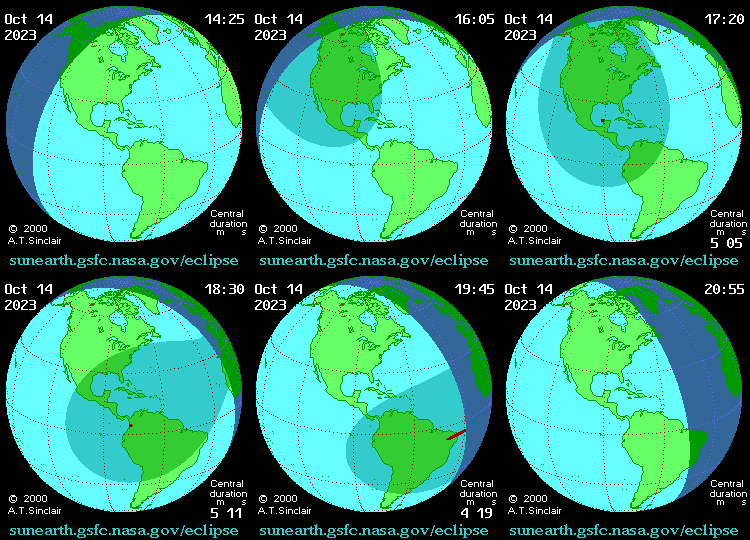
An annular solar eclipse occurred at the Moon’s descending node of orbit on Saturday, October 14, 2023, with a magnitude of 0.952. A solar eclipse occurs when the Moon passes between Earth and the Sun, thereby totally or partly obscuring the image of the Sun for a viewer on Earth. An annular solar eclipse occurs when the Moon's apparent diameter is smaller than the Sun's, blocking most of the Sun's light and causing the Sun to look like an annulus (ring). An annular eclipse appears as a partial eclipse over a region of the Earth thousands of kilometres wide. Occurring about 4.6 days after apogee (on October 10, 2023, at 4:40 UTC), the Moon's apparent diameter was smaller.
Annularity was visible from parts of Oregon, California, Nevada, extreme southwestern Idaho, Utah, Arizona, Colorado, New Mexico, and Texas in the United States, the Yucatán Peninsula, Belize, Honduras, Nicaragua, eastern coastal Costa Rica, Panama, Colombia, and Brazil. A partial eclipse was visible for most of North America, Central America, the Caribbean, and South America.
Visibility
United States
The path of the eclipse crossed the United States beginning in Oregon, entering at Dunes City, and passing over Newport, Crater Lake National Park, Eugene (passing over University of Oregon), and Medford. After passing over the northeast corner of California (in Modoc National Forest), it traveled through Nevada (passing over Black Rock Desert, Winnemucca and Elko) and Utah (passing over Canyonlands National Park, Glen Canyon National Recreation Area, and Bluff). After that, it covered the northeast corner of Arizona (including Kayenta) and the southwest corner of Colorado (including Cortez and the Ute Mountain Reservation). In New Mexico, it passed over Farmington, Albuquerque, Santa Fe, Roswell, Hobbs, and Carlsbad. Afterwards, it entered Texas, passing over Midland, Odessa, San Angelo, Kerrville, San Antonio and Corpus Christi before entering the Gulf of Mexico. This was the second annular eclipse visible from Albuquerque in 11 years, where it crossed the path of the May 2012 eclipse. It also coincided with the last day of the Albuquerque International Balloon Fiesta.
A total solar eclipse crossed the United States in April 2024 (12 states) (Saros 139, Ascending Node), and a future solar eclipse will cross in August 2045 (10 states) (Saros 136, Descending Node). An annular solar eclipse will occur in June 2048 (9 states) (Saros 128, Descending Node).
Mexico
In Mexico, the eclipse path passed over the Yucatán Peninsula, covering San Francisco de Campeche in Campeche, Oxkutzcab in Yucatán (coming close to Mérida), and Chetumal in Quintana Roo.
Western Caribbean
In Western Cuba, Cayman Islands, and Jamaica all saw a partial eclipse (50% and above). The greatest of the partial eclipse was seen over Western Cuba and the Cayman Islands.
Central America
In Guatemala, the eclipse passed over the extreme northeastern tip of Petén Department. In Belize, the eclipse passed over Belmopan and Belize City before leaving land again; when it entered in Honduras, it passed over La Ceiba and Catacamas, and in Nicaragua it passed over Bluefields. The point of greatest eclipse occurred near the coast of Nicaragua. After that, in Costa Rica it passed over Limon, and in Panama it passed over Santiago and came close to Panama City. Its point of greatest duration occurred just off the coast of Nata, Panama.
South America
In South America, the eclipse entered Colombia from the Pacific Ocean and passed over Pereira, Armenia, Cali, Ibagué and Neiva. In Brazil, it passed over the states of Amazonas (covering Fonte Boa, Tefé and Coari), Pará (covering Parauapebas and Xinguara), Tocantins (Araguaína) Maranhão (Balsas), Piauí (Picos), Ceará (Juazeiro do Norte), Pernambuco (Araripina), Paraíba (João Pessoa) and Rio Grande do Norte (Natal) before ending in the Atlantic Ocean.
Eclipse timing
Places experiencing annular eclipse
| Country or territory | City or place | Start of partial eclipse | Start of annular eclipse | Maximum eclipse | End of annular eclipse | End of partial eclipse | Duration of annularity (min:s) | Duration of eclipse (hr:min) | Maximum coverage |
|---|---|---|---|---|---|---|---|---|---|
| United States | Eugene | 08:05:29 | 09:16:59 | 09:18:56 | 09:20:53 | 10:39:50 | 3:54 | 2:34 | 88.92% |
| United States | Farmington | 09:11:44 | 10:31:53 | 10:34:02 | 10:36:12 | 12:04:59 | 4:19 | 2:53 | 89.63% |
| United States | Albuquerque | 09:13:18 | 10:34:37 | 10:37:02 | 10:39:26 | 12:09:32 | 4:49 | 2:56 | 89.74% |
| United States | Santa Fe | 09:13:38 | 10:36:07 | 10:37:29 | 10:38:51 | 12:09:57 | 2:44 | 2:56 | 89.74% |
| United States | Hobbs | 09:17:10 | 10:41:15 | 10:43:42 | 10:46:09 | 12:18:58 | 4:54 | 3:02 | 89.92% |
| United States | Odessa | 10:18:21 | 11:43:16 | 11:45:40 | 11:48:04 | 13:21:42 | 4:48 | 3:03 | 89.98% |
| United States | Midland | 10:18:31 | 11:43:28 | 11:45:55 | 11:48:22 | 13:21:59 | 4:54 | 3:03 | 89.98% |
| United States | Uvalde | 10:22:44 | 11:50:39 | 11:52:36 | 11:54:34 | 13:31:01 | 3:55 | 3:08 | 90.14% |
| United States | San Antonio | 10:23:52 | 11:52:11 | 11:54:21 | 11:56:31 | 13:33:05 | 4:20 | 3:09 | 90.16% |
| United States | Corpus Christi | 10:26:31 | 11:55:51 | 11:58:21 | 12:00:52 | 13:38:18 | 5:01 | 3:12 | 90.24% |
| Mexico | Chetumal | 10:51:04 | 12:29:52 | 12:32:02 | 12:34:12 | 14:17:15 | 4:20 | 3:26 | 90.66% |
| Belize | Orange Walk Town | 09:51:22 | 11:29:49 | 11:32:25 | 11:35:00 | 13:17:44 | 5:11 | 3:26 | 90.67% |
| Belize | Belmopan | 09:52:32 | 11:32:16 | 11:33:48 | 11:35:21 | 13:19:17 | 3:05 | 3:27 | 90.69% |
| Belize | San Pedro Town | 09:52:35 | 11:31:38 | 11:33:59 | 11:36:19 | 13:19:20 | 4:41 | 3:27 | 90.68% |
| Belize | Belize City | 09:52:58 | 11:31:51 | 11:34:26 | 11:37:01 | 13:19:53 | 5:10 | 3:27 | 90.68% |
| Belize | Dangriga | 09:53:53 | 11:33:20 | 11:35:33 | 11:37:47 | 13:21:06 | 4:27 | 3:27 | 90.70% |
| Honduras | Tela | 09:57:19 | 11:37:55 | 11:39:49 | 11:41:43 | 13:25:32 | 3:48 | 3:28 | 90.73% |
| Honduras | La Ceiba | 09:58:22 | 11:38:35 | 11:41:10 | 11:43:47 | 13:26:52 | 5:12 | 3:29 | 90.73% |
| Costa Rica | Limón | 10:17:01 | 12:02:23 | 12:03:07 | 12:03:49 | 13:48:09 | 1:26 | 3:31 | 90.80% |
| Panama | Santiago de Veraguas | 11:25:15 | 13:10:13 | 13:12:19 | 13:14:24 | 14:56:21 | 4:11 | 3:31 | 90.79% |
| Colombia | Buenaventura | 11:43:24 | 13:29:32 | 13:31:15 | 13:32:59 | 15:12:05 | 3:27 | 3:29 | 90.71% |
| Colombia | Cali | 11:45:45 | 13:31:45 | 13:33:35 | 13:35:26 | 15:13:54 | 3:41 | 3:28 | 90.69% |
| Brazil | Tefé | 13:29:39 | 15:09:21 | 15:11:51 | 15:14:22 | 16:40:01 | 5:01 | 3:10 | 90.15% |
| Brazil | São Félix do Xingu | 15:04:32 | 16:32:35 | 16:34:53 | 16:37:11 | 17:51:27 | 4:36 | 2:47 | 89.43% |
| Brazil | Araguaína | 15:12:26 | 16:37:04 | 16:39:09 | 16:41:14 | 17:52:51 | 4:10 | 2:40 | 89.22% |
| Brazil | Balsas | 15:16:35 | 16:39:33 | 16:41:14 | 16:42:56 | 17:53:22 | 3:23 | 2:41 | 89.10% |
| Brazil | Juàzeiro do Norte | 15:26:03 | 16:43:13 | 16:45:08 | 16:47:05 | 17:30:51 (sunset) | 3:52 | 2:05 | 88.73% |
| Brazil | Natal | 15:29:31 | 16:43:57 | 16:45:45 | 16:47:33 | 17:13:34 (sunset) | 3:36 | 1:44 | 88.52% |
| Brazil | Campina Grande | 15:30:08 | 16:45:00 | 16:46:31 | 16:48:01 | 17:17:05 (sunset) | 3:01 | 1:47 | 88.55% |
| Brazil | João Pessoa | 15:31:05 | 16:45:13 | 16:46:45 | 16:48:16 | 17:13:03 (sunset) | 3:03 | 1:42 | 88.50% |
| References: |
Places experiencing partial eclipse
| Country or territory | City or place | Start of partial eclipse | Maximum eclipse | End of partial eclipse | Duration of eclipse (hr:min) | Maximum coverage |
|---|---|---|---|---|---|---|
| Canada | Vancouver | 08:08:36 | 09:20:23 | 10:38:30 | 2:30 | 75.75% |
| United States | Los Angeles | 08:07:59 | 09:24:36 | 10:50:11 | 2:42 | 70.84% |
| Canada | Calgary | 09:14:21 | 10:27:01 | 11:45:19 | 2:31 | 60.81% |
| Mexico | Mexico City | 09:36:36 | 11:09:33 | 12:50:31 | 3:14 | 69.80% |
| United States | Washington, D.C. | 12:00:18 | 13:19:10 | 14:39:08 | 2:39 | 29.82% |
| Cuba | Havana | 11:55:19 | 13:34:31 | 15:15:54 | 3:21 | 68.09% |
| Guatemala | Guatemala City | 09:55:14 | 11:36:12 | 13:21:31 | 3:26 | 81.80% |
| Belize | Punta Gorda | 09:54:39 | 11:36:19 | 13:21:56 | 3:27 | 89.38% |
| El Salvador | San Salvador | 09:58:59 | 11:41:04 | 13:26:38 | 3:28 | 83.45% |
| Bahamas | Nassau | 12:05:09 | 13:41:26 | 15:17:41 | 3:13 | 52.67% |
| Honduras | Tegucigalpa | 10:01:05 | 11:44:16 | 13:30:04 | 3:29 | 89.40% |
| Cayman Islands | George Town | 11:02:40 | 12:44:50 | 14:27:51 | 3:25 | 73.47% |
| Nicaragua | Managua | 10:06:43 | 11:50:52 | 13:36:36 | 3:30 | 87.92% |
| Jamaica | Kingston | 11:15:26 | 12:58:06 | 14:38:31 | 3:23 | 64.99% |
| Costa Rica | San José | 10:15:18 | 12:00:57 | 13:46:11 | 3:31 | 88.82% |
| Haiti | Port-au-Prince | 12:26:54 | 14:07:22 | 15:43:07 | 3:16 | 54.17% |
| Dominican Republic | Santo Domingo | 12:34:20 | 14:13:24 | 15:46:22 | 3:12 | 49.62% |
| Panama | Panama City | 11:26:08 | 13:13:23 | 14:56:59 | 3:31 | 90.23% |
| Colombia | Bogotá | 11:48:28 | 13:36:19 | 15:15:25 | 3:27 | 88.41% |
| Ecuador | Quito | 11:51:21 | 13:37:41 | 15:16:53 | 3:26 | 79.09% |
| Venezuela | Caracas | 12:56:13 | 14:39:18 | 16:11:36 | 3:15 | 60.93% |
| Peru | Iquitos | 12:11:16 | 13:56:12 | 15:30:23 | 3:19 | 80.35% |
| Peru | Lima | 12:29:19 | 14:04:27 | 15:31:08 | 3:02 | 50.04% |
| Guyana | Georgetown | 13:28:58 | 15:05:46 | 16:28:33 | 3:00 | 58.60% |
| Suriname | Paramaribo | 14:38:59 | 16:12:56 | 17:32:45 | 2:54 | 58.70% |
| French Guiana | Cayenne | 14:47:44 | 16:18:55 | 17:36:08 | 2:48 | 59.30% |
| Brazil | Manaus | 13:40:37 | 15:19:30 | 16:43:40 | 3:03 | 88.31% |
| Bolivia | Riberalta | 13:44:38 | 15:21:11 | 16:45:15 | 3:01 | 69.07% |
| Brazil | Belém | 15:04:30 | 16:32:48 | 17:47:27 | 2:43 | 76.76% |
| Brazil | Brasília | 15:25:43 | 16:45:41 | 17:55:00 | 2:29 | 63.10% |
| References: |
Galleries
Videos and sequences
- Animation of the Moon's shadow moving across Earth; captured from the GOES-16 satellite.
- Annular Eclipse timelapse video from Petroglyph National Monument, Albuquerque, New Mexico
- Composite of nine images taken in Hondo, Texas
- Progression of eclipse taken from fixed camera location taken in Petroglyph National Monument
Annularity
- Winnemucca, Nevada, USA
- Mexican Hat, Utah, USA
- Los Alamos, New Mexico, USA
- Annularity in the H-Alpha part of the spectrum. White Rock, NM
- Villanueva, New Mexico, USA
- Annularity in Hobbs, New Mexico, USA
- Hondo, Texas, USA
- Campeche, Mexico
- Juazeiro do Norte, Ceará, Brazil
- Playa Manzanillo, Limón, Costa Rica
Partiality
- Izard County, Arkansas, USA
- Fremont, California, USA
- Santa Ana, California, USA
- Boise, Idaho, USA
- Salt Lake City, Utah, USA
- National Weather Center in Norman, Oklahoma, USA
- Kerrville, Texas, USA
- Belleville, Ontario, Canada
- Apodi, Rio Grande do Norte, Brazil
- Natal, Rio Grande do Norte, Brazil
- Pedra Mole, Sergipe, Brazil
- San Salvador, El Salvador
- Tres Ríos, Cartago, Costa Rica.
Projections
- Salina, Utah. USA.
- Riohacha, La Guajira, Colombia
Citizen science
During the annular and total eclipses of 2023 and 2024, the GLOBE Program (Global Learning and Observations to Benefit the Environment), through the GLOBE Observer app, sought to collect information on air temperature, clouds, and wind. During the August 2017 eclipse, citizen scientists contributed with over 80,000 observations of air temperature and 20,000 cloud observations.
Eclipse details
Shown below are two tables displaying details about this particular solar eclipse. The first table outlines times at which the Moon's penumbra or umbra attains the specific parameter, and the second table describes various other parameters pertaining to this eclipse.
| Event | Time (UTC) |
|---|---|
| First Penumbral External Contact | 2023 October 14 at 15:04:58.2 UTC |
| First Umbral External Contact | 2023 October 14 at 16:11:19.0 UTC |
| First Central Line | 2023 October 14 at 16:13:35.5 UTC |
| First Umbral Internal Contact | 2023 October 14 at 16:15:52.5 UTC |
| First Penumbral Internal Contact | 2023 October 14 at 17:35:49.8 UTC |
| Equatorial Conjunction | 2023 October 14 at 17:37:48.0 UTC |
| Ecliptic Conjunction | 2023 October 14 at 17:56:18.3 UTC |
| Greatest Eclipse | 2023 October 14 at 18:00:40.6 UTC |
| Greatest Duration | 2023 October 14 at 18:14:20.8 UTC |
| Last Penumbral Internal Contact | 2023 October 14 at 18:26:05.1 UTC |
| Last Umbral Internal Contact | 2023 October 14 at 19:45:45.0 UTC |
| Last Central Line | 2023 October 14 at 19:47:59.2 UTC |
| Last Umbral External Contact | 2023 October 14 at 19:50:13.1 UTC |
| Last Penumbral External Contact | 2023 October 14 at 20:56:26.7 UTC |
| Parameter | Value |
|---|---|
| Eclipse Magnitude | 0.95204 |
| Eclipse Obscuration | 0.90638 |
| Gamma | 0.37534 |
| Sun Right Ascension | 13h18m05.4s |
| Sun Declination | -08°14'36.7" |
| Sun Semi-Diameter | 16'02.0" |
| Sun Equatorial Horizontal Parallax | 08.8" |
| Moon Right Ascension | 13h18m44.3s |
| Moon Declination | -07°56'18.9" |
| Moon Semi-Diameter | 15'02.9" |
| Moon Equatorial Horizontal Parallax | 0°55'13.8" |
| ΔT | 71.3 s |
Eclipse season
This eclipse is part of an eclipse season, a period, roughly every six months, when eclipses occur. Only two (or occasionally three) eclipse seasons occur each year, and each season lasts about 35 days and repeats just short of six months (173 days) later; thus two full eclipse seasons always occur each year. Either two or three eclipses happen each eclipse season. In the sequence below, each eclipse is separated by a fortnight.
| October 14 Descending node (new moon) | October 28 Ascending node (full moon) |
|---|---|
| Annular solar eclipse Solar Saros 134 | Partial lunar eclipse Lunar Saros 146 |
Related eclipses
Eclipses in 2023
- A hybrid solar eclipse on April 20.
- A penumbral lunar eclipse on May 5.
- An annular solar eclipse on October 14.
- A partial lunar eclipse on October 28.
Metonic
- Preceded by: Solar eclipse of December 26, 2019
- Followed by: Solar eclipse of August 2, 2027
Tzolkinex
- Preceded by: Solar eclipse of September 1, 2016
- Followed by: Solar eclipse of November 25, 2030
Half-Saros
- Preceded by: Lunar eclipse of October 8, 2014
- Followed by: Lunar eclipse of October 18, 2032
Tritos
- Preceded by: Solar eclipse of November 13, 2012
- Followed by: Solar eclipse of September 12, 2034
Solar Saros 134
- Preceded by: Solar eclipse of October 3, 2005
- Followed by: Solar eclipse of October 25, 2041
Inex
- Preceded by: Solar eclipse of November 3, 1994
- Followed by: Solar eclipse of September 22, 2052
Triad
- Preceded by: Solar eclipse of December 13, 1936
- Followed by: Solar eclipse of August 15, 2110
Solar eclipses of 2022–2025
| Solar eclipse series sets from 2022 to 2025 | |||||
|---|---|---|---|---|---|
| Ascending node | Descending node | ||||
| Saros | Map | Gamma | Saros | Map | Gamma |
| 119 Partial in CTIO, Chile | April 30, 2022 Partial | −1.19008 | 124 Partial from Saratov, Russia | October 25, 2022 Partial | 1.07014 |
| 129 Totality from Exmouth, WA | April 20, 2023 Hybrid | −0.39515 | 134 Mexican Hat, UT | October 14, 2023 Annular | 0.37534 |
| 139 Totality in Dallas, TX | April 8, 2024 Total | 0.34314 | 144 Tres Cerros, Argentina | October 2, 2024 Annular | −0.35087 |
| 149 Partial from Halifax, NS | March 29, 2025 Partial | 1.04053 | 154 | September 21, 2025 Partial | −1.06509 |
Saros 134
This eclipse is a part of Saros series 134, repeating every 18 years, 11 days, and containing 71 events. The series started with a partial solar eclipse on June 22, 1248. It contains total eclipses from October 9, 1428 through December 24, 1554; hybrid eclipses from January 3, 1573 through June 27, 1843; and annular eclipses from July 8, 1861 through May 21, 2384. The series ends at member 72 as a partial eclipse on August 6, 2510. Its eclipses are tabulated in three columns; every third eclipse in the same column is one exeligmos apart, so they all cast shadows over approximately the same parts of the Earth.
The longest duration of totality was produced by member 11 at 1 minutes, 30 seconds on October 9, 1428, and the longest duration of annularity will be produced by member 52 at 10 minutes, 55 seconds on January 10, 2168. All eclipses in this series occur at the Moon’s descending node of orbit.
| Series members 32–53 occur between 1801 and 2200: | ||
|---|---|---|
| 32 | 33 | 34 |
| June 6, 1807 | June 16, 1825 | June 27, 1843 |
| 35 | 36 | 37 |
| July 8, 1861 | July 19, 1879 | July 29, 1897 |
| 38 | 39 | 40 |
| August 10, 1915 | August 21, 1933 | September 1, 1951 |
| 41 | 42 | 43 |
| September 11, 1969 | September 23, 1987 | October 3, 2005 |
| 44 | 45 | 46 |
| October 14, 2023 | October 25, 2041 | November 5, 2059 |
| 47 | 48 | 49 |
| November 15, 2077 | November 27, 2095 | December 8, 2113 |
| 50 | 51 | 52 |
| December 19, 2131 | December 30, 2149 | January 10, 2168 |
| 53 | ||
| January 20, 2186 |
Metonic series
The metonic series repeats eclipses every 19 years (6939.69 days), lasting about 5 cycles. Eclipses occur in nearly the same calendar date. In addition, the octon subseries repeats 1/5 of that or every 3.8 years (1387.94 days). All eclipses in this table occur at the Moon's descending node.
| 21 eclipse events between May 21, 1993 and May 20, 2069 | ||||
|---|---|---|---|---|
| May 20–21 | March 9 | December 25–26 | October 13–14 | August 1–2 |
| 118 | 120 | 122 | 124 | 126 |
| May 21, 1993 | March 9, 1997 | December 25, 2000 | October 14, 2004 | August 1, 2008 |
| 128 | 130 | 132 | 134 | 136 |
| May 20, 2012 | March 9, 2016 | December 26, 2019 | October 14, 2023 | August 2, 2027 |
| 138 | 140 | 142 | 144 | 146 |
| May 21, 2031 | March 9, 2035 | December 26, 2038 | October 14, 2042 | August 2, 2046 |
| 148 | 150 | 152 | 154 | 156 |
| May 20, 2050 | March 9, 2054 | December 26, 2057 | October 13, 2061 | August 2, 2065 |
| 158 | ||||
| May 20, 2069 |
Tritos series
This eclipse is a part of a tritos cycle, repeating at alternating nodes every 135 synodic months (≈ 3986.63 days, or 11 years minus 1 month). Their appearance and longitude are irregular due to a lack of synchronization with the anomalistic month (period of perigee), but groupings of 3 tritos cycles (≈ 33 years minus 3 months) come close (≈ 434.044 anomalistic months), so eclipses are similar in these groupings.
| Series members between 1801 and 2200 | ||||
|---|---|---|---|---|
| June 26, 1805 (Saros 114) | May 27, 1816 (Saros 115) | April 26, 1827 (Saros 116) | March 25, 1838 (Saros 117) | February 23, 1849 (Saros 118) |
| January 23, 1860 (Saros 119) | December 22, 1870 (Saros 120) | November 21, 1881 (Saros 121) | October 20, 1892 (Saros 122) | September 21, 1903 (Saros 123) |
| August 21, 1914 (Saros 124) | July 20, 1925 (Saros 125) | June 19, 1936 (Saros 126) | May 20, 1947 (Saros 127) | April 19, 1958 (Saros 128) |
| March 18, 1969 (Saros 129) | February 16, 1980 (Saros 130) | January 15, 1991 (Saros 131) | December 14, 2001 (Saros 132) | November 13, 2012 (Saros 133) |
| October 14, 2023 (Saros 134) | September 12, 2034 (Saros 135) | August 12, 2045 (Saros 136) | July 12, 2056 (Saros 137) | June 11, 2067 (Saros 138) |
| May 11, 2078 (Saros 139) | April 10, 2089 (Saros 140) | March 10, 2100 (Saros 141) | February 8, 2111 (Saros 142) | January 8, 2122 (Saros 143) |
| December 7, 2132 (Saros 144) | November 7, 2143 (Saros 145) | October 7, 2154 (Saros 146) | September 5, 2165 (Saros 147) | August 4, 2176 (Saros 148) |
| July 6, 2187 (Saros 149) | June 4, 2198 (Saros 150) |
Inex series
This eclipse is a part of the long period inex cycle, repeating at alternating nodes, every 358 synodic months (≈ 10,571.95 days, or 29 years minus 20 days). Their appearance and longitude are irregular due to a lack of synchronization with the anomalistic month (period of perigee). However, groupings of 3 inex cycles (≈ 87 years minus 2 months) comes close (≈ 1,151.02 anomalistic months), so eclipses are similar in these groupings.
| Series members between 1801 and 2200 | ||
|---|---|---|
| March 4, 1821 (Saros 127) | February 12, 1850 (Saros 128) | January 22, 1879 (Saros 129) |
| January 3, 1908 (Saros 130) | December 13, 1936 (Saros 131) | November 23, 1965 (Saros 132) |
| November 3, 1994 (Saros 133) | October 14, 2023 (Saros 134) | September 22, 2052 (Saros 135) |
| September 3, 2081 (Saros 136) | August 15, 2110 (Saros 137) | July 25, 2139 (Saros 138) |
| July 5, 2168 (Saros 139) | June 15, 2197 (Saros 140) |
See also
External links
- Eclipse Predictions by Fred Espenak, NASA/GSFC
- hosted by NASA and Exploratorium
- An educational site with overviews, maps, city data, events, animations, merchandise, historical information, and other resources for the 2023 eclipse and others.
- An educational site with comprehensive eclipse information, an eclipse simulator and other resources for the 2023 and 2024 solar eclipses.
- Jay Anderson (24 March 2024). . Eclipsophile. Archived from on 7 April 2024.
- Jay Anderson (30 April 2020). . Eclipsophile. Archived from on 13 October 2023.