Classification of the Indigenous languages of the Americas
In-game article clicks load inline without leaving the challenge.
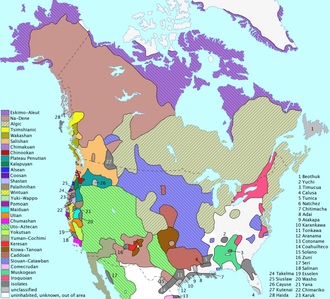


This is a list of different language classification proposals developed for the Indigenous languages of the Americas or Amerindian languages. The article is divided into North, Central, and South America sections; however, the classifications do not correspond to these divisions.
North America
Glottolog 4.1 (2019)
Glottolog 4.1 (2019) recognizes 42 independent families and 31 isolates in North America (73 total). The vast majority are (or were) spoken in the United States, with 26 families and 26 isolates (52 total).
North American languages families proposed in Glottolog 4.1
| Families (42) Otomanguean (180) Arawakan (78) Uto-Aztecan (69) Algic (46) Athabaskan-Eyak-Tlingit (45) Mayan (33) Chibchan (27) Salishan (25) Mixe-Zoque (19) Siouan (18) Eskimo–Aleut (12) Totonacan (12) Cochimi-Yuman (11) Iroquoian (11) Miwok-Costanoan (11) Kiowa-Tanoan (8) Muskogean (7) Pomoan (7) Chumashan (6) Wakashan (6) Caddoan (5) Misumalpan (5) Sahaptian (5) Xincan (5) Chinookan (4) Huavean (4) Maiduan (4) Yokutsan (4) Kalapuyan (3) Shastan (3) Tequistlatecan (3) Tsimshian (3) Chimakuan (2) Coosan (2) Haida (2) Jicaquean (2) Keresan (2) Lencan (2) Palaihnihan (2) Tarascan (2) Wintuan (2) Yuki-Wappo (2) | Isolates (31) Adai Alsea-Yaquina Atakapa Beothuk Cayuse Chimariko Chitimacha Coahuilteco Comecrudan Cotoname Cuitlatec Esselen Guaicurian Karankawa Karok Klamath-Modoc Kutenai Maratino Molale Natchez Salinan Seri Siuslaw Takelma Timucua Tonkawa Tunica Washo Yana Yuchi Zuni |
Gallatin (1836)
An early attempt at North American language classification was attempted by A. A. Albert Gallatin published in 1826, 1836, and 1848. Gallatin's classifications are missing several languages which are later recorded in the classifications by Daniel G. Brinton and John Wesley Powell. (Gallatin supported the assimilation of indigenous peoples to Euro-American culture.)
(Current terminology is indicated parenthetically in italics.)
Families
- Algonkin-Lenape (=Algonquian)
- Athapascas (=Athabaskan)
- Catawban (=Catawba + Woccons)
- Eskimaux (=Eskimoan)
- Iroquois (=Northern Iroquoian)
- Cherokees (=Southern Iroquoian)
- Muskogee (=Eastern Muskogean)
- Chahtas (=Western Muskogean)
- Sioux (=Siouan)
Languages
| Adaize (=Adai) Attacapas (=Atakapa) Salmon River (=Bella Coola) Black Feet (=Blackfoot) Pawnees (=Pawnee) Caddoes (=Caddo) Chinooks (=Chinookan) Chetimachas (=Chitimacha) Fall Indians (=Gros Ventre) Queen Charlotte's Island (=Haida) | 11. Straits of Fuca (=Makah) 12. Natches (=Natchez) 13. Wakash (=Nootka) 14. Salish (=Salishan) 15. Shoshonees (=Shoshone) 16. Atnahs (=Shuswap) 17. Kinai (=Tanaina) 18. Koulischen (=Tlingit) 19. Utchees (=Yuchi) |
Gallatin (1848)
Families
- Algonquian languages
- Athabaskan languages
- Catawban languages
- Eskimoan languages
- Iroquoian languages (Northern)
- Iroquoian languages (Southern)
- Muskogean languages
- Siouan languages
Languages
| 1. Adai 2. Alsean 3. Apache 4. Arapaho 5. Atakapa 6. Caddoan, Northern 7. Caddoan, Southern 8. Cayuse-Molala 9. Chinookan 10. Chitimacha 11. Comanche 12. Haida 13. Kalapuyan 14. Kiowa 15. Klamath 16. Koasati-Alabama 17. Kootenai | 18. Kutchin 19. Maricopa (Yuman) 20. Natchez 21. Palaihnihan 22. Plains Apache 23. Sahaptian 24. Salishan 25. Shasta 26. Shoshone 27. Tanaina 28. Tlingit 29. Tsimshian 30. Ute 31. Wakashan, Southern 32. Wichita 33. Yuchi |
Powell's (1892) "Fifty-eight"
John Wesley Powell, an explorer who served as director of the Bureau of American Ethnology, published a classification of 58 "stocks" that is the "cornerstone" of genetic classifications in North America. Powell's classification was influenced by Gallatin to a large extent.
John Wesley Powell was in a race with Daniel G. Brinton to publish the first comprehensive classification of North America languages (although Brinton's classification also covered South and Central America). As a result of this competition, Brinton was not allowed access to the linguistic data collected by Powell's fieldworkers.
(More current names are indicated parenthetically.)
| 1. Adaizan 2. Algonquian 3. Athapascan 4. Attacapan (=Atakapa) 5. Beothukan (=Beothuk) 6. Caddoan 7. Chimakuan 8. Chimarikan (=Chimariko) 9. Chimmesyan (=Tsimshian) 10. Chinookan 11. Chitimachan (=Chitimacha) 12. Chumashan 13. Coahuiltecan 14. Copehan (=Wintuan) 15. Costanoan 16. Eskimauan (=Eskimoan) 17. Esselenian (=Esselen) 18. Iroquoian 19. Kalapooian (=Kalapuyan) 20. Karankawan (=Karankawa) | 21. Keresan 22. Kiowan (=Kiowa) 23. Kitunahan (=Kutenai) 24. Koluschan (=Tlingit) 25. Kulanapan (=Pomoan) 26. Kusan (=Coosan) 27. Lutuamian (=Klamath-Modoc) 28. Mariposan (=Yokutsan) 29. Moquelumnan (=Miwokan) 30. Muskhogean (=Muskogean) 31. Natchesan (=Natchez) 32. Palaihnihan 33. Piman (=Uto-Aztecan) 34. Pujunan (=Maiduan) 35. Quoratean (=Karok) 36. Salinan 37. Salishan 38. Sastean (=Shastan) 39. Shahaptian (=Sahaptian) | 40. Shoshonean (=Uto-Aztecan) 41. Siouan (=Siouan–Catawba) 42. Skittagetan (=Haida) 43. Takilman (=Takelma) 44. Tañoan (=Tanoan) 45. Timuquanan (=Timucua) 46. Tonikan (=Tunica) 47. Tonkawan (=Tonkawa) 48. Uchean (=Yuchi) 49. Waiilatpuan (=Cayuse & Molala) 50. Wakashan 51. Washoan (=Washo) 52. Weitspekan (=Yurok) 53. Wishoskan (=Wiyot) 54. Yakonan (=Siuslaw & Alsean) 55. Yanan 56. Yukian 57. Yuman 58. Zuñian (=Zuni) |
Rivet (1924)
Paul Rivet (1924) lists a total of 46 independent language families in North and Central America. Olive and Janambre are extinct languages of Tamaulipas, Mexico.
| North American families Algonkin Beothuk Eskimo Hoka Iroquois (Irokwa) Kaddo Keres Kiowa Klamath Kutenai Muskhogi Na-Dene Penutia Sahaptin Salish Siou (Syu) Tano Timukua Chimakum Tunika Uto-Azten Waiilatpu Wakash Yuki Yuchi Zuñi | Central American families Amusgo Kuikatec Kuitlatek Lenka Maya Miskito-Sumo-Matagalpa Mixe-Zoke Mixtek Olive Otomi Paya Subtiaba Tarask (Michoacano) Totonak Chinantek Waїkuri Xanambre (Janambre) Xikake (Jicaque) Xinka (Jinca, Sinca) Zapotek |
Sapir (1929): Encyclopædia Britannica
Below is Edward Sapir's (1929) famous Encyclopædia Britannica classification. Note that Sapir's classification was controversial at the time and it additionally was an original proposal (unusual for general encyclopedias). Sapir was part of a "lumper" movement in Native American language classification. Sapir himself writes of his classification: "A more far-reaching scheme than Powell's [1891 classification], suggestive but not demonstrable in all its features at the present time" (Sapir 1929: 139). Sapir's classifies all the languages in North America into only 6 families: Eskimo–Aleut, Algonkin–Wakashan, Na-Dene, Penutian, Hokan–Siouan, and Aztec–Tanoan. Sapir's classification (or something derivative) is still commonly used in general languages-of-the-world type surveys. (Note that the question marks that appear in Sapir's list below are present in the original article.)
"Proposed Classification of American Indian Languages North of Mexico (and Certain Languages of Mexico and Central America)"
| I. Eskimo–AleutII. Algonkin–Wakashan 1. Algonkin–Ritwan (1) Algonkin (2) Beothuk (?) (3) Ritwan (a) Wiyot (b) Yurok 2. Kootenay 3. Mosan (Wakashan–Salish) (1) Wakashan (Kwakiutl–Nootka) (2) Chimakuan (3) Salish III. Nadene 1. Haida 2. Continental Nadene (1) Tlingit (2) Athabaskan IV. Penutian 1. Californian Penutian (1) Miwok-Costanoan (2) Yokuts (3) Maidu (4) Wintun 2. Oregon Penutian (1) Takelma (2) Coast Oregon Penutian (a) Coos (b) Siuslaw (c) Yakonan (3) Kalapuya 3. Chinook 4. Tsimshian 5. Plateau Penutian (1) Sahaptin (2) Waiilatpuan (Molala–Cayuse) (3) Lutuami (Klamath-Modoc) 6. Mexican Penutian (1) Mixe–Zoque (2) Huave | V. Hokan–Siouan 1. Hokan–Coahuiltecan A. Hokan (1) Northern Hokan (a) Karok, Chimariko, Shasta–Achomawi (b) Yana (c) Pomo (2) Washo (3) Esselen–Yuman (a) Esselen (b) Yuman (4) Salinan–Seri (a) Salinan (b) Chumash (c) Seri (5) Tequistlatecan (Chontal) B. Subtiaba–Tlappanec C. Coahuiltecan (1) Tonkawa (2) Coahuilteco (a) Coahuilteco proper (b) Cotoname (c) Comecrudo (3) Karankawa 2. Yuki 3. Keres 4. Tunican (1) Tunica–Atakapa (2) Chitimacha 5. Iroquois (1) Iroquoian (2) Caddoan 6. Eastern group (1) Siouan–Yuchi (a) Siouan (b) Yuchi (2) Natchez–Muskogian (a) Natchez (b) Muskogian (c) Timucua (?) | VI. Aztec–Tanoan 1. Uto-Aztekan (1) Nahuatl (2) Piman (3) Shoshonean 2. Tanoan–Kiowa (1) Tanoan (2) Kiowa 3. Zuñi (?) |
Voegelin & Voegelin (1965): The "Consensus" of 1964

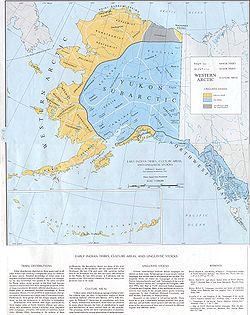
The Voegelin & Voegelin (1965) classification was the result of a conference of Americanist linguists held at Indiana University in 1964. This classification identifies 16 main genetic units.
| American Arctic-Paleosiberian phylum Eskimo–Aleut Chukchi–Kamchatkan Na-Dene phylum Athapascan Tlingit Haida Macro-Algonquian phylum Algonquian Yurok Wiyot Muskogean Natchez Atakapa Chitimacha Tunica Tonkawa Macro-Siouan phylum Siouan Catawba Iroquoian Caddoan Yuchi Hokan phylum Yuman Seri Pomoan Palaihnihan Shastan Yanan Chimariko Washo Salinan Karok Chumashan Comecrudan Coahuiltecan Esselen Jicaque Tlapanecan Tequistlatecan | 6. Penutian phylum Yokuts Maidu Wintun Miwok–Costanoan Klamath–Modoc Sahaptin–Nez Perce Cayuse Molale Coos Yakonan Takelma Kalapuya Chinookan Tsimshian Zuni Mixe–Zoque Mayan Chipaya–Uru Totonacan Huave 7. Aztec–Tanoan phylum Kiowa–Tanoan Uto-Aztecan 8. Keres 9. Yuki 10. Beothuk 11. Kutenai 12. Karankawa 13. Chimakuan 14. Salish 15. Wakashan 16. Timucua |
Chumashan, Comecrudan, and Coahuiltecan are included in Hokan with "reservations". Esselen is included in Hokan with "strong reservations". Tsimshian and Zuni are included in Penutian with reservations.
Campbell & Mithun (1979): The "Black Book"
Campbell & Mithun's 1979 classification is more conservative, since it insists on more rigorous demonstration of genetic relationship before grouping. Thus, many of the speculative phyla of previous authors are "split".
Goddard (1996), Campbell (1997), Mithun (1999)
(preliminary)
Subtiaba–Tlapanec is likely part of Otomanguean (Rensch 1977, Oltrogge 1977).
Aztec–Tanoan is "undemonstrated"; Mosan is a Sprachbund.
Campbell (2024)
Lyle Campbell (2024) proposed the following list of 30 uncontroversial indigenous language families and 24 isolates north of Mexico – a total of 54 independent families and isolates. Language families deemed major are highlighted in bold. The remaining language families all considered small.
| Families Algic (c.54) Caddoan (5) Cochimi-Yuman (12) Eskimo-Aleut (13) Iroquoian (13) Kiowa-Tanoan (7) Muskogean (7) Na-Dene (c.47) Plateau (4) Salishan (23) Siouan-Catawban (17) Utian (15) Uto-Aztecan (c.48, of which c.16 are in Mexico and Central America) Wakashan (6) Chimakuan (2) † Chinookan (3) † Chumashan (6) † Comecrudan (3) † Coosan (2) † Kalapuyan (3) † Keresan (2) Maiduan (4) † Palaihnihan (2) † Pomoan (7) † Salinan (2) † Shastan (3~4) † Tsimshianic (4) Wintuan (2) † Yokutsan (6~7) Yukian (2) † | Isolates Adai † Alsea † Atakapa † Beothuk † Cayuse † Chimariko † Chitimacha † Coahuilteco † Cotoname † Esselen † Haida Karankawa † Karuk Kootenai Natchez † Siuslaw † Takelma † Tonkawa † Timucua † Tunica † Washo Yana † Yuchi † Zuni |
Mesoamerica
(Consensus conservative classification)
Families
- Uto-Aztecan (Other branches outside Mesoamerica. See North America) languages
Corachol (Cora–Huichol) Aztecan (Nahua–Pochutec)
Otopamean Popolocan–Mazatecan Subtiaba–Tlapanec Amuzgo Mixtecan Chatino–Zapotec Chinantec Chiapanec–Mangue (extinct)
- Tequistlatecan
- Mixe–Zoque
- Mayan
- Jicaquean
- Misumalpan (Outside Mesoamerica proper. See South America)
- Chibchan (Outside Mesoamerica proper. See South America)
Isolates
Proposed stocks
- Hokan (see North America)
- Macro-Mayan (Penutian affiliation now considered doubtful.)
Totonac–Tepehua Huave Mixe–Zoque Mayan
Chibchan Misumalpan Xinca Lenca
South America
Notable early classifications of classifications of indigenous South American language families include those by Filippo Salvatore Gilii (1780–84), Lorenzo Hervás y Panduro (1784–87), Daniel Garrison Brinton (1891), Paul Rivet (1924), John Alden Mason (1950), and Čestmír Loukotka (1968). Other classifications include those of Jacinto Jijón y Caamaño (1940–45), Antonio Tovar (1961; 1984), and Jorge A. Suárez (1974).
Glottolog 4.1 (2019)
Glottolog 4.1 (2019) recognizes 44 independent families and 64 isolates in South America.
South American languages families proposed in Glottolog 4.1
Rivet (1924)
Paul Rivet (1924) lists 77 independent language families of South America.
- Alakaluf
- Al'entiak
- Amuesha
- Araukan
- Arawak
- Arda (spurious)
- Atakama
- Atal'an
- Auaké
- Aymará
- Bororó
- Diagit
- Enimaga
- Esmeralda
- Guahibo
- Guarauno
- Guató
- Guaykurú
- Het (Chechehet)
- Huari
- Itonama
- Kahuapana
- Kaliána
- Kañari
- Kanichana
- Karajá (Karayá)
- Karib
- Karirí
- Katukina
- Kayuvava
- Kichua
- Koche (Mokóa)
- Kofane
- Leko
- Maku (Nadahup)
- Maskoi
- Mashubi
- Matako-Mataguayo
- Mobima
- Moseten
- Múra
- Nambikuára
- Otomak
- Pano
- Puelche
- Puinave
- Puruhá
- Sáliba
- Samuku
- Sanaviron
- Shavanté
- Sek
- Shirianá
- Timote
- Trumaí
- Chapakura
- Charrúa
- Chibcha
- Chikito
- Chirino
- Choko
- Cholona
- Chon
- Tukáno
- Tupi-Guaraní
- Tuyuneiri
- Vilela-Chulupí
- Witóto
- Xíbaro (Shiwora, Shuara)
- Xiraxara
- Yahgan
- Yaruro
- Yunka
- Yurakáre
- Yuri
- Záparo
- Je (Ge)
Mason (1950)
Classification of South American languages by J. Alden Mason (1950):
Loukotka (1968)
Čestmír Loukotka (1968) proposed a total of 117 indigenous language families (called stocks by Loukotka) and isolates of South America.
| Languages of Paleo-American tribes A. Southern Division 1. Yámana 2. Alacaluf 3. Aksanás 4. Patagon 5. Gennaken 6. Chechehet 7. Sanaviron B. Chaco Division 8. Guaicuru 9. Vilela 10. Mataco 11. Lengua 12. Zamuco 13. Chiquito 14. Gorgotoqui Unclassified or unknown languages of the areas of Divisions A and B. C. Division of Central Brazil 15. Charrua 16. Kaingán 17. Opaie 18. Puri 19. Mashakali 20. Botocudo 21. Baenan 22. Kamakan 23. Fulnio 24. Jê 25. Kukura (spurious) 26. Otí 27. Boróro 28. Karajá Unclassified or unknown languages of the area of Division C. D. Northeastern Division 29. Katembri 30. Tushá 31. Pankarurú 32. Chocó 33. Umán 34. Natú 35. Shukurú 36. Kiriri 37. Tarairiú 38. Gamela Unclassified or unknown languages of the area of Division D. E. Northwestern Division 39. Múra 40. Matanawí 41. Erikbaktsa 42. Nambikwára 43. Iranshe 44. Yabutí | Languages of tropical forest tribes A. North Central Division 45. Tupi 46. Arawak 47. Otomac 48. Guamo 49. Taruma 50. Piaroa 51. Tinigua 52. Máku (Jukude) 53. Tucuna 54. Yagua 55. Kahuapana 56. Munichi 57. Cholona 58. Mayna 59. Murato 60. Auishiri 61. Itucale 62. Jíbaro 63. Sabela 64. Záparo 65. Chapacura 66. Huari 67. Capixana 68. Koaiá 69. Purubora 70. Trumai 71. Cayuvava 72. Mobima 73. Itonama 74. Canichana Unclassified or unknown languages of the area of the North Central Division. B. South Central Division 75. Pano 76. Tacana 77. Toyeri 78. Yuracare 79. Mosetene 80. Guató Unclassified or unknown languages of the area of the South Central Division. C. Languages of the Central Division 81. Tucano 82. Andoque 83. Uitoto 84. Bora 85. Yuri 86. Makú (Nadahup) 87. Catuquina 88. Arawa Unclassified or unknown languages of the area of the Central Division. D. Northeastern Division 89. Karaib 90. Yanoama 91. Uarao 92. Auaké 93. Kaliána Unclassified or unknown languages of the area of the North Eastern Division. | Languages of Andean tribes A. Northern Division 94. Chibcha 95. Timote 96. Jirajara 97. Chocó 98. Idabaez Unclassified or unknown division. B. North Central Division 99. Yurimangui 100. Cofán 101. Sechura 102. Catacao 103. Culli 104. Tabancale 105. Copallén 106. Chimú C. South Central Division 107. Quechua 108. Aymara 109. Puquina 110. Uro 111. Atacama 112. Leco Unclassified or unknown languages of the area of the Ancient Inca Empire. D. Southern Division 113. Mapuche 114. Diaguit 115. Humahuaca 116. Lule 117. Huarpe |
Kaufman (1990)
Families and isolates
Terrence Kaufman's classification is meant to be a rather conservative genetic grouping of the languages of South America (and a few in Central America). He has 118 genetic units. Kaufman believes for these 118 units "that there is little likelihood that any of the groups recognized here will be broken apart". Kaufman uses more specific terminology than only language family, such as language area, emergent area, and language complex, where he recognizes issues such as partial mutual intelligibility and dialect continuums. The list below collapses these into simply families. Kaufman's list is numbered and grouped by "geolinguistic region". The list below is presented in alphabetic order. Kaufman uses an anglicized orthography for his genetic units, which is mostly used only by himself. His spellings have been retained below.
Stocks
In addition to his conservative list, Kaufman list several larger "stocks" which he evaluates. The names of the stocks are often obvious hyphenations of two members; for instance, the Páes-Barbakóa stock consists of the Páesan and Barbakóan families. If the composition is not obvious, it is indicated parenthetically. Kaufman puts question marks by Kechumara and Mosetén-Chon stocks.
"Good" stocks:
- Awaké–Kaliana (Arutani–Sape)
- Chibcha–Misumalpa
- Ezmeralda–Jaruro
- Jurí–Tikuna
- Kechumara (=Kechua + Haki) (good?)
- Lule–Vilela
- Mosetén–Chon (good?)
- Páes–Barbakóa
- Pano–Takana
- Sechura–Katakao
- Wamo–Chapakúra
"Probable" stocks:
- Macro-Jê (=Chikitano + Boróroan + Aimoré + Rikbaktsá + Je + Jeikó + Kamakánan + Mashakalían + Purían + Fulnío + Karajá + Ofayé + Guató)
- Mura–Matanawí
"Promising" stocks:
"Maybe" stocks:
Clusters and networks
Kaufman's largest groupings are what he terms clusters and networks. Clusters are equivalent to macro-families (or phyla or superfamilies). Networks are composed of clusters. Kaufman views all of these larger groupings to be hypothetical and his list is to be used as a means to identify which hypotheses most need testing.
Campbell (2012)
Lyle Campbell (2012) proposed the following list of 53 uncontroversial indigenous language families and 55 isolates of South America – a total of 108 independent families and isolates. Language families with 9 or more languages are highlighted in bold. The remaining language families all have 6 languages or fewer.
| Families Arawakan (Maipurean, Maipuran) (~65) – widespread Cariban (~40) – Brazil, Venezuela, Colombia, etc. Chapacuran (Txapakúran) (9) – Brazil, Bolivia Chibchan (23) – Colombia, Venezuela, Panama, Costa Rica Jêan (12) – Brazil Pano–Takanan (~30) – Brazil, Peru, Bolivia Makúan (Makú–Puinavean, Puinavean, Guaviaré–Japurá) (8) – Brazil, Colombia, Venezuela Quechuan (23 ?) – Colombia, Ecuador, Peru, Bolivia, Argentina Tukanoan (Tucanoan) (~20) – Colombia, Ecuador, Peru, Brazil Tupían (~55) – Brazil, Paraguay, Bolivia, etc. Arawan (Arahuan, Arauan, Arawán) (6) – Brazil, Peru Aymaran (2) – Bolivia, Peru Barbacoan (5) – Colombia, Ecuador Bororoan (3) – Brazil Cahuapanan (2) – Peru Cañar–Puruhá (2; uncertain) – Ecuador Charruan (3) – Uruguay, Argentina Chipaya–Uru (3) – Bolivia Chocoan (2–6) – Colombia, Panama Cholonan (2) – Peru Chonan (Chon) (3) – Argentina Guaicuruan (Waykuruan) (5) – Argentina, Paraguay, Brazil Guajiboan (4) – Colombia Harákmbut–Katukinan (3; uncertain) – Peru, Brazil Huarpean (Warpean) (2) – Argentina Jabutían (2) – Brazil Jirajaran (3) – Venezuela Jivaroan (4 ?) – Peru, Ecuador Kamakanan (5 ?) – Brazil Karajá (2 ?) – Brazil Karirian (Karirí) (4) – Brazil Krenákan (Botocudoan, Aimoré) (3) – Brazil Lule–Vilelan (2) – Argentina Mascoyan (4) – Paraguay Matacoan (4) – Argentina, Paraguay, Bolivia Maxakalían (3) – Brazil Mosetenan (2) – Bolivia Muran (4, only 1 living) – Brazil Nambikwaran (5 ?) – Brazil Qawasqaran (Kaweskaran, Alacalufan) (2–3) – Chile Otomacoan (2) – Venezuela Paezan (1–3; isolate ?) – Colombia Purían (2) – Brazil Sáliban (Sálivan) (3 ?) – Venezuela, Colombia Sechura–Catacaoan (3) – Peru Timotean (2) – Venezuela Tikuna–Yuri – Peru, Colombia, Brazil Tiniguan (2) – Colombia Yaguan (3) – Peru Witotoan (Huitotoan) (5) – Colombia, Peru Yanomaman (4) – Venezuela, Brazil Zamucoan (2) – Paraguay, Bolivia Zaparoan (3) – Peru, Ecuador | Isolates Aikaná – Brazil Andaquí – Colombia Andoque (Andoke) – Colombia, Peru Atacameño (Cunza, Kunza, Atacama, Lipe) – Chile, Bolivia, Argentina Awaké (Ahuaqué, Uruak) – Venezuela, Brazil Baenan – Brazil Betoi – Colombia (small family ?) Camsá (Sibundoy, Coche) – Colombia Candoshi (Candoxi, Maina, Shapra, Murato) – Peru Canichana – Bolivia Cayuvava (Cayuwaba, Cayubaba) – Bolivia Chiquitano – Bolivia Chono – Chile Cofán (A’ingaé) – Colombia, Ecuador Culle – Peru Gamela – Brazil Guachí – Brazil Guató – Brazil Irantxe (Iranche, Münkü) – Brazil Itonama (Saramo, Machoto) – Bolivia, Brazil Jeikó (Jeicó, Jaiko) – Brazil (Macro–Jêan ?) Jotí (Yuwana) – Venezuela Kaliana (Sapé, Caliana, Cariana, Chirichano) – Venezuela Kapixaná (Kanoé) – Brazil Koayá (Kwaza, Koaiá, Arara) – Brazil Máku (Jukude) – Brazil Mapudungu (Mapudungun, Araucano, Mapuche, Maputongo) – Chile, Argentina Matanauí – Brazil Mochica (Yunga, Yunca, Chimú, Mochica, Muchic) – Peru Movima – Bolivia Munichi (Muniche, Munichino, Otanabe) – Peru Natú (Peagaxinan) – Brazil Ofayé (Opayé, Ofayé–Xavante) – Brazil (Macro–Jêan ?) Omurano (Humurana, Numurana) – Peru Otí – Brazil Pankararú (Pancararu, Pancarurú, Brancararu) – Brazil Payaguá – Paraguay Puquina – Bolivia Rikbaktsá (Aripaktsá, Eribatsa, Eripatsa, Canoeiro) – Brazil (Macro–Jêan ?) Sabela (Huao, Auca, Huaorani, Auishiri) – Ecuador Taruma (Taruamá) – Brazil, Guyana Taushiro (Pinchi, Pinche) – Peru Tequiraca (Tekiraka, Aushiri, Auishiri, Avishiri) – Peru Trumai (Trumaí) – Brazil Tuxá – Brazil Urarina (Simacu, Kachá, Itucale) – Peru Wamoé (Huamoé, Huamoi, Uamé, Umã; Araticum, Atikum) – Brazil Warao (Guarao, Warau, Guaruno) – Guyana, Suriname, Venezuela Xokó – Brazil Xukurú – Brazil Yagan (Yaghan, Yamana, Yámana) – Chile Yaruro (Pumé, Llaruro, Yaruru, Yuapín) – Venezuela Yaté (Furniô, Fornió, Carnijó; Iatê) – Brazil Yuracaré – Bolivia Yurumangui – Colombia |
Campbell (2012) leaves out the classifications of these languages as uncertain.
- Boran – Brazil, Colombia
- Esmeralda – Ecuador
- Guamo – Venezuela
- Leko – Bolivia
- Mure – Bolivia
- Puinave – Colombia, Venezuela
Jolkesky (2016)
Jolkesky (2016) lists 43 language families and 66 language isolates (and/or unclassified languages) in South America – a total of 109 independent families and isolates.
- † = extinct
Campbell (2024)
Lyle Campbell (2024) proposed the following list of 47 uncontroversial indigenous language families and 53 isolates of South America – a total of 100 independent families and isolates. Language families with more than 6 languages are highlighted in bold. The remaining language families all have 6 languages or fewer.
| Families Arawakan (Maipurean, Maipuran) (~65–80) – widespread Cariban (~40–50) – Brazil, Venezuela, Colombia, etc. Chapacuran (Txapakúran) (10) – Brazil, Bolivia Chibchan (23) – Colombia, Venezuela, Panama, Costa Rica Macro-Jê Sensu Stricto (~33) – Brazil Pano–Takanan (~39) – Brazil, Peru, Bolivia Quechuan (23 ?) – Colombia, Ecuador, Peru, Bolivia, Argentina Tukanoan (Tucanoan) (~29, 8 extinct) – Colombia, Ecuador, Peru, Brazil Tupían (~55–70) – Brazil, Paraguay, Bolivia, etc. Arawan (Arahuan, Arauan, Arawán) (6?) – Brazil, Peru Aymaran (2) – Bolivia, Peru Barbacoan (5) – Colombia, Ecuador Boran (3) – Brazil, Colombia Bororoan (3) – Brazil Cahuapanan (3, possibly 2) – Peru Cañar–Puruhá (2; uncertain) – Ecuador Charruan (3) – Uruguay, Argentina Chicham (4) – Peru, Ecuador Chocoan (3?) – Colombia, Panama Cholonan (2) – Peru Chonan (Chon) (5–6?) – Argentina Enlhet–Enenlhet Mascoyan (6) – Paraguay Guaicuruan (Waykuruan) (5) – Argentina, Paraguay, Brazil Guajiboan (4) – Colombia Harákmbut–Katukinan (4) – Peru, Brazil Huarpean (Warpean) (2) – Argentina Jirajaran (3) – Venezuela Kakua–Nukak (2) – Colombia, Brazil Karirian (Karirí) (4) – Brazil Kaweskaran (Qawasqaran, Alacalufan) (3?) – Chile Lule–Vilelan (2) – Argentina Mapudungun (Mapudungu, Araucano, Mapuche, Maputongo) (2) – Chile, Argentina Matacoan (4) – Argentina, Paraguay, Bolivia Nadahup (4) – Colombia, Venezuela, Brazil Nambikwaran (4 ?) – Brazil Otomacoan (2) – Venezuela Sáliban (Sálivan) (3 ?) – Venezuela, Colombia Tallán (2) – Peru Tikuna–Yuri (3) – Peru, Colombia, Brazil Timotean (2) – Venezuela Tiniguan (2) – Colombia Uru–Chipaya (3) – Bolivia Yaguan (3) – Peru Witotoan (Huitotoan) (5) – Colombia, Peru Yanomaman (4) – Venezuela, Brazil Zamucoan (2) – Paraguay, Bolivia Zaparoan (3–8?) – Peru, Ecuador | Isolates Aikaná – Brazil Andaquí – Colombia Andoque (Andoke) – Colombia, Peru Arara do Rio Branco – Brazil Arutani (Ahuaqué, Uruak) – Venezuela, Brazil Atacameño (Cunza, Kunza, Atacama, Lipe) – Chile, Bolivia, Argentina Betoi–Jirara – Colombia Candoshi (Candoxi, Maina, Shapra, Murato) – Peru Canichana – Bolivia Cayuvava (Cayuwaba, Cayubaba) – Bolivia Chiquitano – Bolivia Chono – Chile Cofán (A'ingaé) – Colombia, Ecuador Culle – Peru Esmeralda – Ecuador Guachí – Brazil Guamo – Venezuela Guató – Brazil Iatê (Furniô, Fornió, Carnijó; Yaté) – Brazil Irantxe (Iranche, Münkü) – Brazil Itonama (Saramo, Machoto) – Bolivia, Brazil Jotí (Yuwana) – Venezuela Kamsá (Sibundoy, Coche) – Colombia Kanoê (Kanoé, Kapixaná) – Brazil Kwaza (Koayá, Koaiá, Arara) – Brazil Leko – Bolivia Máku (Jukude) – Brazil Matanawí – Brazil Mochica (Yunga, Yunca, Chimú, Mochica, Muchic) – Peru Moseten–Chimane (Mosetén) – Bolivia Movima – Bolivia Munichi (Muniche, Munichino, Otanabe) – Peru Omurano (Humurana, Numurana) – Peru Paezan (1–3; smal family ?) – Colombia Payaguá – Paraguay Pirahã (Muran) (possibly family of close languages) – Brazil Puinave (Wãnsöhöt) – Colombia, Venezuela Purí–Coroado – Brazil Puquina – Bolivia Sapé (Kaliana, Caliana, Cariana, Chirichano) – Venezuela Sechura? – Peru Taruma (Taruamá) – Brazil, Guyana Taushiro (Pinchi, Pinche) – Peru Tequiraca (Tekiraka, Aushiri, Auishiri, Avishiri) – Peru Trumai (Trumaí) – Brazil Urarina (Simacu, Kachá, Itucale) – Peru Waorani (Sabela, Huao, Auca, Huaorani, Auishiri) – Ecuador Warao (Guarao, Warau, Guaruno) – Guyana, Suriname, Venezuela Xukurú – Brazil Yagan (Yaghan, Yamana, Yámana) – Chile Yaruro (Pumé, Llaruro, Yaruru, Yuapín) – Venezuela Yuracaré – Bolivia Yurumangui – Colombia |
All of the Americas
Swadesh (1960 or earlier)
Morris Swadesh further consolidated Sapir's North American classification and expanded it to group all indigenous languages of the Americas in just 6 families, 5 of which were entirely based in the Americas.
- Vasco-Dene languages included the Eskimo–Aleut, Na-Dene, Wakashan and Kutenai families along with most of the languages of Eurasia.
- Macro-Hokan roughly comprised a combination of Sapir's Hokan–Siouan and Almosan families and expanded into Central America including the Jicaque language.
- Macro-Mayan comprising Mayan along with Sapir's Penutian and Aztec-Tanoan families, the Otomanguean languages and various languages of Central and South America including the Chibchan languages, the Paezan languages and the Tucanoan languages.
- Macro-Quechua comprising the Zuni language, the Purépecha language and various languages of South America including Quechua, the Aymara language, the Panoan languages and most of the various other languages of Patagonia and the Andes.
- Macro-Carib, an almost entirely South American family including the Carib languages, the Macro-Jê languages and the Jirajara languages, albeit including some Caribbean languages.
- Macro-Arawak, a family primarily confined to South America and its component families included the Arawakan languages and the Tupian languages. However, it also was proposed to include the Taíno language in the Caribbean and the Timucua language in Florida.
Greenberg (1960, 1987)
Joseph Greenberg's classification in his 1987 book Language in the Americas is best known for the highly controversial assertion that all North, Central and South American language families other than Eskimo–Aleut and Na-Dene including Haida, are part of an Amerind macrofamily. This assertion of only three major American language macrofamilies is supported by DNA evidence, although the DNA evidence does not provide support for the details of his classification.
Mixed languages
In American Indian Languages: The Historical Linguistics of Native America, Lyle Campbell describes various pidgins and trade languages spoken by the indigenous peoples of the Americas. Some of these mixed languages have not been documented and are known only by name.
- Medny Aleut (Copper Island Aleut)
- Chinook Jargon
- Broken Slavey (Slavey Jargon)
- Loucheux Jargon
- Michif (French Cree, Métis, Metchif)
- Broken Oghibbeway (Broken Ojibwa)
- Basque-Algonquian Pidgin (spoken by the Basques, Micmacs, and Montagnais in eastern Canada)
- Delaware Jargon
- Pidgin Massachusett
- Jargonized Powhatan
- Lingua Franca Creek
- Lingua Franca Apalachee
- Mobilian Jargon
- Güegüence-Nicarao (formerly spoken in Nicaragua)
- Carib Pidgin or Ndjuka-Amerindian Pidgin (Ndjuka-Trio)
- Carib Pidgin-Arawak mixed language
- Media Lengua
- Catalangu
- Callahuaya (Machaj-Juyai, Kallawaya)
- Nheengatú or Lingua Geral Amazonica ("Lingua Boa," Lingua Brasílica, Lingua Geral do Norte)
- Lingua Geral do Sul or Lingua Geral Paulista (Tupí Austral)
- Labrador Eskimo Pidgin
- Hudson Strait Pidgin Eskimo (spoken from 1750–1850)
- Nootka Jargon (18th–19th centuries; later replaced by Chinook Jargon)
- Trader Navajo
- Yopará (Guaraní-Spanish pidgin)
- Afro-Seminole Creole (variety of Gullah)
- Haida Jargon
- Kutenai Jargon
- Guajiro-Spanish mixed language
Lingua francas
- Ocaneechi (spoken in Virginia and the Carolinas in early colonial times)
- Tuscarora language
- Plains sign language
Linguistic areas
See also
- Indigenous languages of South America List of indigenous languages of South America
- List of extinct languages of South America Extinct languages of the Marañón River basin List of extinct Uto-Aztecan languages
- List of unclassified languages of South America Category:Unclassified languages of South America
- Classification of indigenous peoples of the Americas
- Classification of Southeast Asian languages
- Intercontinental Dictionary Series
- M–T and N–M pronoun patterns
Notes and references
Bibliography
- See: Indigenous languages of the Americas § Bibliography
External links
- Nicolai, Renato (2006). .
- Petrucci, Victor A. (2007). .
- , The University of Texas at Austin